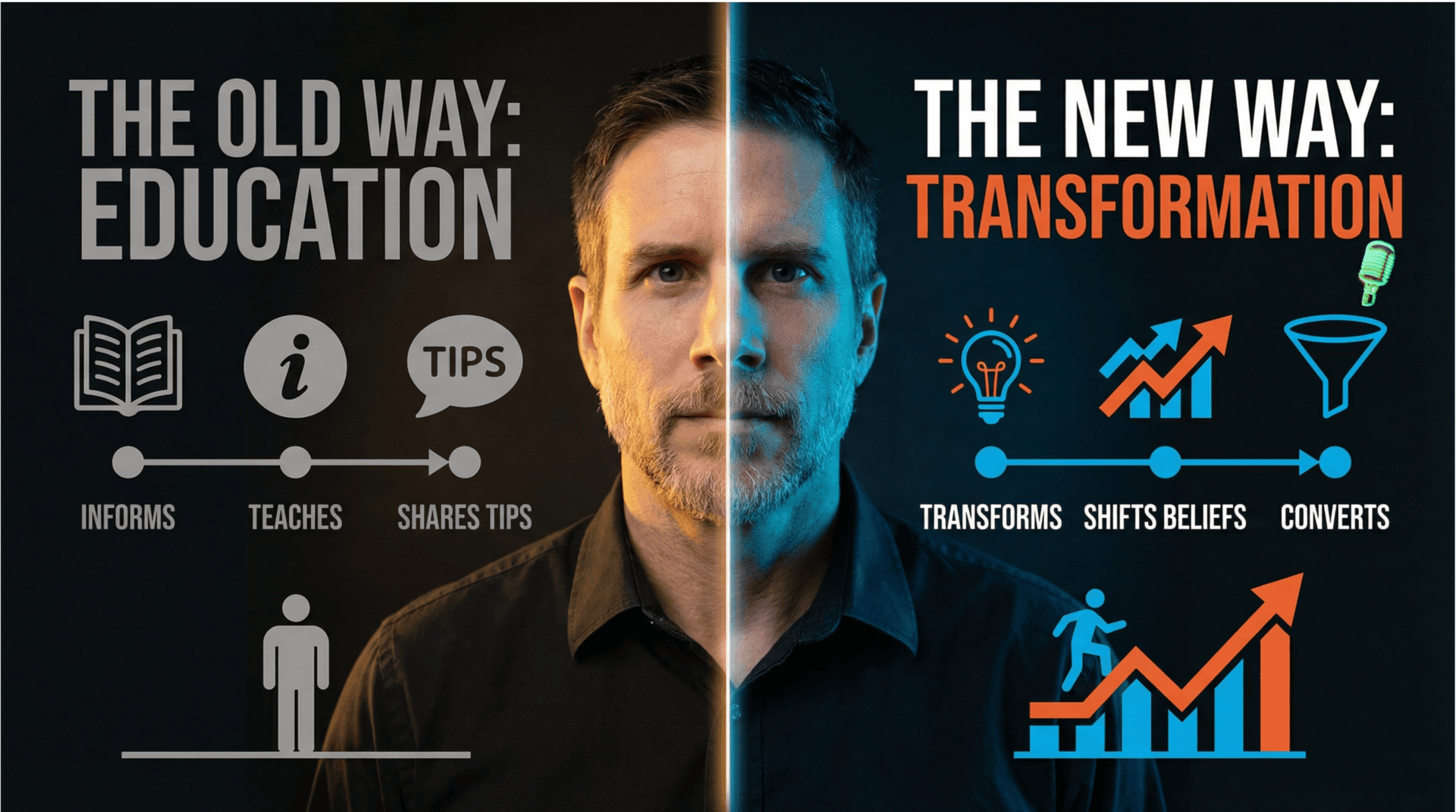
The 4-Hour Workday
(I Had Breakfast With Tim Ferriss. Here's the Question I Was Too Polite to Ask)

Back in 2011, I attended a marketing event on Lake Travis in Austin, Texas.
Some of the biggest names in the game were there. I picked up a ticket last minute, the hotel was sold out, and I ended up sharing a room with my homie Matt Gill.
Now, Matt traveled with a hat rack... with at least 10 different ballcaps. I sh!t you not. Which tells you everything you need to know about the man and the chaos that followed.
Suffice it to say, there was no shortage of shenanigans, and we both have enough compromising photos of each other to ensure mutual silence on the details. (A sort of mutually assured destruction situation.)
But I digress.
The most memorable part of the whole trip was getting to have breakfast with someone I admired... Tim Ferriss.
You’re probably familiar. He wrote a book called The 4-Hour Workweek. Sold millions of copies.
And the promise was seductive... outsource everything, build a small automated income stream, scatter "mini-retirements" throughout your life instead of waiting until you're 65 and can barely walk.
Work a few focused hours. Live the rest.
Beautiful idea. I wanted to believe every word of it.
At the time, I was grinding 60-hour weeks.
Ferriss was smart, genuine, clearly someone who'd thought deeply about all of this.
But I had a pretty big network... entrepreneurs, marketers, online business owners who'd been in the game for years... and I'd never met anyone who pulled it off.
Not one.
They projected it. Laptop-on-the-beach photos. "Writing this from Bali" openers.
But underneath, they were grinding just as hard as the rest of us.
There was a question I was dying to ask at that table.
Maybe a little rude. Maybe a lot rude.
"Do you actually know anyone doing this?"
I didn't ask it. But I thought it the whole damn time.
Because deep down I already knew the answer. The “4-hour workweek” was technically possible... the same way getting struck by lightning while winning the lottery is technically possible.
It happens. Just… not to you.
And here's the context that matters most...
This was 2011. Pre-AI. No real automation. No leverage that could scale without more humans.
The best tool available was a cheap virtual assistant and a willingness to outsource your inbox to someone in the Philippines for $5 an hour.
The dream was real. The infrastructure wasn't.
Ferriss wasn't wrong about the destination. He was just 15 years too early.
And a whole generation of entrepreneurs tried to prove otherwise.
But here's what “living the dream” looks like behind the scenes...
Checking Slack at midnight on vacation. Taking client calls from the pool. Telling your wife “five more minutes” for the third time.
That's not freedom. You’re still grinding. Just with a better view.
That was 2007's best version of leverage... virtual assistants, "muse" income streams, ruthless elimination of tasks.
Smart, for the time. But it was still dependent on humans showing up.
On YOU showing up. The model never quite escaped that.
(If you've been reading these newsletters, you already know the name for this. It's the “Burnout Zone”; a better-paying prison.)
So here's the question worth asking:
What if you actually had a team that worked while you were on the beach?
Not VAs who ghost you during launch week. Not the agency sending a deck every Friday and billing you $15k a month. Something structurally different.
Because here's what I’ve come to realize... the 4-hour workweek didn't fail because the people were wrong. It failed because the tools were wrong.
The tools exist now. And the 4-hour version of this (the workday, not the workweek) isn't a fantasy anymore. It's a structural reality, if you build it right.
Why This Time Is Different (And I Know How That Sounds)
The difference between 2011 and now comes down to one thing.
Infrastructure.
Ferriss had outsourcing, cheap labor, and small automated businesses. That was the best lever available, and it worked... inconsistently.
Because it still required managing humans. Humans who had bad days, got sick, needed more hours, and occasionally just disappeared on you.
AI is not that.
Every few years there's a "this changes everything" moment, and half the time it's Bullsh!t.
But I've spent enough time in the weeds on this to say it clearly... AI is the biggest innovation in 100 years.
Bigger than the internet in the 90s. Bigger than the smartphone. 10x more significant.
And we are at mile two of a marathon.
Most people are still treating it like a shiny toy. A chatbot that writes mediocre emails. A way to save 20 minutes on something tedious.
Let me show you what it looks like when you go all in.
$426 a Month. No Team. No Drama.
Here's what my AI team does... development, content, creative direction, CRM management, research, newsletters, social media, video production.
The work that used to require a developer, a creative director, a couple of writers and editors, and an operations manager to keep everything from falling apart.
I've hired for every single one of those roles before. Multiple times.
It used to run $25k a month.
And it came with all the human drama you'd expect.
Someone's always in crisis. Someone always needs more hours. Someone quits two weeks before your biggest launch and suddenly you're scrambling to hold it together.
(Managing a full team sounds like leverage… until you realize you've become a full-time HR department who occasionally gets to do actual CEO work.)
My AI spend last month... $426.
Four hundred and twenty-six dollars.
That's “Jenny” and the whole AI team I broke down last week. Never sleeps. Never has a bad day. Never sends a passive-aggressive Slack message at 11:00pm about workload balance. Never asks for equity. Never ghosts you.
Now, to be clear... the $426 is just the infrastructure.
What made the 4-hour workday possible was something else entirely.
The Experiment (Running Right Now)
I run two businesses.
AwesomeCRM is on track for 7 figures next year with about 6 people. My other company (also a multi-7-figure operation) runs with 30+. Same revenue ceiling. Fraction of the overhead.
Let that sink in.
My personal brand, TimErway.com, is targeting 7 figures in 18 months with zero employees. And I'm proving it right now... not as a hack or a gimmick, but as a real operational system.
The split:
2 hours a day on AwesomeCRM, 2 hours on the personal brand.
Four hours total. That's the experiment.
Two years ago I would've called bullsh!t on anyone who told me that.
But then I started tracking where my hours were going. I mean really tracking... not the story I told myself about how I spent my time, but what I was doing hour by hour.
Turns out... most of my day was noise. Slack threads that didn't need me. Meetings that could've been a 3-line message. Reviewing work I should've delegated. Reacting to fires that weren't fires.
When I stripped all that away, the real work... the stuff that moved revenue, built the brand, and created long-term leverage... fit into about four hours.
This is the Freedom Zone from the Yield Leverage Matrix... the intersection of high leverage and high yield.
The 20% of the 20%. The work that moves the needle, stripped of everything that doesn't.
Four hours. The right four hours.
Three Things. Everything Else Is Noise.
Here's what fills those four hours. Not email. Not meetings. Not reacting to whatever caught fire this morning. Three things.
Strategy. Thinking time, clarity, asking better questions. This is the highest-leverage activity on the list, and the one most entrepreneurs never do because they're buried in execution. We'll come back to this one.
Marketing. Getting the right offer in front of the right eyeballs. Right now that looks like short-form content and this newsletter... the long game of indoctrination and pre-selling. Core job never changes though. Right offer, right people.
Value Optimization. More premium offers, more often. Serving customers well enough that they stay longer and send referrals. The retention and ascension engine... the one that makes everything else compound over time.
That's it. Three things.
Optimize those three and you've got profitable, sustainable revenue growth. The kind that builds. Not the kind that burns through cash and team and your sanity.
Most entrepreneurs spend 90% of their time as the Operator... executing, reacting, managing.
If you've seen Keith Cunningham's four-hat framework, that's the Technician hat. The one that feels productive but keeps you trapped. Same reason 88% of million-dollar businesses are prisons... the owner never gets out of Operator mode.
The 4-hour workday forces the shift. You can't spend four hours on busywork and survive. So you stop. And the highest-leverage of the three... the one that unlocks everything else... is Strategy.
Which brings me to Keith.
Keith Cunningham's “Dumb Tax”
A few years ago, we were working with Keith Cunningham... and if you don't know Keith, he's one of the sharpest business minds I've come across in 25 years of doing this.
My business partners were on his “Board of Directors” program, which is a by-invitation-only thing. Keith doesn't advertise it. You get in because someone who knows you recommends you, and then Keith decides whether you're worth his time. That's the caliber of the room.
Keith turned us on to his book, "The Road Less Stupid."
And one line stopped me cold...
"The key to getting rich and staying that way is to avoid doing stupid things. I don't need to do more smart things. I just need to do fewer dumb things. I need to think."
Simple. Obvious. Something almost nobody does.
He calls it Thinking Time... 30 to 45 minutes, one high-quality question, no phone, no email, no interruptions. Pen and paper. That's it. The insight underneath is this... most business failures aren't caused by lack of hustle or bad tactics or wrong markets. They're caused by avoidable decisions made without enough thinking.
Keith calls this the "dumb tax."
I've paid that tax. A lot. More than I want to put in a newsletter.
Let's just say there are some pivots and hires and investments that never would've happened if I'd sat down and thought for 45 minutes before pulling the trigger.
(And that's the thing about dumb tax... you don't realize you're paying it until the bill comes due.)
Here's what made it stick for me... Thinking Time is about stopping stupid decisions before they happen. The compounding value of not making a bad move is higher than almost any clever growth tactic.
Keith also referenced Drucker, and this one's worth writing down...
"Most serious mistakes are not the result of wrong answers. The truly dangerous thing is asking the wrong question."
Sit with that for a second.
He uses a four-hat framework... Artist/Creator, Operator/Technician, Owner, Board member.
Thinking Time is Board-level work. The hat most owners never put on because they're drowning in Operator mode.
(That's the Burnout Zone. Different language, same trap.)
When you only have 4 hours, you stop tolerating fake work... which means Thinking Time finally makes it onto the calendar.
Four Questions I Come Back to Every Week
Here are the four questions I keep coming back to every week.
First, who is my ideal customer, and what specific problem am I solving for them? Sounds basic. It is. Which is exactly why most business owners can't answer it clearly without rambling for five minutes. Clarity here fixes almost everything downstream.
Second, what are my revenue and profit targets, and what's my timeline? Not vague goals. Real numbers, real deadlines. "I want to grow" isn't a strategy. A specific number with a specific date is.
Third, what's my offer strategy, and what machine do I need to build to get there? The offer is the product. The machine is the system that sells, delivers, and scales it. Most people have one without the other.
Fourth, what are my 3 to 5 big “rocks” for this quarter? Not the to-do list. The real priorities. The ones where, if they moved, everything else becomes easier or irrelevant.
You don't tackle all four in one session. You sit down with ONE question, think hard, on paper, for 30 to 45 minutes, and you resist the urge to grab your phone and "just check one thing."
The output is clarity. Not a to-do list. Not an action plan.
And that's the whole point.
(Sounds deceptively simple until you try to answer that first question clearly. Go ahead. Try it right now. I'll wait.)
OK so that's the nerdy strategy part. Now let me get personal for a second.
Strategic Laziness (And Becoming a Grandpa)
Here's the part that's a little harder to admit... I'm lazy now.
Not couch lazy. Not "I can't be bothered" lazy.
Strategically lazy.
I'm 48 years old. I've spent the better part of my adult life building businesses, and I don't regret it... the hustle built everything I have.
But I paid for it. Missed moments with my kids. Seasons of their lives that moved past while I was in a hotel room somewhere, working on something that felt urgent and wasn't.
That's not dramatized for effect. That's just what happens when you confuse busy with productive for long enough.
I just found out I'm going to be a grandpa. (Still processing that one, honestly.)
And when I heard that, every conviction I've been building toward this experiment got louder. Doubled down on all of it.
F#CK working for the sake of working.
Strategic Laziness is wisdom earned the hard way. It's what you figure out after you've paid enough dumb tax, pushed hard enough, and finally gotten honest about what you want out of this one life.
The goal is to enjoy it. Be present. Travel. Pursue joy. Build something real and leave something behind that matters.
The people who figured this out at 25 are either geniuses or liars. Most of us had to earn it... had to hit a wall or two before the question changed from "how do I do more?" to "what's worth doing?"
This is the philosophy underneath the Freedom Zone. The reason the 4-hour workday exists.
Not because four hours is some magic number... but because when you get ruthlessly honest about what moves the needle, the rest falls away.
You only have so many hours. Your grandkids are only little once. Work the 4 hours, make them count, then close the laptop.
Ferriss Had the Right Dream (in the Wrong Decade)
The people who understood what the internet was in 1995 built category-defining companies.
The people who saw mobile's real potential in 2007 became the most valuable businesses on earth.
We are at that exact moment again… except this time, you don't need a developer, venture capital, or a 30-person team to build something that runs without you.
You just need to understand what you're looking at.
The infrastructure exists now. The leverage is real. The advantage goes to whoever goes all-in now.
And if what I'm describing sounds like something you want to build... the Magnetic Brand System is the on-ramp.
It's where you build the AI specialists, the brand foundation, and the content system that makes all of this work.
👉 Grab the Magnetic Brand System Right Here.
Until next time,

—Tim Erway
P.S. Next issue I'll go deeper into the Marketing layer, specifically what "getting the right offer in front of the right eyeballs" looks like when you're a one-person operation with a $426/month AI team.
P.P.S. My future grandkid doesn't know it yet, but they're already the reason I work smarter. Weirdest competitive advantage I've ever had.