It's the End of the World as We Know It
(And I Feel Fine. Well, Mostly.)
They Always Laugh First
I'm about to show you a video that will make you cringe.
It's from 1994.
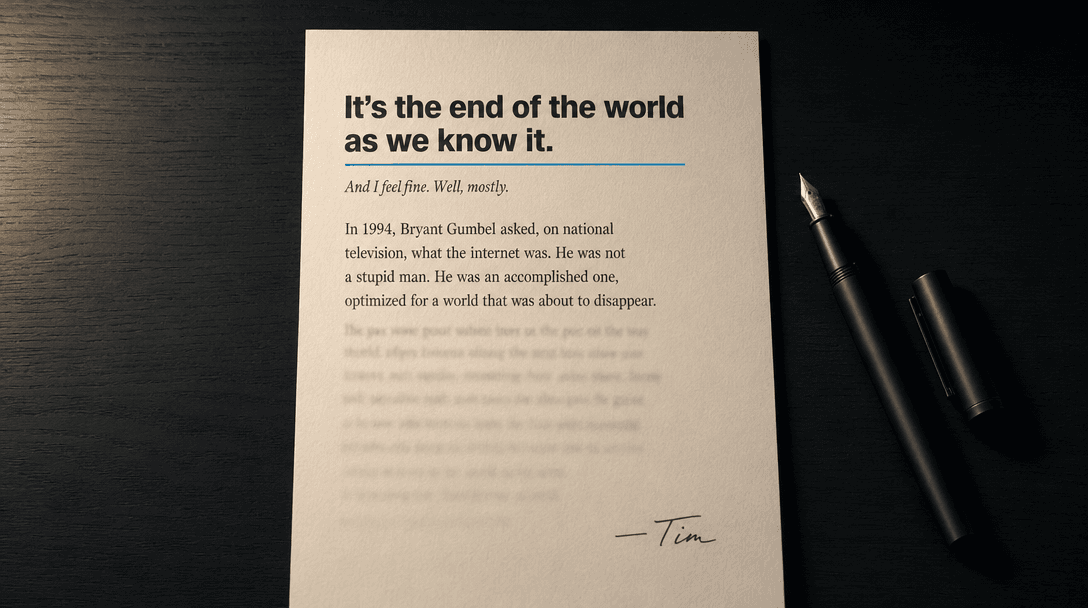
Bryant Gumbel and Katie Couric... two of the most trusted names in news and the hosts of the most-watched morning show in America… sitting on the Today Show set trying to figure out this new thing called "the internet."
Gumbel literally asks: "What is ‘internet,’ anyway?"
It's painful.
Not because he's stupid, but because you know exactly what’s coming.
Here are sharp, experienced, accomplished media personalities.
Completely optimized for a world that’s about to disappear.
They couldn't see it.
Not because the information wasn't already there.
Because nothing in their entire mental framework had a place to put it.
It’s like William Gibson said, “the future is already here. It’s just not evenly distributed.“
It’s a pattern that keeps repeating.
In 1995, Newsweek ran an opinion piece titled "The Internet? Bah!"
(That was the actual headline. I'm not being cute. You can even read it right here, but they omitted the original title.)
The author argued the internet would never replace newspapers. Never replace real shopping. Never replace genuine human connection.
He concluded it was mostly hype.
That author, who seems like a smart dude, now has a Wikipedia page that prominently features the fallout from that article.
(Poor guy.)
Thirteen Years Later
The internet is obviously a thing by now.
Lesson learned, right?
Nope.
Apple announces the iPhone.
Steve Ballmer, CEO of Microsoft, laughs.
Actually laughs.
"$500 fully subsidized with a plan? That is the most expensive phone in the world. And it doesn't appeal to business customers because it doesn't have a keyboard, which makes it not a very good email machine."
From where he was standing... it probably did seem ridiculous.
Nokia was king. BlackBerry owned the business market. A phone without a physical keyboard was... weird.
(Remember, this was a world where people bragged about their BlackBerry typing speed.)
His analysis wasn't insane.
It was just wrong.
Within three years, the iPhone had eaten his company's lunch. That one laugh probably cost shareholders somewhere north of $100 billion in market cap...
Same pattern.
Experienced. Confident. Wrong.
And now it's happening a third time.
The New Hecklers
Pay attention to who's laughing this time.
The people dismissing AI right now aren't your uncle who still has a flip phone.
They're the people who BUILT the world we live in.
Linus Torvalds.
The guy who created Linux.
If you've ever used an Android phone, a web server, or pretty much anything on the internet... you've used his work.
October 2024, he told an interviewer:
"I think the whole tech industry around AI is in a very bad position and it's 90% marketing and 10% reality. [...] My approach to AI right now is I will basically ignore it..."
Read that again.
"I will basically ignore it."
What!?
Pure Bryant Gumbel energy.
(To be fair, he also said AI would eventually change the world. But "eventually" and "right now" are different zip codes.)
And I think history is going to be just as unkind to that sentence.
Meanwhile...
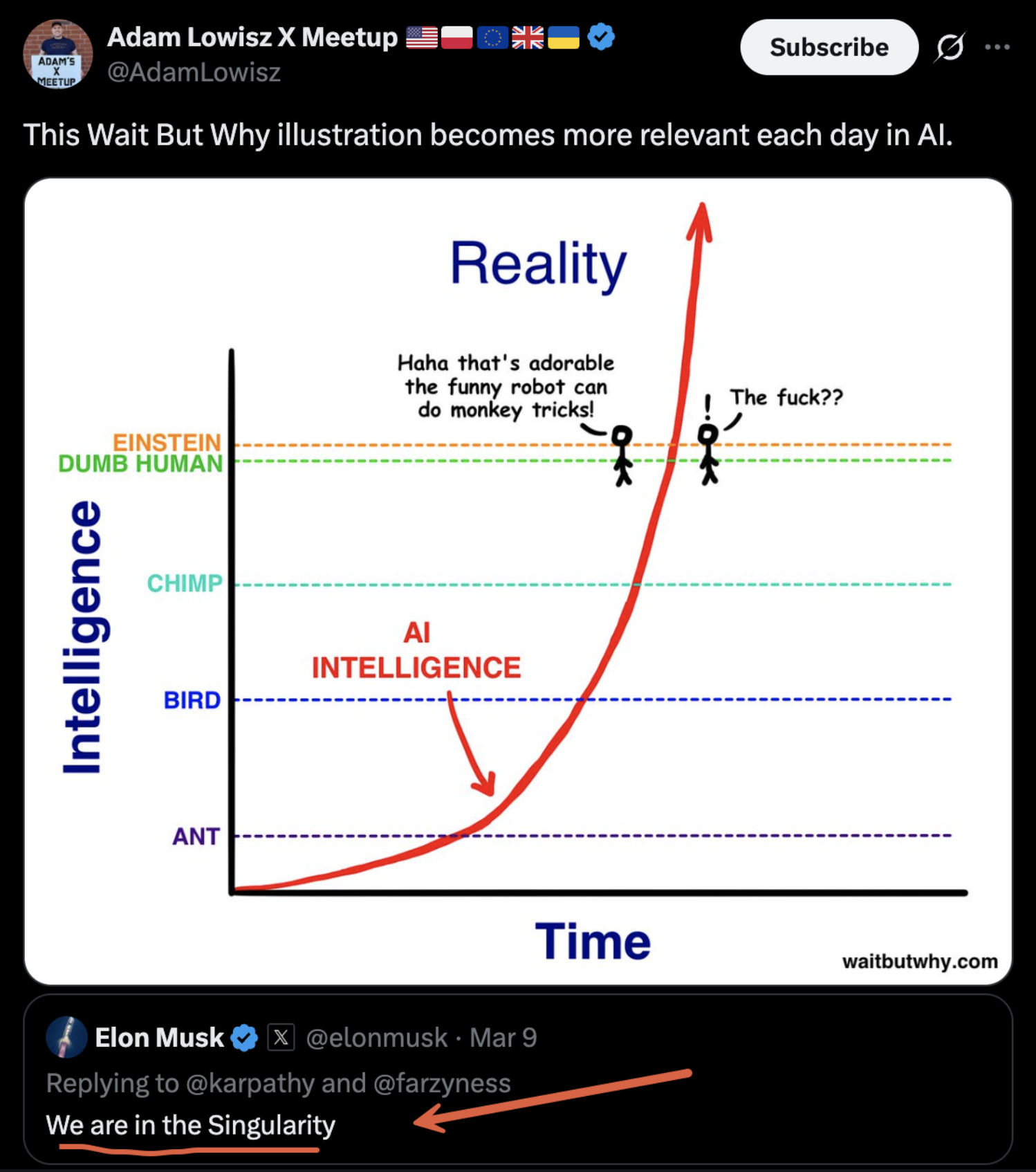
Elon Musk commented on a Wait But Why illustration showing AI's exponential intelligence curve.
(The kind of chart that makes your stomach drop when you actually think about it.)
Elon's reply?
Five words.
"We are in the Singularity."
You can love Elon or hate him.
Doesn't matter.
The point is the gap.
"Ignore it" on one side. "We are in the Singularity" on the other.
And when a chasm like that opens up around a new technology...
Only one side ends up being right.
(And the other looks comically foolish in retrospect.)
So Much for “It's Just a Chatbot”
I need to say something before I tell you this next part.
War is hell.
What’s happening in Iran involves real people, real families, real loss.
I'm not making a political statement here.
I'm not celebrating anything.
I’m just stating facts.
What I’m about to share is a data point... and it's the single most unambiguous piece of evidence we have that AI has moved out of the lab.
Here's what happened.
The U.S. military integrated Anthropic's Claude AI into Palantir's "Maven Smart System."
Not a test.
Live battlefield infrastructure.
The system analyzes satellite imagery, drone feeds, and electronic intercepts in real time. Identifies patterns. Flags threats. Recommends targets.
In the opening days of the Iran campaign in late February 2026, Claude helped prioritize targets.
In the first 24 hours, the U.S. struck over 1,000 targets.
One thousand.
In a single day.
In previous campaigns, that would have taken weeks. Maybe months. Of human analysts working around the clock.
The AI collapsed the "kill chain" from days to minutes.
(Let that sit for a second.)
Here's the part that really got me...
Anthropic drew a line. Two restrictions... no fully autonomous weapons and no mass domestic surveillance.
The Trump administration told them to remove the restrictions. Anthropic refused.
So the administration blacklisted them... labeled them a "supply chain risk to national security."
(An American AI company. Blacklisted. For having guardrails.)
And military commanders... were so dependent on the system... so reliant on it... that they kept using Claude anyway while they scrambled to find alternatives.
They were told to stop.
They couldn't.
Because removing it would have degraded their operational capability mid-campaign.
If you thought AI was a toy... a chatbot... a thing that writes mediocre blog posts...
That sh!t is over.
AI is making life-and-death decisions in an active hot war.
That's the world we're in right now.
And just so we're clear... the underlying technology that's running targeting decisions for the U.S. military is the same technology I'm using to run my business from a Mac Mini in my office.
Same AI. Different application.
That's not a comfortable thought. But it's an honest one.
And Then There's the Money
The military story is the dramatic, undeniable proof point.
But something else happened this month that was quieter... and for people building businesses, maybe more important long-term.
In early March 2026, a company called Circle launched "Nanopayments."
Circle is the company behind USDC, one of the most widely used stablecoins in the world.
And what they built is the financial plumbing for a world where AI agents don't just do tasks...
They operate as “economic actors.”
In plain English...
An AI agent can now earn money.
Hold money.
Spend money.
Transact with other AI agents.
Autonomously.
No human in the loop. No approval process. No credit card. No bank account that requires a Social Security number.
The agents just... operate.
I was reading my friend Mike Dillard's breakdown of this and the thing that hit me was how quiet the mainstream news was.
Circle built the financial rails for the AI economy and it barely made a ripple in mainstream media.
(Which is exactly how the internet crept up on Bryant Gumbel and crew. Quietly. Until it wasn't.)
Right now, we think of AI agents as really good employees.
They write your emails. Draft your content. Answer customer questions.
That's already valuable.
But that's not where this ends.
Agents that negotiate with vendors... process transactions... fulfill orders... handle customer relationships...
And now, with Circle's infrastructure, hold and move money to do all of it.
The scaffolding for that world isn't being planned.
It's here.
You Already Know (So There’s No Excuses)
Bryant Gumbel didn't have much to work with in 1994.
Hard to blame him. The internet was a punchline back then. Nobody was betting their business on it.
But you are reading this in March of 2026.
You've watched AI go from "write a haiku about my cat" to running targeting decisions in an active military campaign... in roughly three years.
You've watched it go from summarizing articles you were too lazy to read to financial infrastructure for autonomous economic agents... in the same window.
The data isn't ambiguous anymore.
It's not even close.
This is the third time in 30 years that a technology has shown up, gotten laughed at by smart people… and then eaten the world.
Bryant Gumbel couldn't figure out what the internet was.
Ballmer didn't take the iPhone seriously.
Linus Torvalds said he'd ignore AI.
History doesn't remember the skeptics fondly.
But Leonard Bernstein once said...
"Man's noblest endowment is his capacity to change."
You don't have to be early. You just can't be last.
To the ones claiming the AI boom is one of the largest bubbles in history…
We'll see.
(But I wouldn't bet on it.)
What Nobody's Saying Out Loud
People hear "AI is the future" and they panic.
They think they need to become a prompt engineer. Or learn to code. Or somehow become a technical person overnight.
That's not it.
I've been documenting this AI shift in real time for months now.
You've watched me build an AI team on a Mac Mini... you've seen what Manus can do for remote management... you've watched the whole thing evolve week by week in this newsletter.
And all of that showed me something...
The technology is moving faster than anyone predicted. The military just proved it. Circle just built the financial rails for it. The curve isn't slowing down.
But the people who are going to get crushed by this aren't the ones who lack technical skills.
They're the ones with nothing worth amplifying.
AI amplifies.
That's what it does.
It takes what you already have and scales it.
If what you have is a generic, interchangeable presence... if you sound like everyone else in your market... AI is just going to amplify your invisibility.
You'll produce more content. But none of it will connect.
Because there's no you in it.
(And trust me... the market can smell it.)
I know the challenge. When I first started using AI for content, the output was clean... efficient... and sounded like everybody else on the internet.
Took me months of building my Story File, my Brand DNA, my voice guardrails before the AI started producing stuff that actually sounded like me.
That work is the foundation. Everything else is just tools.
Learning more tools won't save you. Having a clear, distinctive, authentic presence that AI can actually amplify... that's the advantage.
That's what the Magnetic Brand System is for.
The positioning. The voice. The message that makes someone stop mid-scroll and think... "wait, who is this person?"
Build something AI makes exponentially more powerful. That's the point.
If you want to see how it works...
👉 Get Access to the Magnetic Brand System right here.
If not, no worries. Either way, this newsletter isn't going anywhere.
Every week I'm sharing what I'm building, what's breaking, and what I'm learning.
Until next time,

—Tim Erway

P.S. Bryant Gumbel eventually figured out the “@” sign. Ballmer's successor eventually made Microsoft relevant again. It's never too late to adapt. But the longer you wait, the more it costs. Just saying.
P.P.S. If you know someone who's still in the "it's just a chatbot" camp... send them this. They'll either thank you or think you've lost your mind. Either way, you did your part.