The Million-Dollar Junk Drawer
Why people mailed in checks years after the twenty-page sales letter hit the landfill.
Right now I've got a finished offer that I can't F#%$&@!G launch.
Sales letter. VSL. Full email campaign. Ad creative. Cart connected.
The whole thing. Done. Ready to sell.
And I can't run a single ad to it.
Because back in March, some skid hacked my Meta account, downgraded my permissions on the way out, and I have spent the last three-plus months trying to get one trillion-dollar company to flip one setting back on.
Fourteen support cases. Fourteen.
I've got their canned responses memorized at this point. I see the little typing bubble pop up and I already know what it's gonna say before it finishes typing.
A couple weeks ago they sent me my 13th satisfaction survey. Asked how satisfied I was with the help provided.
Here's how that went:
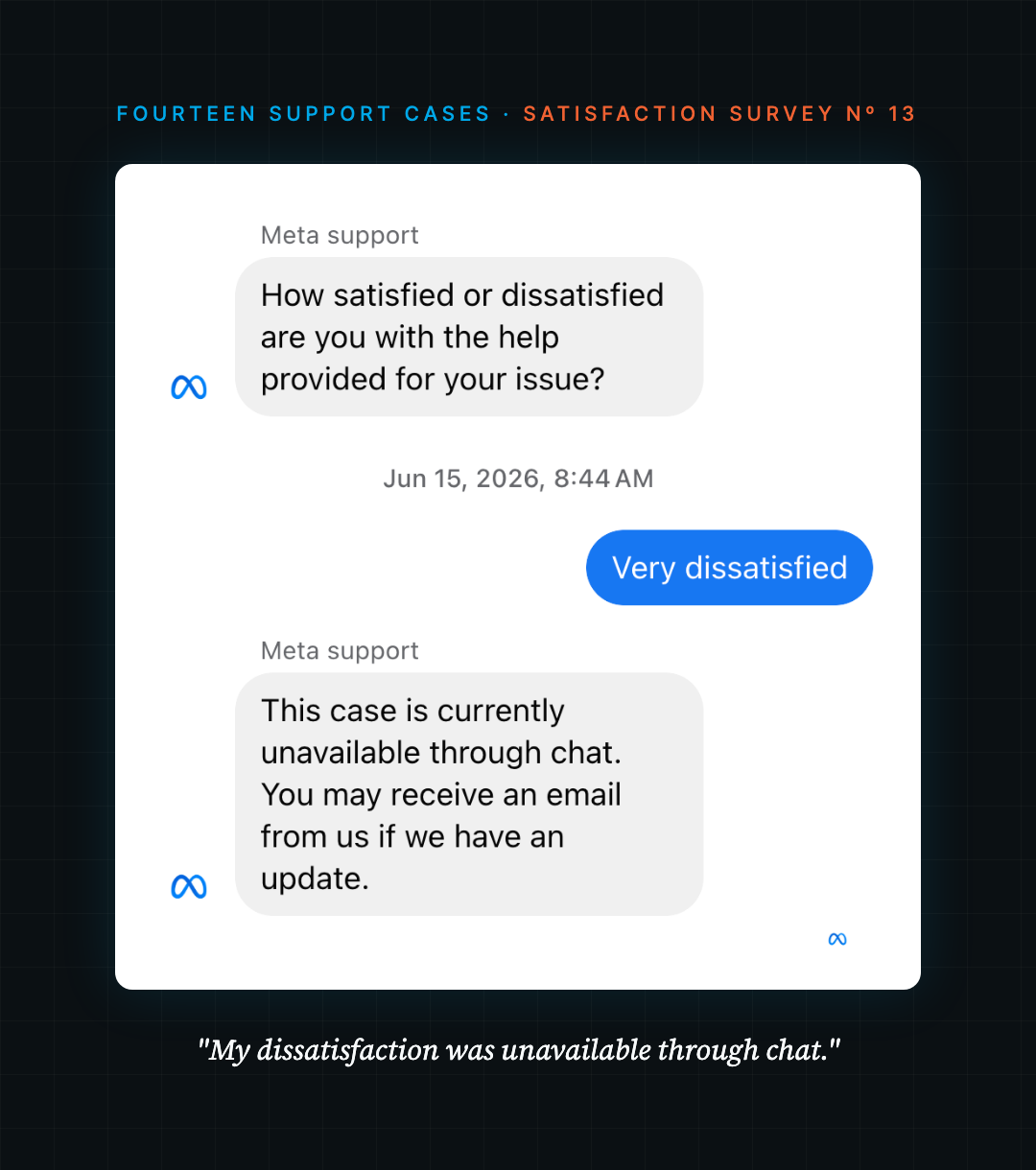
I told a robot I was very dissatisfied (13 surveys, 14 cases, zero fixes) and it told me my dissatisfaction was closed for business.
(When Apple refunds you two months of Meta's premium support because it flat-out didn't work... you know you've entered a special dimension of dumb.)
Anyway.
That's not what this letter is about.
But it's exactly what this letter is about. And I'll come back to it, because it's the sneakiest part of the whole thing.
Here's where I actually want to start...
The order form nobody meant to keep
Back when direct mail was king, the standard play was a long-form sales letter with a separate order form attached.
The letter did the selling. Ten, twelve, sometimes twenty pages of it.
The order form was one page. Just a summary. Who it's for. What you get. What it costs. Where to sign.
Here's what happened that nobody planned for...
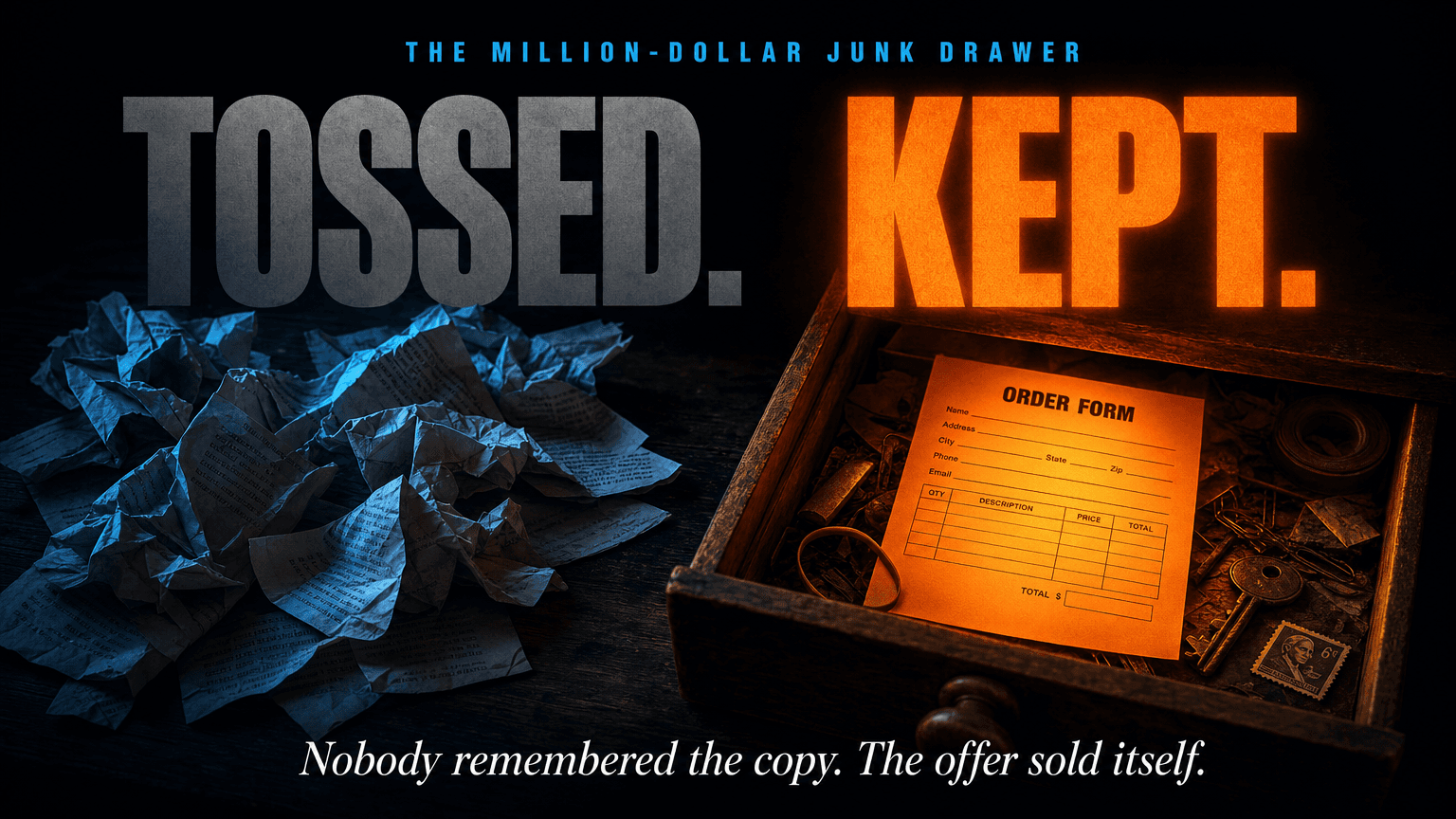
People threw away the letter and kept the form.
Months later. Sometimes years later. They'd be digging through a junk drawer looking for a stamp or a takeout menu... find that one-page order form... and mail it back in.
With a check.
No sales letter. Nobody remembered a single line of the copy. The twenty pages that cost a fortune to write were in a landfill somewhere decomposing next to a Blockbuster card.
The offer sold itself. Off one page. Long after everybody involved had moved on with their lives.
Sit with that for a second. Because most people believe the money is in the copy.
It never was.
The five factors behind every dollar I've ever made
I've done over $100 million in sales across 24 years. Every dollar of it traces back to the same five factors.
In order.
And here's the part that trips everybody up... most people work on them in exactly the wrong order. They start at number four and then act shocked when nothing converts.
Let me walk you through the actual order. And I'm gonna be honest about which one you're probably obsessing over instead.
1. Audience
This is the who.
Get it right and half the battle's already won before you type a word.
If there's no market for what you've got... no audience with a burning, itchy, keep-you-up-at-night desire to solve a specific problem... you're dead on arrival.
You will not sell snow removal in Miami.
Not with a better headline. Not with a prettier funnel. Not with more ad spend. Not with a "limited time bonus."
Wrong audience means the rest of this list is just you rearranging furniture in a burning house.
2. Offer
This is the one-pager. This is the junk-drawer order form.
A simple, single page that makes it dead clear how your buyer gets from where they are to where they want to be. Who it's for. The big promise. And the how... the deliverables plus the breakthroughs that actually get them the result.
That order form worked from a junk drawer two years later because an irresistible offer fits on one page and doesn't need a babysitter.
So here's a little gut-check you can run on your own business tonight...
If your offer can't fit on one page that a total stranger gets in about sixty seconds... you don't have an offer yet. You've got an idea wearing accessories.
I'll come back to the offer. It's the one that matters most and it's the one everybody skips. Of course.
3. Timing
Right audience. Right offer. Now it's about the right moment.
And timing is really two things. When people see your offer. And how many times they see it.
Because the first time somebody sees your thing, most of 'em don't buy. Nobody converts 100% on first exposure. Nobody ever has.
That's the entire reason follow-up exists. It's why retargeting works. It's why email makes so much money. Follow-up is just you catching the right person on the right day instead of the wrong one.
That order form sitting in a drawer for two years? That was the greatest follow-up sequence ever built. Zero automation. The offer just waited. Patiently. Until the timing was right and the guy finally needed a stamp.
4. Copy
Yeah.
Fourth.
This is where 90% of people start. Because they've convinced themselves copy is the whole game.
It's the founder who's rewritten his headline nine times this week. Swapped the button from green to orange. A/B tested two words in his subject line while his actual offer underneath is... how do I put this gently... dogshit.
He's polishing the brass on a sinking boat.
You can have the greatest sales letter ever written sitting on top of a garbage offer, and your conversions will be a rounding error above zero.
Copy amplifies an offer. It cannot rescue one.
Get the first three right and even mediocre copy cashes checks. Get 'em wrong and world-class copy just makes the failure look prettier on the way down.
(This, by the way, is also why your AI content sounds like a corporate memo banged a thesaurus. Everybody's trying to fix the words. The words were never the problem.)
5. Modality
If you nailed the first four, congratulations. You're already ahead of most of your competition.
And here's where almost everybody quits without knowing they quit...
Your competition stops at four.
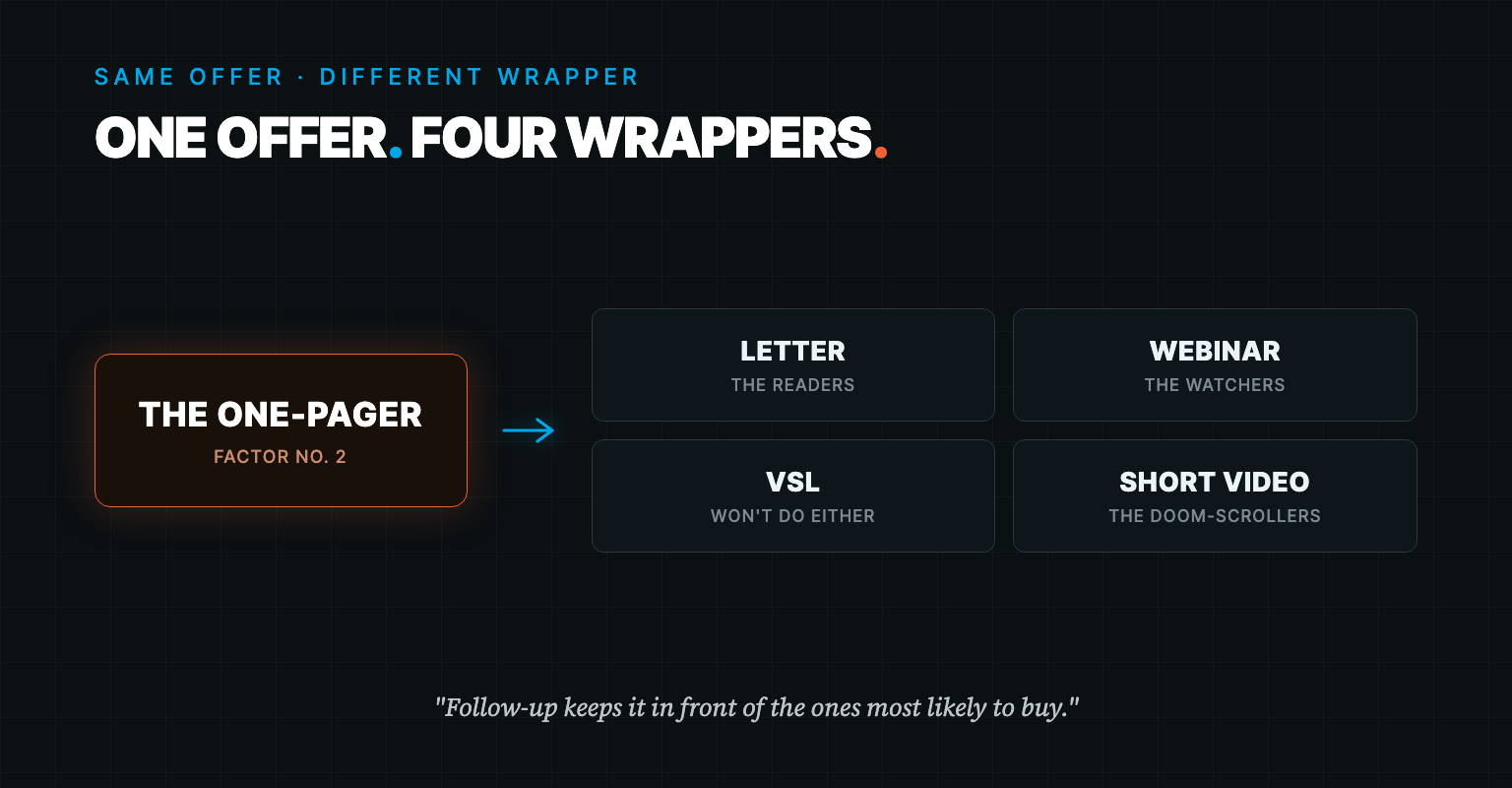
Modality is where you take the exact same offer and package it in different formats. Because your market doesn't consume the way you do.
And here's the frame that makes this whole factor click: every modality leaks. No format catches everybody. The play isn't finding the "best" one... it's putting another net where the last one leaked.
Watch how it works.
Run a live webinar and it converts great. Best way to sell mid and high ticket, period. But it leaks. Not everyone who registered showed up. Not everyone who's interested has 90 minutes to give you. Those people didn't say no to your offer. They said no to a 90-minute time slot.
The long-form sales letter catches a bunch of them. Your pour-over-coffee people... the ones who'll happily sit down with fifteen written pages and read every glorious word like it's a Sunday paper. On their schedule. At their pace. The webinar was never getting those people. The letter did.
But the letter leaks too. Some people see that same wall of text and their soul leaves their body. Hand that same human a five-minute VSL and they'll watch it, nod along, and buy. Same offer. They just needed it in a format they'd actually consume.
And then there's the TikTok doom-scroller. The one whose thumb has developed independent motor function from all the swiping. That person is never reading your letter, never registering for your webinar. But a punchy short-form video that hooks in the first few seconds and hands them an easy, low-friction doorway into your funnel? Now they're in the water with everybody else.
(And this is where factor three sneaks back in. Follow-up is how the nets pass buyers to each other... Tuesday's webinar no-show sees a retargeting ad for the five-minute VSL on Thursday. Same offer. Second net.)
Nobody in that lineup was a lost sale. They were buyers your one modality couldn't hold.
Same offer. Four wrappers. Four buyers instead of one... and three of them would've been written off as "not ready."
That's how the same offer converts more of the same audience over time. Not by chasing new traffic. By catching your own leaks.
Most businesses build one modality and quietly wonder where the rest of their market went.
Let me prove the whole thing with my own scars
Years ago, before any of the fancy stuff, I built a business selling an ebook on how to get out of debt legally.
Solo operator. Kitchen table. One guy with a Google AdWords account and a link-buying budget.
And I was going head-to-head with these massive debt-negotiation companies and consumer credit counseling outfits. Real companies. Real payroll. Real ad budgets that dwarfed mine.
Here's the thing though...
They were paying a fortune for every single lead. Bleeding money to acquire a name and a phone number, then hoping to close 'em on the phone later.
I was selling a cheap ebook that made me a profit on every lead I generated.
Sit with what that means for a second.
They paid to get a lead. I got paid to get a lead.
And they were higher quality, because they voted with their credit card. (Yes, for a get-out-of-debt offer… the irony isn’t lost on me.)
Which meant I could outspend all of 'em. On a kitchen table. In my pajamas. While they had a whole office.
I was so far ahead I started spinning up other websites to compete against my own websites.
And I was buying links to muscle those same sites up the organic rankings too. So I'd show up in the sponsored spots AND the "earned" spots at the same time. Number one, number three, number six. Paid and organic. Me, me, and me.
(This was back when buying links was just called Tuesday. Wild west. Anything went.)
Those poor debt-negotiation companies were paying premium per lead just to watch a dude at his kitchen table buy backlinks and take over the entire page. Against myself. Just hogging the whole aisle.
That's when I hit seven figures for the first time.
Now watch closely, because here's the part that matters...
That was not a copy story.
I mean, sure, the copy was fine. But the copy is not why it worked.
It worked because I had a rabid audience (people drowning in debt, desperate, up at night). A genuinely irresistible offer (get out of debt legally without bankruptcy... and I'll pay YOU to look at it). And a timing/arbitrage advantage nobody else had.
Audience. Offer. Timing.
The first three factors. In order.
The copy was fourth. It was fourth the whole time. I just didn't have a name for it yet.
(The business eventually attracted some very polite letters from a couple of state attorneys general, which is a whole other story for a whole other letter. Turns out when you get too good at competing with entire industries from your kitchen table, people notice. But that's a tale for another day.)
The bridge from Suckville to Awesometown
The framework I use to build factor number two... the offer itself... is one I've been running for two decades.
I call it Suckville to Awesometown.
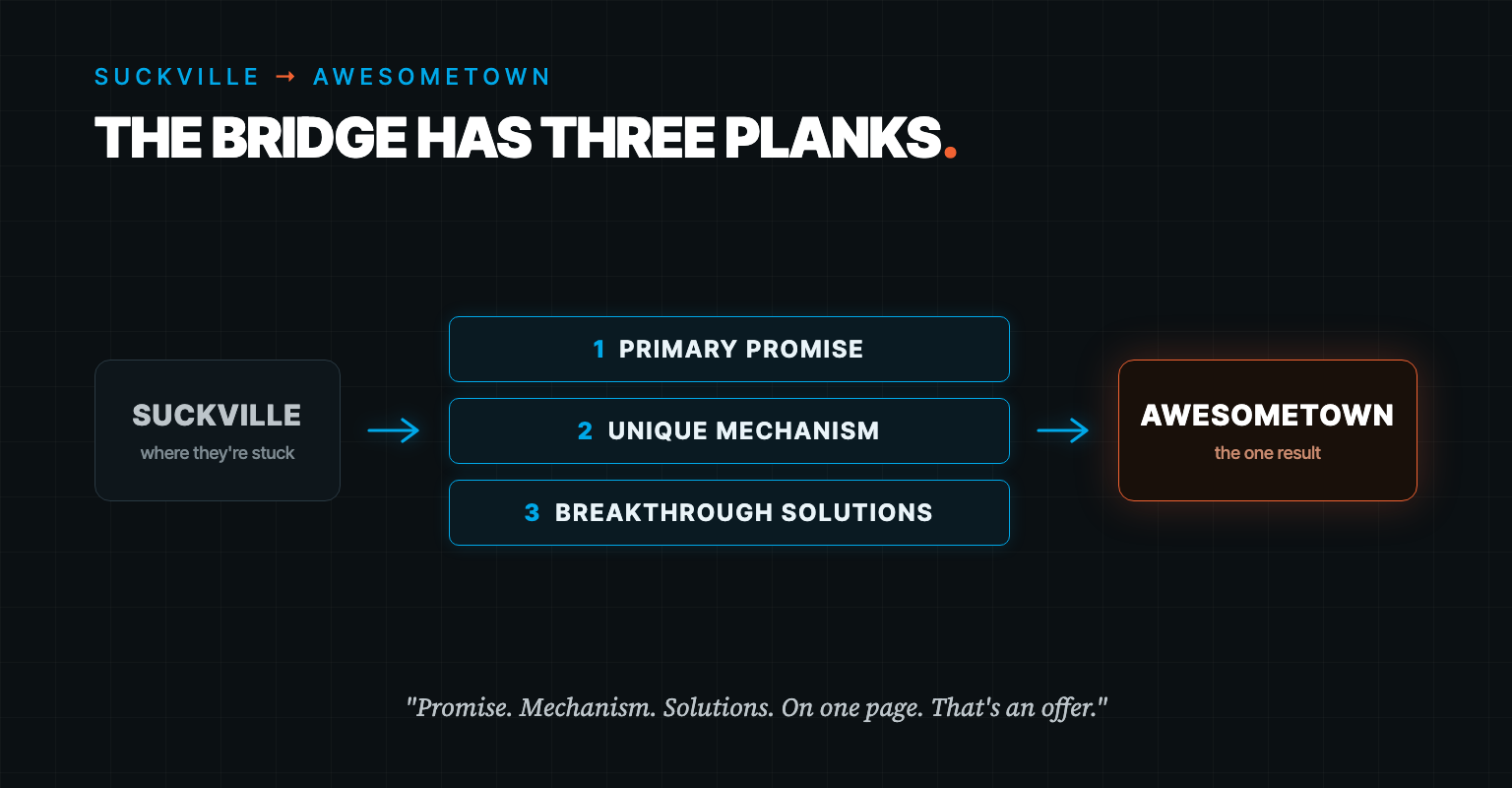
Every sale, at every price point, is a transformation. Your buyer is stuck somewhere frustrating right now. That's Suckville. And they want to be somewhere better. That's Awesometown.
Your offer is the bridge between the two.
And the bridge has exactly three planks...
The primary promise. The destination. One specific result. Not five. One. It's the answer to the magic wand question: if I could wave a magic wand and give you the one thing you want most... what is it? That. That's your promise.
The unique mechanism. The vehicle. How they get there, and why this way works when every other thing they tried face-planted.
The breakthrough solutions. The route. The specific deliverables that knock down each obstacle sitting between them and the result.
Promise. Mechanism. Solutions. On one page.
That's an offer.
And that's where you should be spending the bulk of your time. Not the headline. Not the button color. Not agonizing over whether the font feels "premium."
The bridge. Build the bridge.
Now here's the math nobody puts on the whiteboard
At this point you know more about building a real offer than most people running six-figure ad budgets. You've got the five factors. The order they actually matter in. And the framework for the one that matters most.
And knowing all this was never the hard part.
Producing it is.
Because look at what these five factors actually demand you build...
The one-page offer. Then a long-form letter for the readers. A webinar for the watchers. A VSL for the people who won't do either. An email sequence to handle the timing. Ads to feed the whole beast.
That's five expert skills. Weeks of work each. Per offer.
That's the exact wall where most million-dollar offers go to die. Not at the idea stage because the idea was bad... but because one human being cannot physically produce all of it. So it sits in a Google Doc. Forever.
Last week I showed you the team I built to get around that wall. Five AI specialists I trained on my own frameworks. If you missed it, that's the "here's my little AI army" letter.
This week was the thinking those specialists actually run on. The why underneath the machine.
And here's where it all loops back...
When I built Monetize OS, the very first specialist you meet is the Offer Creation Specialist.
It's the most valuable one in the entire system. And it's not close.
Because everything downstream executes from the offer. The Sales Copy Specialist takes your finished offer and turns it into the long-form letter and the VSL. The Webinar Specialist takes that same offer and builds the deck and the scripts. The Email Specialist writes the follow-up that handles your timing... then hands it to your CRM's own AI to build into a live workflow. The Ads Specialist puts the whole thing in front of the right audience.
Four executors. One offer.
If the offer's weak, all you've done is automate the mass-production of stuff that doesn't convert. If the offer's right, everything downstream multiplies it.
The Offer Creation Specialist runs the exact Suckville-to-Awesometown process I just walked you through. It sits you down. Interviews you. Asks the magic wand question. Pulls the promise, the mechanism, the solutions... and drops the whole thing onto the one page it always belonged on.
You don't write it. You answer questions. The one-pager comes out the other side.
This is the same system I used to build a complete Monetize OS campaign in about four hours. And a full webinar funnel (deck and all) in four and a half. AI-me on the video. AI editing. The works.
A finished campaign that used to take a room full of humans two weeks.
Which brings us all the way back to Meta.
Because I built all of it. The offer. The copy. The VSL. The deck. The emails. The ads.
Nailed all five factors.
And I still can't run the ads. Because a trillion-dollar company has my Business Manager hostage over a permission a stranger changed in about four clicks.
So let that be the real lesson buried in here...
Get the five factors right and you can outproduce an entire agency by yourself.
And the universe will still find one dumb gremlin to remind you it's never fully in your control.
The difference is, with the five factors handled, the gremlin is the only thing left standing between you and the sale. Not your offer. Not your copy. Just one setting, at one company, run by one bot that told me my dissatisfaction was unavailable through chat.
I'll take those odds every day of the week.
Monetize OS is live right now. And everybody who grabs it during this window gets into my Live AI Build-Out Event in July, free... where I build complete campaigns with these specialists in real time and you build yours right alongside me.
The window closes this weekend. When it does, the event seat goes with it.
Instant access. Includes the Live AI Build-Out Event in July. 30-day "launch your first campaign" guarantee.
To your next launch,
—Tim Erway

P.S. Right now your offer lives across a Google Doc, two notebooks, and the back of your skull. It fits on one page... and you're not the one who has to get it there. That's the Offer Creation Specialist's entire job. It interviews you, runs every framework I just showed you, and extracts the offer that's already in your head onto the page it belongs on. You answer questions. The one-pager comes out. Turns out you never needed to learn how to build an offer. You needed somebody who knows exactly what to ask.
P.P.S. If you're skimming for the catch: when this promo closes Sunday at midnight, Monetize OS comes down for a while. And when it comes back, the Live Build-Out Event won't be included. Same price, less inside. The idea in your head tonight could be a one-pager by tomorrow and a built campaign by Sunday... or it could still be an idea in a drawer next year. And you already know exactly how long things sit in drawers. (Ask Meta. They've had my permissions in one since March.)
Build the offer first. The copy was always fourth. Now you've got a name for it.