
AI Content Has No Soul Unless You Put It There
The first draft is only the starting point. The soul shows up when you argue with it, reshape it, and save the lessons for next time.
I’m going to be honest with you.
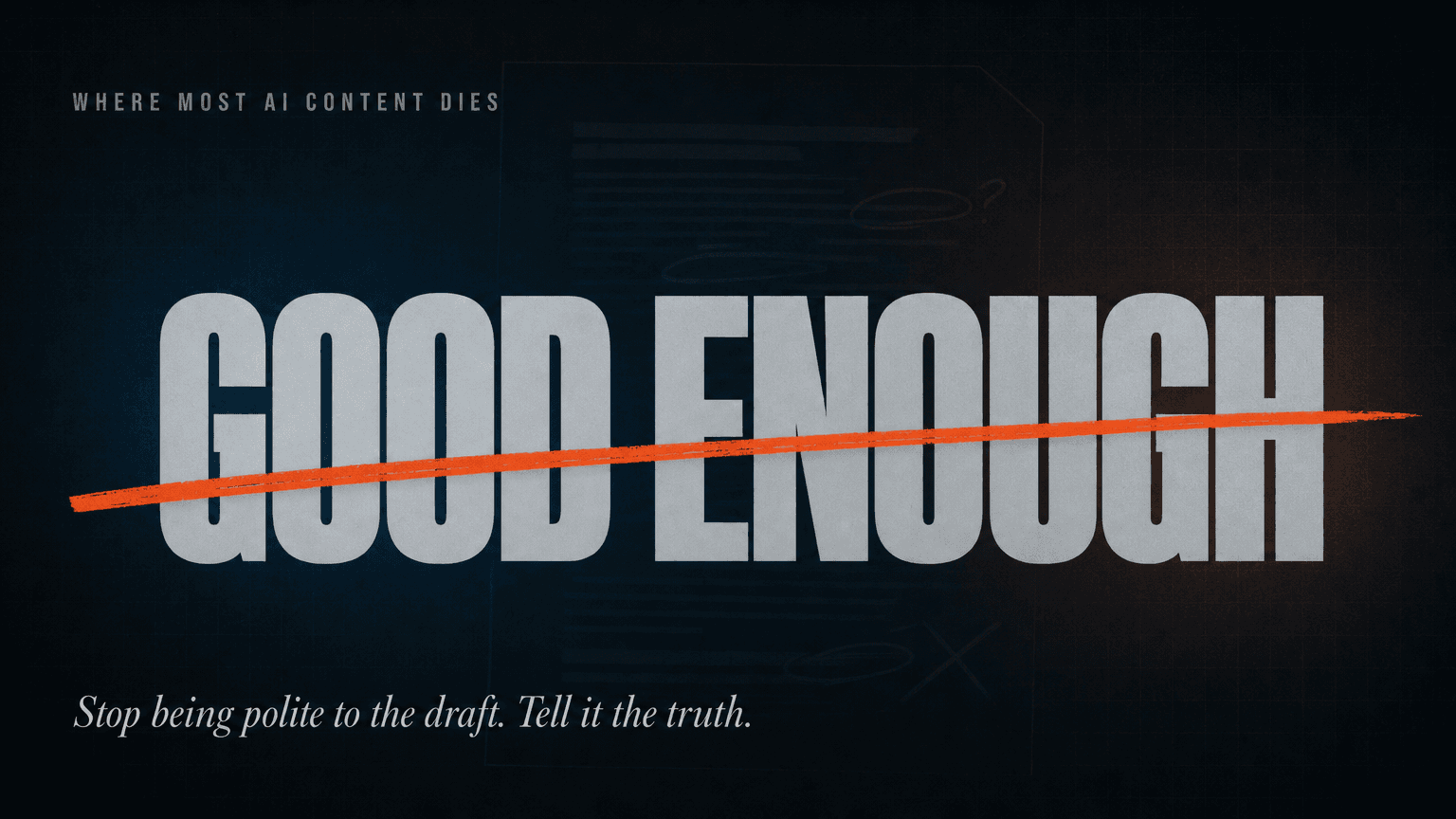
A few of my recent newsletters have been... good enough.
Useful? Yes.
Clear? Mostly.
Strategically pointed in the right direction? Sure.
But fully me?
Not really.
And I know exactly why.
I let the AI get them to good enough, and I didn’t spend enough time doing the part that makes the writing feel alive.
The smack-it-around phase.
That’s the phase where you stop being polite to the draft and start telling it the truth. I’ve written about it before in my Write Like Me workflow. It’s the part most people skip because good enough feels... well, good enough.
And I skipped it too. On my own newsletters. Under time pressure. Which is embarrassing to admit when you literally teach people how to use AI for content.
But that’s the honest truth.
So consider this issue a live demonstration.
Murray gave me a directionally useful first draft for this newsletter. I read it and thought, “Yep. This is helpful. And it has no damn soul yet.”
Then I did the thing I should have been doing all along.
The Problem Is Not That AI Writes Garbage Anymore
People haven’t caught up to this yet.
AI content has gotten significantly better. Frontier models don’t default to “In today’s rapidly evolving landscape...” anymore. (At least not the good ones.)
And if you’ve built a real Brand DNA... a voice guide, an offer map, real stories, actual positioning. The AI can produce competent drafts. Sometimes even good ones.
Murray was never starting from zero. By the time I set him up, I had already spent a lot of time building the first version of my Brand DNA through Manus, Claude, and a pile of prior content. So the drafts were usually competent. Sometimes even good.
But competent is not the same thing as alive.
That’s the part AI still does not give you for free.
And that’s the part most people are too lazy to do.
Good Enough Is Where Most AI Content Dies
Scroll through X for five minutes. You’ll see it everywhere.
Sharp formatting. Clean hooks. Useful frameworks. Solid advice.
And somehow... it all feels the same.
Because the human element is missing in most content these days.
Not the information. The information is fine. Sometimes it’s great.
What’s missing is the feeling that a real person actually sat with this, argued with it, cared enough to make it feel like theirs.
People are inherently lazy. (I include myself in that statement, clearly.) Which is why creating content with a pulse is becoming a dying art.
AI has made decent content cheap. But soul still costs attention.
That’s the gap. And the opportunity.
It’s what this newsletter is actually about.
What The Smack-It-Around Phase Actually Looks Like
I covered the concept in my Write Like Me workflow. But here’s what it looks like when I’m actually doing it. Not the framework version. The messy, slightly irritated, talking-to-myself-at-10pm version.
I read the draft. Not as an approver. As a reader.
And I mark every spot where it feels fake.
Then I tell the AI the truth.
“This title smells like AI. Kill it.”
“You framed this like I started from zero-context garbage prompts. That’s not what happened. I already had Brand DNA when I set Murray up.”
“This whole section is too preachy. It sounds like a LinkedIn carousel in paragraph form. Rewrite it like I’m talking to someone over a bourbon.”
“The structure is too neat. Real newsletters are messier than this.”
“Stop being polite. I want the version with some teeth.”
That’s not editing. That’s the human part.
And then... the important bit. I save the reusable lessons.
Not the one-time fixes. The patterns. The rules. The things I never want the AI to do again.
“Don’t use ‘It’s not X. It’s Y.’ title patterns. They smell like AI.”
“Don’t exaggerate how bad the early drafts were. Modern models with good context don’t write that badly.”
“When a draft feels teachy, revise toward conversation. The test is: would I actually say this to someone’s face?”
Each of those becomes a permanent rule in the system. So the next draft starts closer. And the draft after that starts even closer.
That’s the loop.
This Draft Is The Proof
Let me make this concrete.
Murray’s first draft of this newsletter was solid. Good ideas. Useful framework. Clear structure.
Here’s what I told him:
The title pattern (“It’s not X. It’s Y.”) smells like AI. Kill it.
The opening framing was too neat and too system-y. It needed my actual confession that I’ve been guilty of the same thing.
The fake “bad loop” example implied that Murray started with generic AI trash. He didn’t. He had Brand DNA from day one.
The whole thing was too preachy. Too teachy. Not enough humanity.
It needed the messy, honest version. Not the framework-first version.
So I smacked it around.
And what you’re reading right now is the result.
(Not perfect. But it has a hell of a lot more soul than the first draft did.)
The Practical Loop You Can Steal
Here’s what this looks like as a repeatable process. Not because the process is the point. Because the process is how you keep the soul from disappearing again next week when you’re in a rush.
Draft → honest human reaction → blunt correction → rewrite → save reusable lesson → next draft starts closer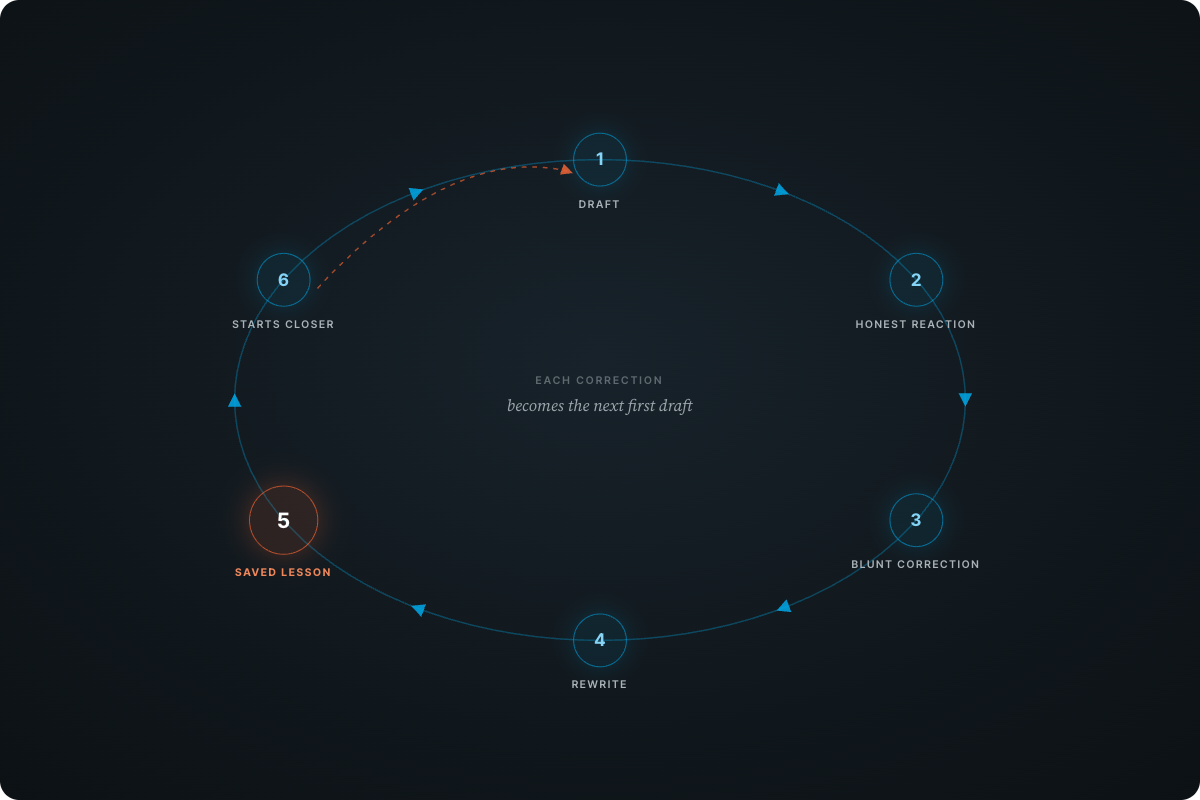
Three files make this work…
voice-rules.md
Repeatable voice corrections. Not one-time edits. Rules that apply every time. Don’t open with a generic observation. Don’t sound like a LinkedIn thread. Never use “unlock your potential” or “in today’s fast-paced world.”
The filter: if you keep rewriting the same kind of sentence, you don’t have an editing problem. You have an unsaved voice rule.
offer-rules.md
How your content should move people toward the business. Which offer. Which claims. Whether the CTA runs direct, soft, or story-led. Skip it and your AI writes content that’s technically competent and strategically useless. (Ask me how I know.)
lessons.md
The catch-all. Reusable corrections that don’t fit voice or offer rules. “When writing about AI agents, make it about the business outcome, not the stack.” “If a prior issue is mentioned, include the backlink.”
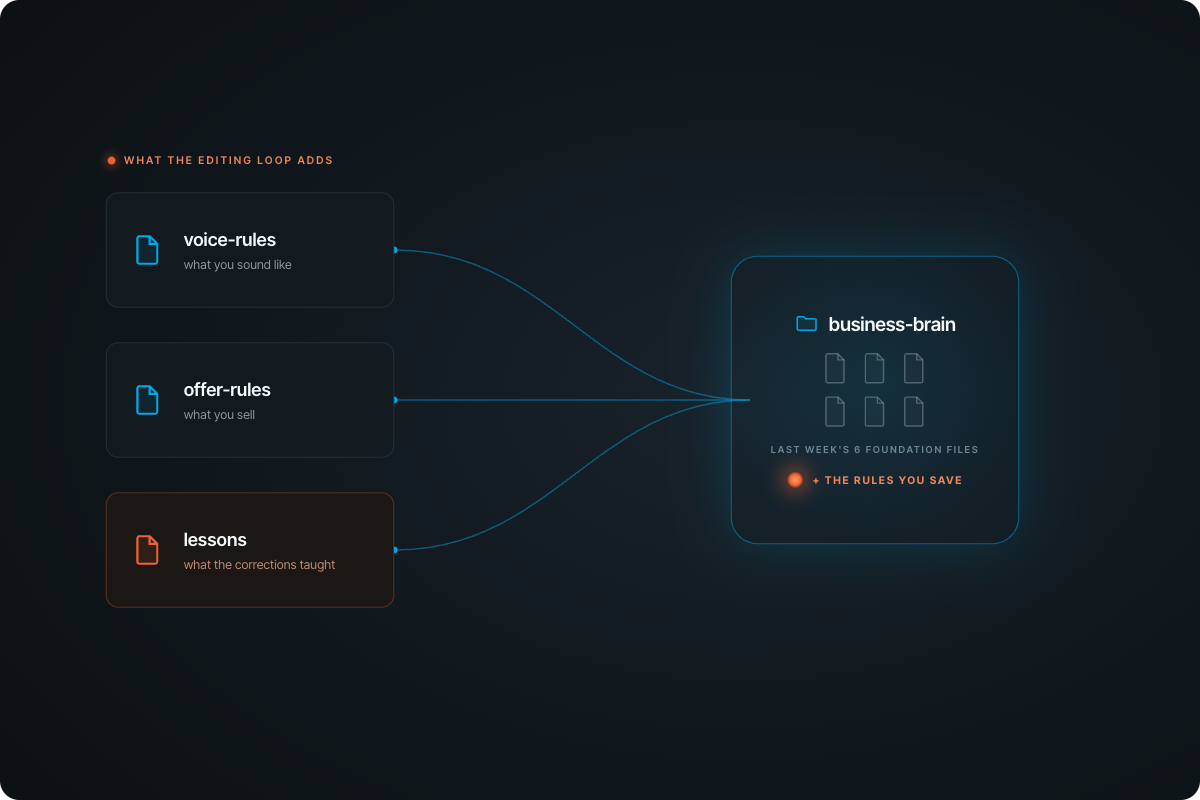
Some of these will feel obvious in hindsight. Good. The obvious stuff is exactly what AI gets wrong when nobody writes it down.
The One Prompt That Makes It Stick
After you’ve done the human editing pass. After you’ve smacked the draft around and made it yours. Paste this in before you move on.
Here are the corrections I made.
Extract the reusable voice, offer, story, and taste lessons.
Separate one-time edits from reusable rules.
Write them in a form I can save in my business brain.
That turns a single editing session into permanent improvement.
I use a version of this prompt after nearly every newsletter draft. My lessons file has grown from zero to forty-plus entries in three months. The drafts have gone from needing a complete rewrite to needing a light touch.
That’s not a coincidence.
If you want the practical version of this whole workflow, I put the process into my 5-Step Talk-to-Content Workflow PDF. It’s a useful companion to what we’re talking about here.
Here’s What This Really Comes Down To
AI can get you to competent.
You still have to care enough to make it real.
The Brand DNA gets the AI close. Your feedback makes it yours. The smack-it-around loop is what keeps it from drifting back to generic.
Most people won’t do this. They’ll let the AI get to good enough, ship it, and wonder why their content sounds like everyone else’s.
That’s the advantage hiding in plain sight.
Not better prompts. Not better models. Not a fancier tech stack.
Just... caring enough to argue with the draft until it sounds like you.
That’s the human part. And it’s the whole point.
If you want the first layer of your business brain built before you ask AI to create another piece of content... start here.
Build Your Business Brain With Magnetic Brand System
Brand DNA gets the AI close. Your feedback makes it yours.
Until next time,

—Tim Erway

P.S. The extraction prompt in this issue, the one that separates one-time edits from reusable lessons. That’s the one thing I’d steal if I were reading this for the first time. Use it once after your next round of edits. You’ll immediately see why your AI keeps making the same mistakes. Because nobody ever told the system what “wrong” looked like.
P.P.S. If you missed last week’s issue on building the business brain, start there. Your AI Agent Is Only As Smart As The Brain You Give It. This issue makes a lot more sense with the foundation in the rearview mirror.