Your AI Agent Is Only As Smart As The Brain You Give It
The six files I'd build before touching any AI tool... and why your business brain should outlive every one of them.
Over two months ago, Meta reminded me that I don't actually own my presence on Meta.
Someone hacked my Business Manager.
Ad accounts. Facebook Page. Business identity. Gone.
Still have my personal profile. But my Business Manager stayed dead in the water.
So I did what any reasonable person would do. I filed a support ticket.
Then another one…
We're going on week 10 now. I'm on ticket #9. Currently waiting for approval to get control of my own business manager.
Every ticket before this one closed with some bullshit canned response.
Not resolved.
Closed.
I'm paying $150 a month for "enhanced support," which apparently means they close the ticket faster while not helping you.
(I'm genuinely curious what the un-enhanced version looks like. Maybe they just delete the ticket before you hit send.)
Ten weeks of this clarified something I should have learned years ago.
If someone else can lock you out of it, it's not the foundation of your business.
It's rented land.
Now...
Most people hear that story and think it's about social media.
It's not.
The Same Problem Is Eating Your AI Setup
Here's what I want you to think about.
The tools, models, and platforms you use right now are mostly rented land too.
Claude. ChatGPT. Hermes. OpenClaw. Viktor. Manus. Whatever launches Thursday that everyone loses their mind over for 72 hours.
All rented.
Useful? I use them every day. But rented.
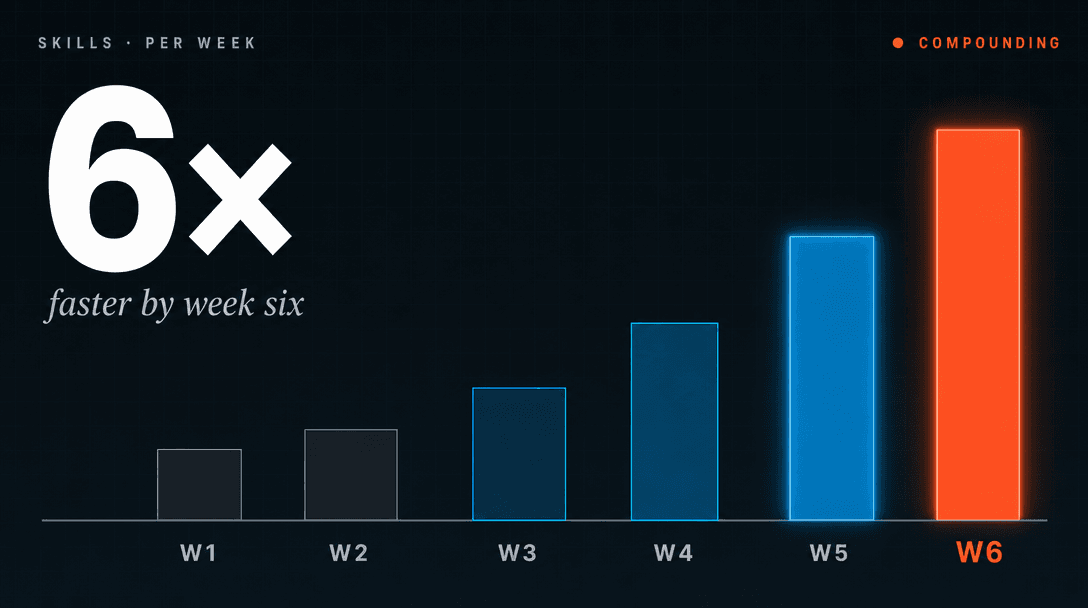
Six weeks from now, half the tools you're using will have a sharper replacement. I made that whole case last week in I Don't Care Which AI Agent Wins Anymore. The short version... the industry runs on a six-week clock now, and anything welded to one tool is already the slow option.
But here's the part I didn't go deep on.
Most people use AI the exact same way they use social platforms.
They show up. They type something. They get an answer. They close the tab.
Tomorrow they do it again.
From zero.
The tool remembers nothing. Your voice, your offers, your audience, the correction you made yesterday... gone.
You're not building anything.
You're renting autocomplete by the hour. From a landlord who can change the locks, raise the price, or shut down the building any time they want.
(Yeah. That's the Meta story again. Different platform, same trap.)
The Fix Is Not a Better Prompt
Most people think the answer is better prompting.
It's not.
The answer is a business brain.
Here's what I mean by that.
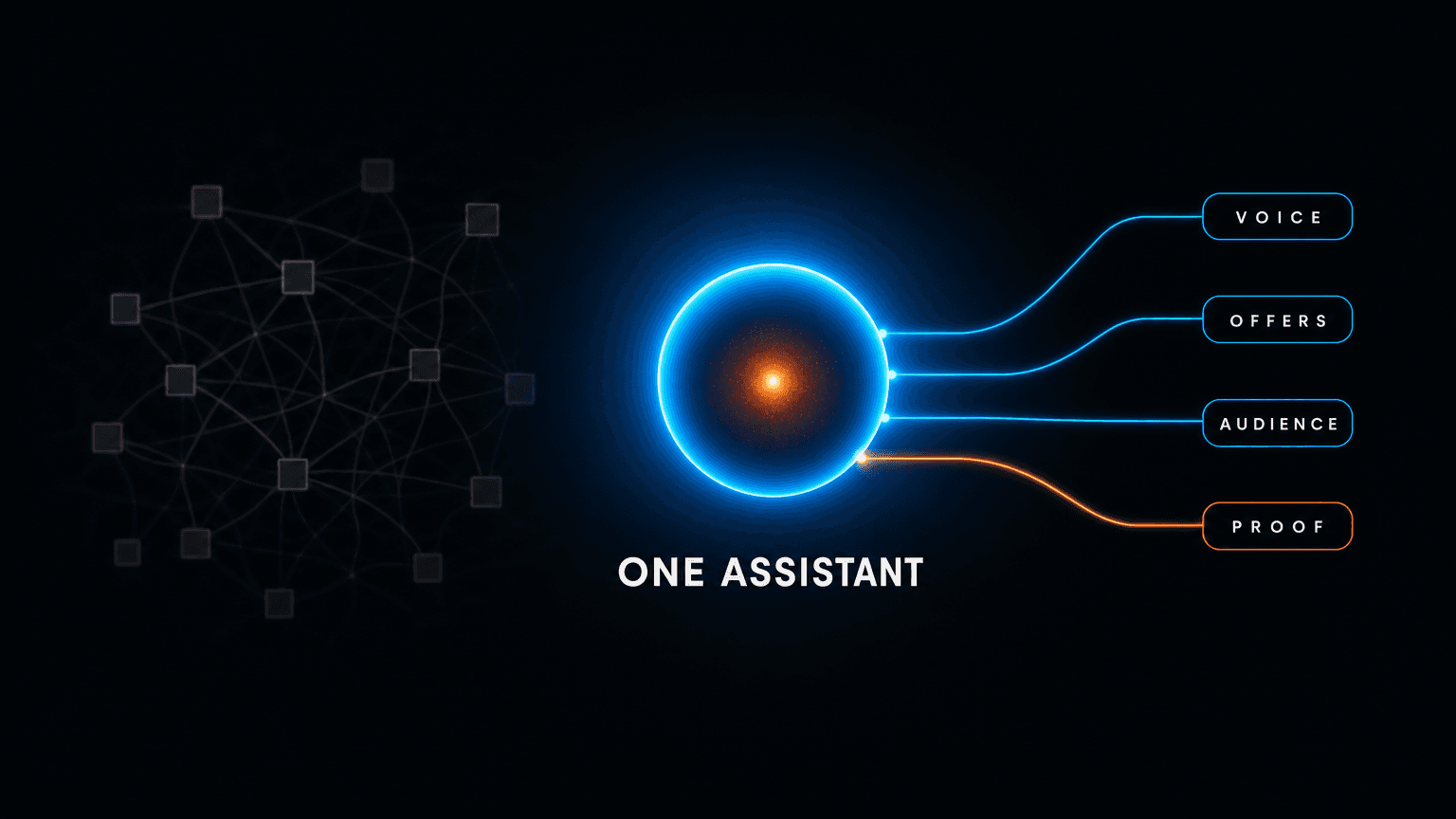
A business brain is a structured, portable set of files that contain everything your AI needs to understand your business. Your voice. Your audience. Your offers. Your stories. Your proof. Your visual identity. Your workflows.
Not inside the AI tool.
Outside it.
In plain files that any capable tool can read.
The tool changes every six weeks.
The brain compounds.
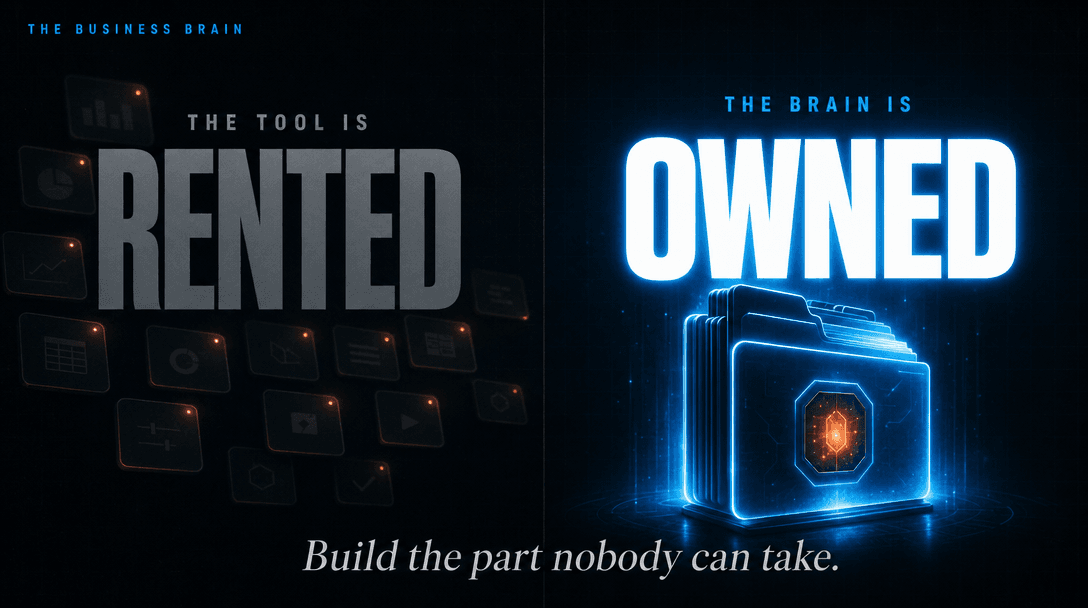
That's the whole game. The tool is rented. The brain is owned.
Last week a lot of you wrote back with the obvious question... "Ok, what IS this brain, and how do I actually build one?"
So this issue is the tactical answer. Let me show you.
The Structure I'd Build First
Here's the full picture of what a mature business brain looks like.
/business-brain
  /brand
    voice-guide.md
    visual-brand-guide.md
    forbidden-language.md
    positioning.md

  /audience
    ideal-customer.md
    beliefs-and-objections.md
    pain-points.md
    language-bank.md

  /offers
    offer-map.md
    current-offers.md
    proof-and-results.md
    funnels.md

  /stories
    origin-stories.md
    failure-stories.md
    customer-stories.md
    personal-proof.md

  /content
    newsletter-archive.md
    best-posts.md
    content-principles.md
    repurposing-rules.md

  /workflows
    newsletter-workflow.md
    social-workflow.md
    video-workflow.md
    research-workflow.md
That's the destination.
Don't let it scare you.
You do not need all of that to start. You need six files.
Six Files Before Any Tool
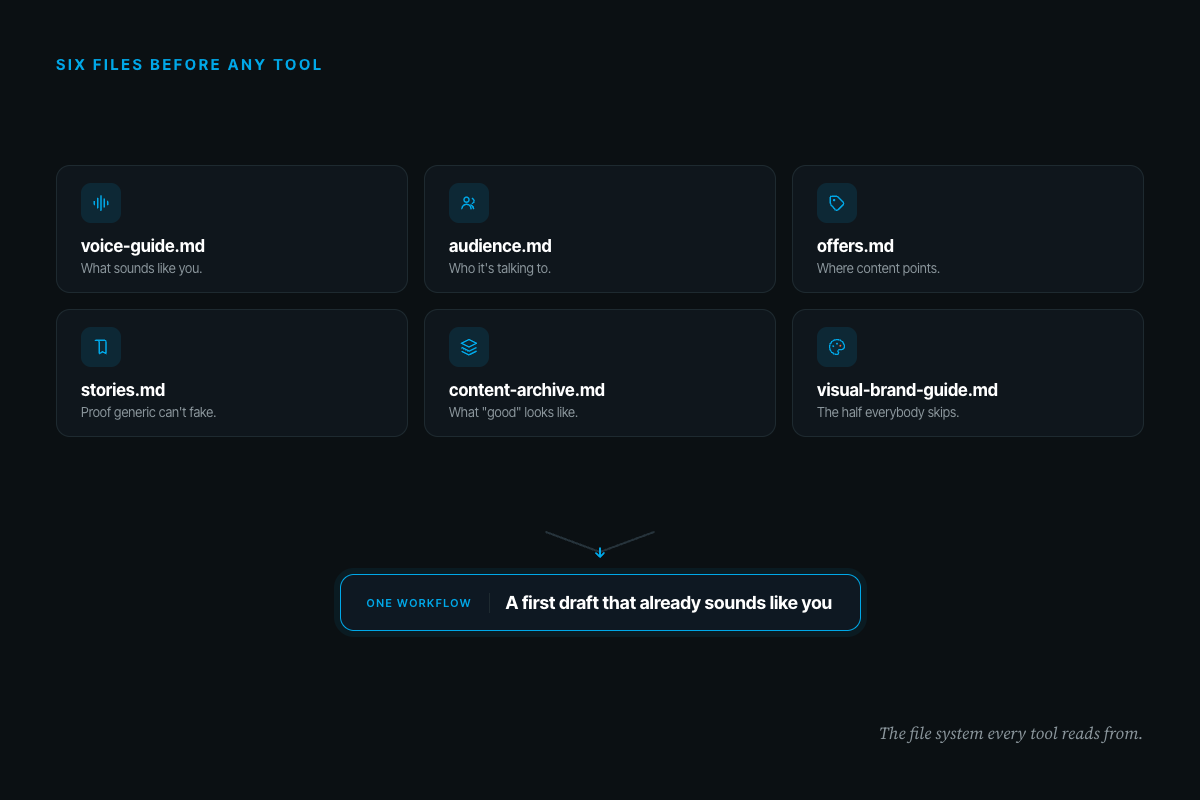
If I were building this from scratch today... no vault, no agents, nothing... these are the six files I'd create before I touched any AI tool.
- voice-guide.md: This is the file that teaches your AI what sounds like you and what doesn't.
- audience.md: This teaches your AI who it's talking to.
- offers.md: This teaches your AI what the business sells and where content should naturally point.
- stories.md: This gives your AI the proof and specificity that generic content can never have.
- content-archive.md: This gives your AI examples of what "good" looks like for your brand.
- visual-brand-guide.md: Your written voice is only half the brand. The other half is what people recognize before they read a single word.
Full copy-paste templates for all six files: The AI Business Brain.
1. voice-guide.md
This is the file that teaches your AI what sounds like you and what doesn't.
How you write. How you talk. Rhythm. Sentence patterns. Words you use. Words you'd never use. Examples of your strongest writing. Examples of rejected writing. Editing rules.
Most people tell AI to "write in my voice" before they've ever defined what their voice is.
That's like handing someone a guitar and saying "play my song" without ever writing one.
If you want the exact process I use to build this file, I broke it down step by step in How To Make AI Write Exactly Like You. The voice guide is the single most important file in the whole brain. Start there.
2. audience.md
This teaches your AI who it's talking to.
Who they are. What they want. What they're afraid of. What they're tired of hearing. What they secretly believe. What they need to hear but will resist. What separates buyers from browsers.
If your AI doesn't understand your audience, it'll write for "the internet."
And "the internet" is not your customer.
3. offers.md
This teaches your AI what the business sells and where content should naturally point.
Current offers. Who each offer is for. Who each offer is not for. Core promise. Mechanism. Objections. FAQs. CTA rules.
Your AI cannot create strategic content if it doesn't know what the content is supposed to move people toward.
Every piece of content should exist for a reason. Skip this file and your AI will just produce... content. Technically competent, strategically useless content.
4. stories.md
This gives your AI the proof and specificity that generic content can never have.
Origin stories. Failures. Wins. Customer examples. Weird details. Lessons you keep repeating. Moments that actually happened to you.
Stories are where generic AI content goes to die.
An AI with no stories writes like a marketing textbook. An AI with your actual stories writes like someone who was there.
(Because in a very real sense... it was. You put it there.)
5. content-archive.md
This gives your AI examples of what "good" looks like for your brand.
Past newsletters. Best social posts. Strong headlines. Strong openings. Final published versions, not first drafts.
Your published work is one of the most valuable training assets you own. Most people treat it like old content. I treat it like source code.
Every published piece is a reference implementation of how your brand sounds at its best. Hand that to the tool writing your next draft. Obviously.
6. visual-brand-guide.md
This is the one everybody skips. Don't.
Brand colors. Fonts. Logo rules. Graphic style. Screenshot standards. Image prompt rules. Layout preferences. Examples of good visuals. Examples of bad visuals. "Never make it look like..." rules.
Your written voice is only half the brand. The other half is what people recognize before they read a single word.
Skip the visual guide and every image tool defaults to the same glossy cyberpunk slop. You've seen it. The purple-and-teal gradient hellscape that every AI-generated business graphic lives in.
(It's like a neon fever dream designed by someone who learned design from Tron and never moved on.)
That's what you get without a visual guide. With one, you get graphics that actually look like your brand. More on my approach to that in How to Create Graphics With AI That Actually Grow Your Audience.
Plain Files. Always.
One rule on where this lives.
Keep it portable. Plain text. Folders.
I use and recommend Obsidian, because it helps you manage your brain in a special kind of text file called markdown (AI loves markdown). But the tool doesn't matter and I beat that drum to death last week. Notion, Google Docs, a folder on your desktop called "brain" with six text files in it... doesn't matter.
What matters is that the brain isn't loyal to the tool.
The tool works for the brain.
Most people do it backwards. They start with the tool and try to make it smarter. That's like picking a car before you know where you're driving.
Pick the destination first. The car is replaceable.
How This Actually Works in My Setup
When I ask Murray to draft this newsletter, he's not starting from a blank page.
In my setup, Murray is one of the AI agents on my team.
Jim has the audience and offer context.
Murray has the newsletter archive and voice guide.
Gavin has the visual brand guide.
Jared has the offer map.
Rex has the research lane.
Different agents. Same brain.
Here's the actual workflow...
Raw idea from a conversation or something I noticed.
Jim turns it into a brief with audience context and structural direction.
Murray drafts it pulling from the voice guide, archive, and corrections from every prior issue.
I do the editorial tightening pass.
Gavin and the creative tools do the visual pass.
It goes to TimErway.com, then a manual Beehiiv send.
Lessons get captured back into the brain.
Here's the part that matters...
A one-off prompt creates an artifact.
A business brain creates a workflow.
A workflow improves every single time it runs.
I told the longer version of this last week, but the short of it... my first newsletter through this system was rough and now most sections need a light touch instead of a rewrite. None of that improvement lived in the tool. It lived in the brain.
Start Ugly
I know what you're thinking.
"That's a lot of files. I need to build all of that before I can use AI?"
No.
Please don't spend three weeks building the perfect vault.
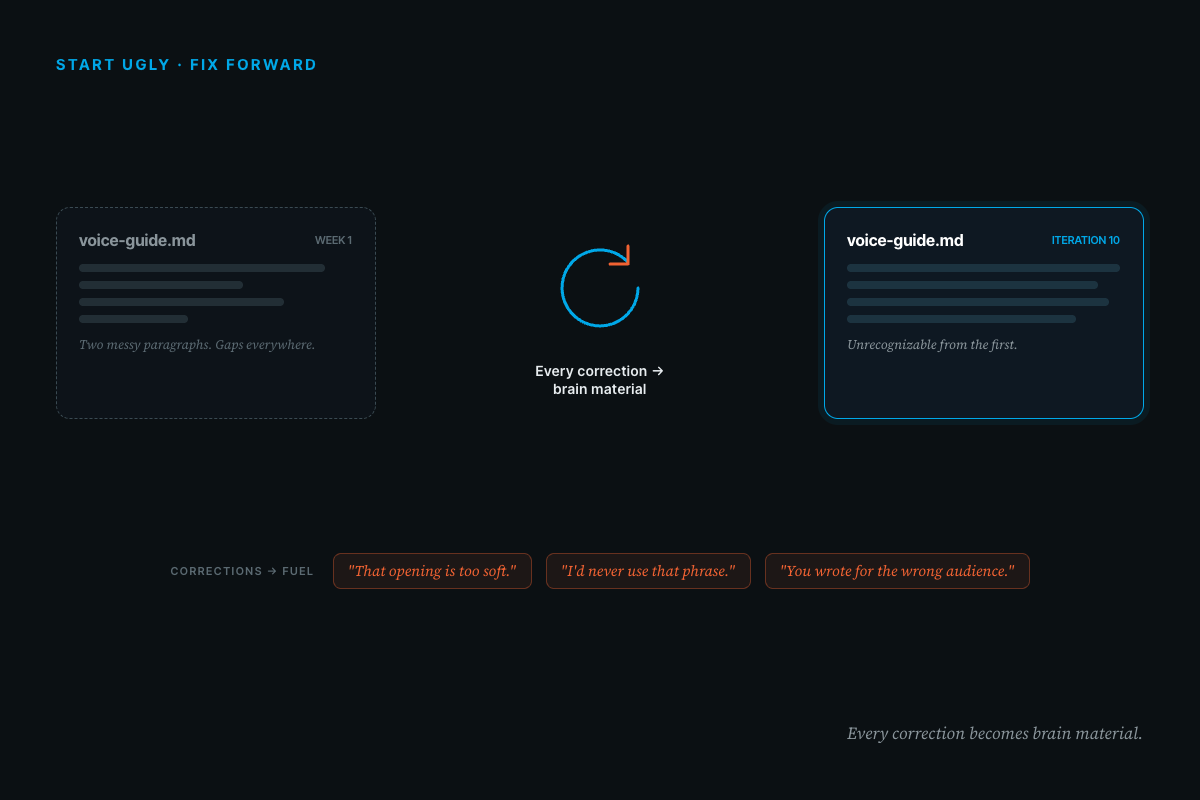
Start with six messy files and improve them as your AI gets things wrong.
That's the whole secret.
Seriously.
Your voice guide will be two paragraphs the first week. Your audience file will have gaps. Your stories file will be half-finished.
That's fine.
Because every time your AI produces something that sounds off... that's a correction. And every correction becomes brain material.
"That opening is too soft." Brain material.
"I'd never use that phrase." Brain material.
"You wrote for the wrong audience." Brain material.
The brain doesn't need to be perfect on day one.
It needs to exist on day one.
Perfection is what kills most people's AI setups. They want the vault pristine before they start. So they never start.
Meanwhile, someone with six ugly files and a feedback loop is already on their tenth iteration. And the tenth iteration is unrecognizable from the first.
Start ugly. Fix forward. That's how every useful system gets built.
One More Thing
Everything I just described... the voice, the audience, the offers, the stories, the proof, the visual identity...
That's Brand DNA.
And building that Brand DNA is exactly why I created the Magnetic Brand System.
It walks you through the whole foundation... audience, positioning, offer strategy, voice, stories, proof, visual identity... all in a format your AI tools can actually use.
Not a course you watch and forget.
A system that produces the actual files your AI needs to stop guessing and start sounding like you.
Build it once. Use it everywhere. Take it with you no matter what tool you're running on top of it.
Whatever wins next... Claude Code, Codex, Hermes, the thing nobody's named yet... your brain goes with you.
Build Your Business Brain With Magnetic Brand System
Until next time,
—Tim Erway

P.S. Quick update on the Meta hostage situation since a few of you have asked. Week 10. Ticket #9. Still locked out of my own Business Manager, still waiting on regaining full control. The one upside... it made the point of this whole issue better than I ever could. Anything you can be locked out of isn't a foundation. Build the part nobody can take.
P.P.S. If you want a video and full setup instructions, let me know. I’m launching my YouTube channel (finally), and I’m thinking this may be a good topic for one of my first videos.