You're Not Behind. That's the Problem.
The disruption you're watching for won't arrive as a competitor. It'll arrive as a software update. Here's how much time you've actually got.

Go look around your industry right now.
I'll wait.
Notice anything? Yeah. Me neither.
Nobody's replaced a single workflow with AI agents. Your competitors are running their businesses the exact same way they ran them in 2023. The guy down the street is still doing everything by hand. Nothing is eating your lunch. Nothing's even sniffing at your plate.
It feels early. It feels calm. It feels like you've got time.
That feeling is the most expensive thing you own right now.
The question everybody's arguing about is the wrong one
Back on May 29th, I wrote you a letter called "I Don't Care Which AI Agent Wins Anymore."
That was seven weeks ago. Since then? Oh, buddy.
Anthropic shipped Fable. OpenAI shipped GPT-5.6 Sol. xAI shipped Grok 4.5. And every AI bro on the internet lost his mind. Benchmarks flying. A new king crowned every 36 hours. Guys with ring lights making fourteen-minute videos about which one "changes everything."
Three new champions in seven weeks. Do the math on that. If you'd spent those seven weeks mastering whichever model was "best" on May 29th, congratulations: you're now two kings behind, and the video that told you to do it has been quietly deleted.
I still don't care. It still doesn't matter.
Because while everybody argues about model names, nobody's watching the one number that actually has a clock on it: how much time you've got left.
And that question has a real answer. With data behind it instead of vibes and thumbnail faces.
So let's answer it.
There are two curves running right now, and everybody's watching the wrong one
Stick with me for a second, because this is the whole ballgame.
There are two AI adoption curves happening at the same time. And almost everybody confuses them, which is exactly why almost everybody's about to get caught with their pants down.
Curve one is the chatbot stuff. ChatGPT. Copilots. "Summarize this email." "Write me a caption." "Make this sound less angry before I send it to my accountant."
That curve is basically done. Cooked. Finished.
88% of businesses already use AI somewhere in their operation. Eighty-eight percent. And here's the punchline...
It changed almost nothing about how those businesses actually run.
McKinsey went and looked. Fewer than 10% have turned AI into real, company-wide value. Everybody's using it. Almost nobody's been transformed by it. The researchers have a name for that gap. They call it the Great Disconnect.
I call it "using a forklift to hold your coffee." Sure, technically you're using the forklift. You're just using it to do something a coaster could do.
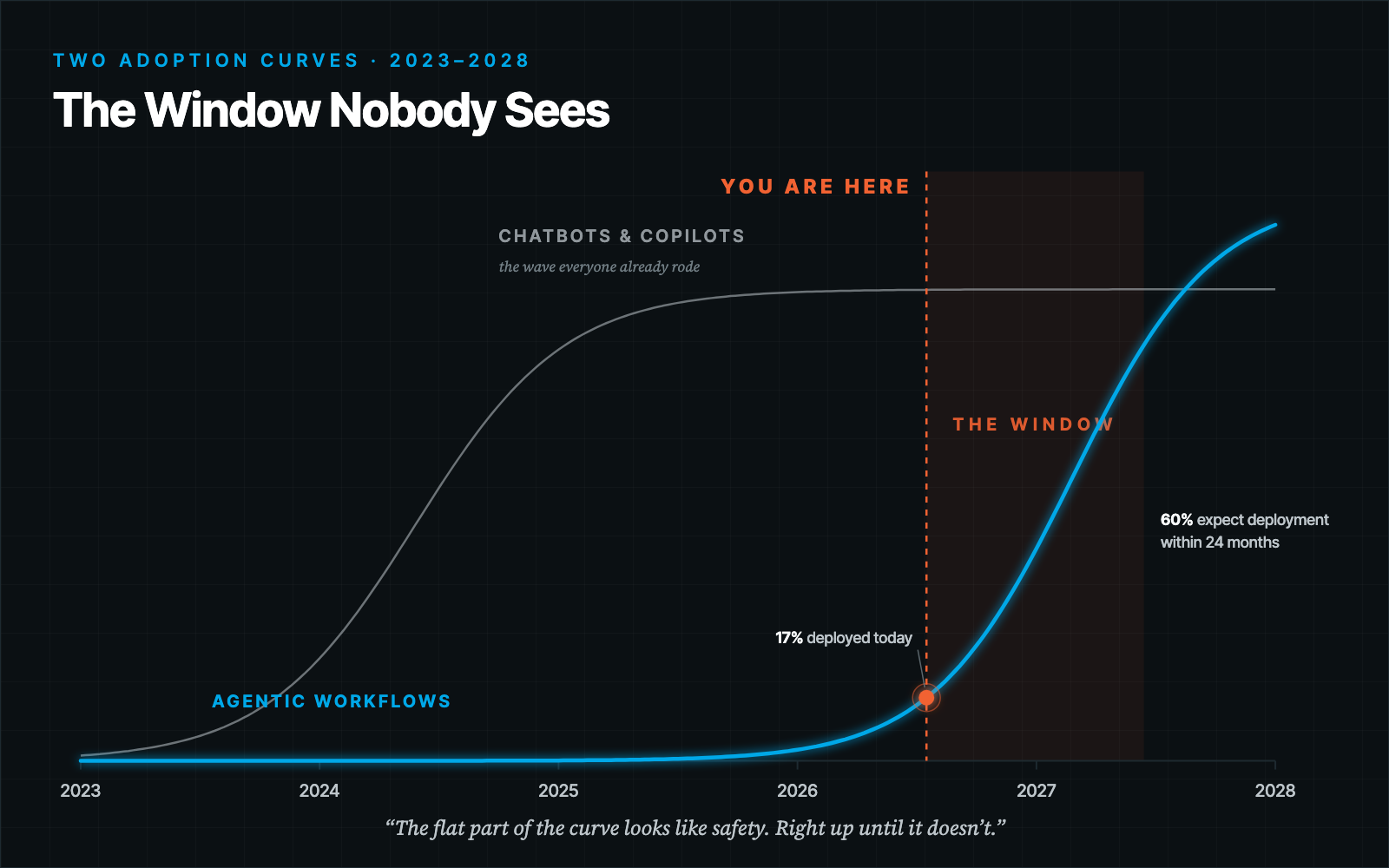
Curve two is the one nobody's watching. Agentic workflows.
Not AI that answers your questions. AI that does the work. Multi-step jobs, start to finish, without you. It doesn't tell you how to write the email sequence. It writes the email sequence, builds the funnel, and loads it into your CRM while you're at your kid's soccer game.
That curve is sitting at the flat bottom of the S. The very beginning. Gartner says only 17% of organizations have AI agents actually in production today.
But over 60% expect to deploy them inside 24 months.
Sit with that number for a second. Gartner has been measuring how technology gets adopted for decades. Decades. And they're on record saying this is the most aggressive adoption-intent curve they have ever recorded. Not "one of." The most.
Now here's the part that should make the hair on your neck stand up.
The flat part of an S-curve is where all the money gets decided. Every single time. Because the flat part looks exactly like nothing is happening.
Operators look around, see no threat, see everybody else moving slow, and go "eh, I've got years." They read the quiet as safety.
It's not safety.
It's the wind-up.
You know that half-second right before someone throws a punch, when everything goes still? That's the flat part of the curve. That stillness isn't peace. It's the arm cocking back.
The disruption isn't coming from where you're looking
This is the part I really need you to get.
You've been scanning the horizon for the wrong threat.
You're watching for a competitor. Some slick AI-native startup that shows up in your niche, undercuts you, and forces you to scramble. And you figure, hey, when that guy shows up, I'll see him coming and I'll adapt. I always have.
You won't see him coming. Because he's not the threat.
The threat is the software you're already paying for. Right now. This month.
80% of enterprise software vendors are already shipping their apps with AI agents baked in. Gartner projects that 40% of all enterprise apps will have task-specific agents built in by the end of this year.
Your CRM. Your books. Your project management tool. Your email platform.
And here's the kicker that makes this different from every tech shift before it...
Your competitor's CRM gets the same update. Same quarter. Same button.
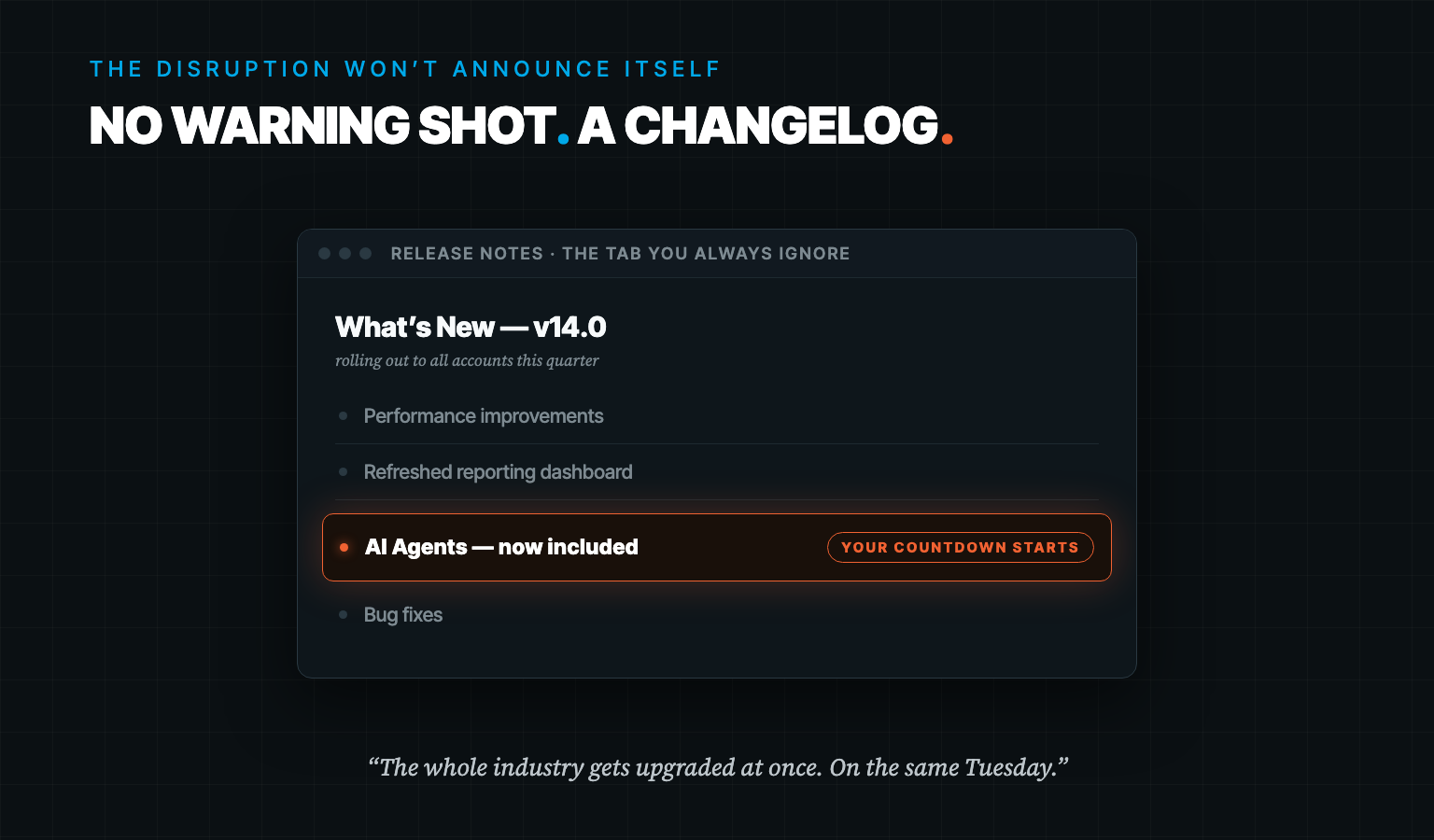
The whole industry gets upgraded at once. On the same Tuesday.
That's why this one won't creep in slow the way the chatbot wave did. It won't tiptoe. It'll land. One quarter, AI agents are a thing people talk about at conferences. The next quarter, they're a default feature that every single person in your market already has, whether they asked for it or not.
You won't get a warning shot. You'll get a changelog.
"But I'll just turn the AI on too"
Sure. You will. So will everybody else. That morning.
And that's exactly the problem.
The day the update drops, everyone in your market gets the same agents. Same power. Same button. Handed out like flu shots.
Possession stops being an advantage the second it becomes a default setting.
Owning a thing everyone owns isn't an edge. It's just Tuesday.
So what stays rare? The skill.
Knowing how to actually direct the agents. How to string them together across a whole business so they hand off to each other instead of tripping over each other. How to check their work so you don't cheerfully ship garbage at scale to your entire list. (Which, by the way, is a real thing that happens, and it's spectacular when it does. Nothing like automating a mistake and sending it to 40,000 people at once.)
That's the meta-skill of the next ten years. And it has a nasty little learning curve that most people are about to discover the hard way.
The data on that curve is genuinely brutal. Gartner forecasts that over 40% of agentic AI projects will get canceled. Runaway costs. No clear ROI. No guardrails. People bolt an agent onto a broken process, watch it faceplant, and quietly kill the project.
Meanwhile, the operators who set this up right? Averaging 171% ROI on the exact same technology.
Same tools. Same models. Opposite universe of results.
The difference isn't the software. The difference is the operator holding it.
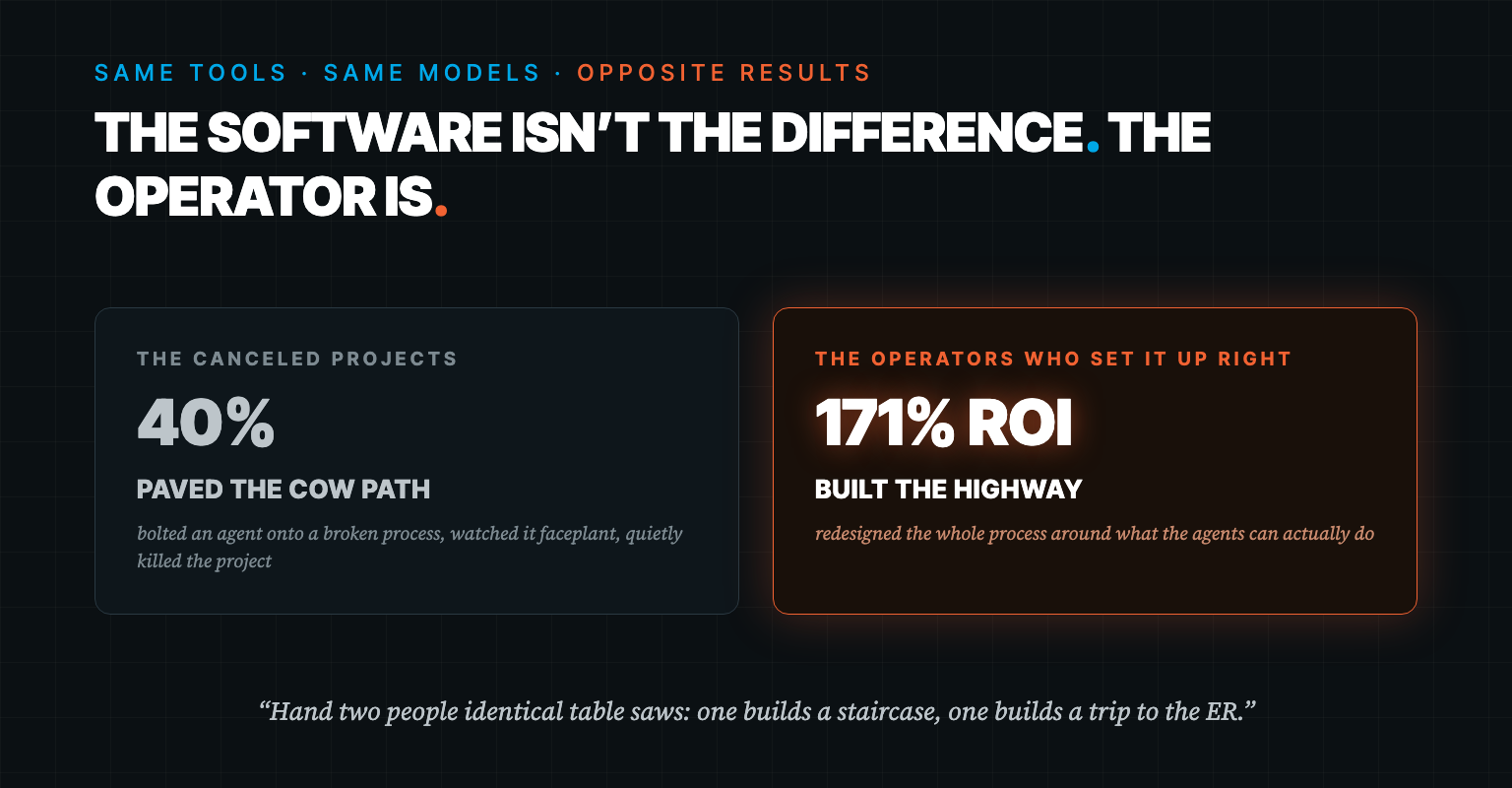
It's the same reason you can hand two people identical table saws and one builds a staircase and the other builds a trip to the emergency room.
And you cannot cram for this exam. You can't speedrun that learning curve the week your industry's update drops and everybody panics at once. The window was never "how long until the robots take over." That was always the wrong clock.
The window is the time until the update.
That's the countdown. And it's a lot shorter than it feels.
Let me be real about the stakes for a second
Over the next 36 to 48 months, this thing accelerates at a rate nothing in our careers prepared us for. I've been doing this 24 years. Lived through Google AdWords when it was the wild west. Watched SEO go from "buy some links" to a full-time science. Watched social media eat the entire marketing world. I've seen a few of these waves, and I've watched smart people laugh at every single one of them.
This one's different. This one's faster, and it's not close.
Jobs are already getting replaced. White-collar industries that swore they were untouchable are about to get a very rude wake-up call. And the economic shakeup is going to blindside most people for the exact same reason your competitors feel cozy today.
The flat part of the curve looks like safety. Right up until it doesn't.
For the people who wait? It's going to be rough. I'm not going to sugarcoat that.
But for the people who lean in now, while the skill is still rare and everyone else is still arguing about model names on YouTube... this is the single biggest window of opportunity any of us will see in our lifetimes.
Doesn't matter if you're an employee, a business owner, or an investor. The people who build the skill while it's rare get launched. Everybody else gets averaged.
I know which side of that line I'm building on.
How to read your own industry (so you see it before anyone around you)
Good news: you don't have to guess where your market sits on the curve. There are three leading indicators. Track these and you'll see the takeoff coming while everyone around you is still squinting at the horizon looking for a startup that isn't there.
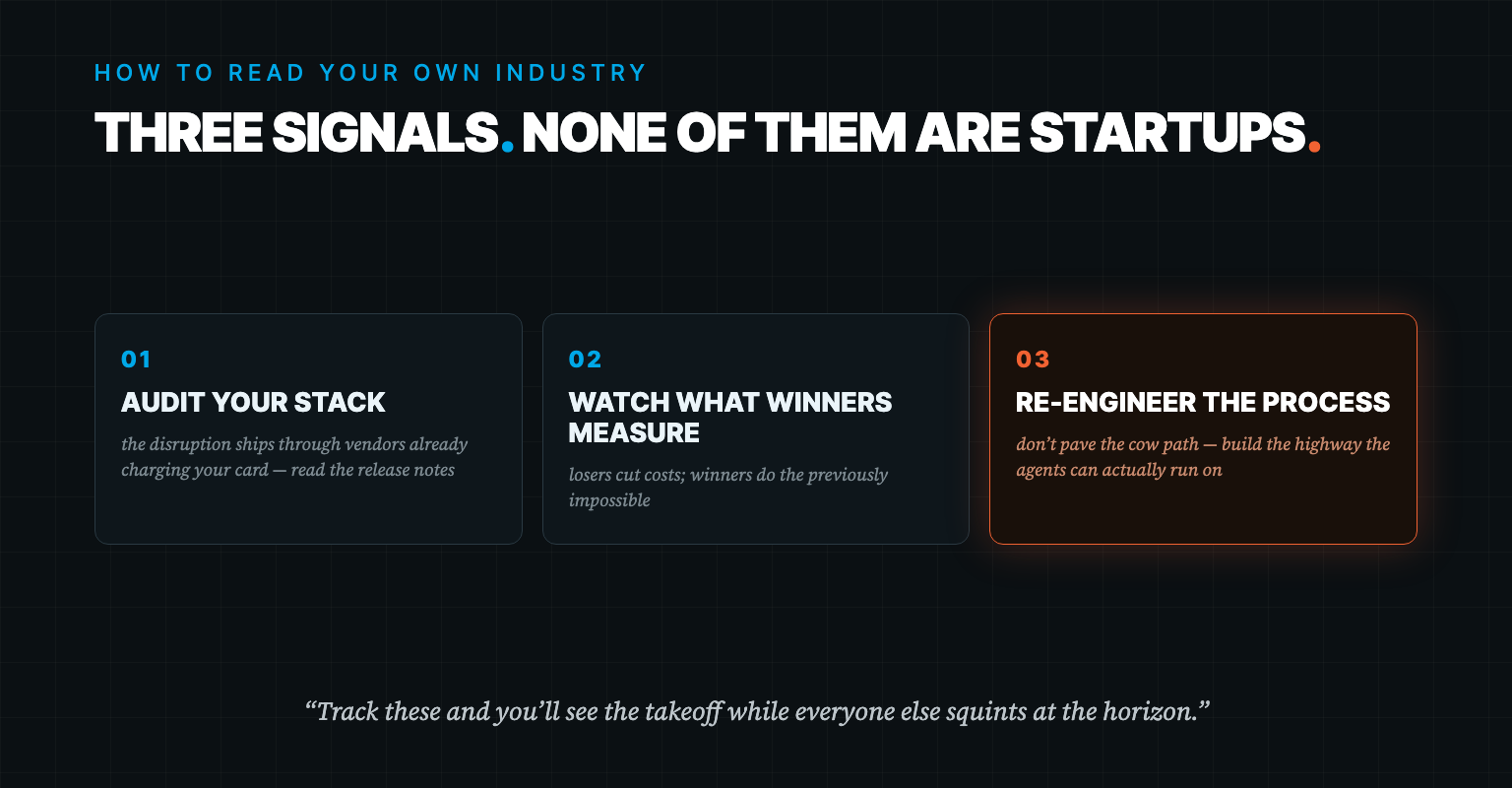
1. Audit your software stack, not the startup scene.
Stop watching for the competitor. The disruption is coming through the vendors already charging your card every month. Open the release notes on your CRM. Your accounting software. Your ops tools. (Yeah, actually read them. I know. Nobody reads the release notes. That's the point.)
The moment your vendors start shipping agents, your countdown officially started. You don't need a memo. It's right there in the "what's new" tab you always ignore.
2. Watch what the winners actually measure.
This one separates the two crowds instantly.
Losers use agents to cut costs. Fewer support hours. Cheaper output. Same business, slightly leaner. Boring. Marginal. A rounding error.
Winners use agents to do things that were flat-out impossible at their size before. McKinsey's own example: running a fully personalized campaign to every past customer at the same time. Not "cheaper marketing." Marketing that a small team literally could not have executed at any price a year ago.
That's the tell. If someone's using agents to shave a little off the bill, they don't get it. If they're using agents to do the previously-impossible, those are the ones who'll be eating your lunch by spring. Remember the empty plate from the top of this letter. It doesn't stay empty.
3. Re-engineer the process. Don't pave the cow path.
This is where the 40% who fail go to die.
They take a workflow that was designed for humans, jam an agent into it, and act surprised when it chokes. That's called paving the cow path. You took the crooked dirt trail the cows wandered into 80 years ago and you poured asphalt on it instead of building an actual road.
The winners redesign the whole process around what the agent can actually do. That's the difference between the canceled 40% and the 171% club. Same technology. One group paved the cow path. The other built the highway.
That's the entire framework. Three signals. Read those and you can now time this window better than the consultants charging five figures to tell you the same thing on a slide with their logo in the corner.
Okay, now the honest part
Everything I just gave you is free. I handed you the whole framework, complete, no gate. Go use it.
Because knowledge was never the wall.
The wall is labor.
Reading those three signals tells you the window's open. Great. It does not build you a single thing. Re-engineering even one revenue workflow still means building the offer, writing the copy, structuring the funnel, writing the email sequence, producing the ads.
Five skills. Five actual, separate crafts. Each one takes years to get halfway decent at.
I know, because I used to buy all five. My old business ran on a $50,000-a-month payroll plus six figures in ad spend, and even with all that horsepower, a single launch still took weeks. Weeks. With a whole team. Bleeding money the entire time.
Tomorrow morning I'm going to compress that whole thing into four hours.
Live. On screen. In front of you.
Saturday, 10:00 AM Eastern. The Live AI Build-Out Event.
Four hours where I stand up the five specialists that actually move the needle in any business. Offer Creation. Sales Copy. Webinar. Email. Ads. And then we don't just talk about them. We run an actual launch with them. Start to finish. From "here's an idea" to an irresistible offer to a complete, ready-to-launch campaign. Funnel. Emails. Ads. Ready to take orders before lunch.
That's the process re-engineering this whole letter is about. Not a theory slide. Not a case study from some company you'll never meet. A real build, on a real business, happening in real time while you watch.
The exact thing I just spent 2,000 words telling you the window rewards.
Here's how you get in: the only door is Monetize OS. It's $197. The event comes free with it, but only until I go live at 10:00 tomorrow morning. The second I start, the event leaves the offer. For good. Not "for now." For good.
I've made that promise before and I kept it. I'm keeping this one too.
Look...
The update is coming either way. That part's not up for debate. It's already in the release notes of software you haven't opened yet.
The only real question is whether it shows up as your upgrade... or your competitor's.
The flat part of the curve looks exactly like safe. It always has.
Build the skill while it's still rare.

—Tim Erway

P.S. The doors on the event close the second I go live. Saturday, 10:00 AM Eastern. Not 10:05. If you're reading this with hours to spare, you've got hours. If you're reading it with minutes, quit reading and go move.
P.P.S. This whole shift is also why I've been quietly buying the picks and shovels since 2023. Data centers. Power. The demand is running years ahead of the supply and the gap isn't closing anytime soon. But that's a whole different letter. And it's definitely not investment advice, so don't come at me.