13 Tells Your Content Reeks of AI
I spent 20 minutes on LinkedIn and watched a room full of robots congratulate each other for being authentic.
Greetings, hooligans and misfits.
Yesterday morning I spent 20 minutes on LinkedIn. I don't recommend it.
I clicked through a dozen posts from influencers, most of them obviously written by AI, and then I made the mistake of reading the comments.
Good news. I now know exactly how to CRUSH IT on LinkedIn.
Here's the formula.
Post some generic "five lessons" bullshit. Drop it into an engagement pod. Fifty people use AI to leave comments in the first ten minutes. Your AI comment generator replies to their AI comments. LinkedIn sees "engagement" and shoves the whole robot circle jerk into more feeds.
Winning!
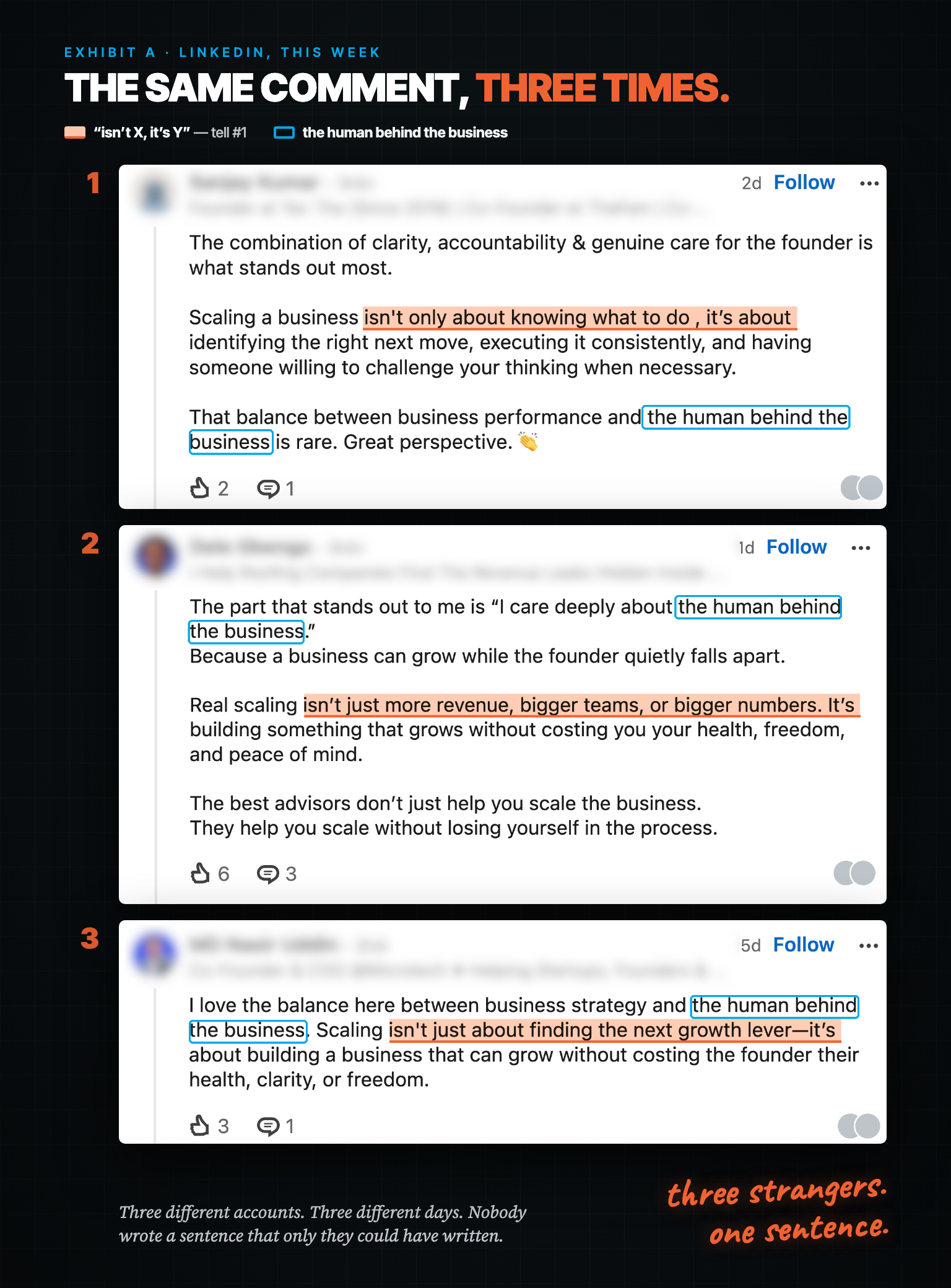
The post was written by AI. The comments were written by AI. The replies to the comments were written by AI. And everybody involved was congratulating a room full of robots for being brave, real, insightful, and authentic.
It's slop. lol
Before I start throwing rocks, I'll just go ahead and stand in the blast radius.
I've spent 25 years writing copy, building offers, and marketing companies, and I use AI every single day. I teach people how to use it. Murray, the writer who handed me the first pass of this newsletter, is an AI.
So no, I'm not telling you to unplug everything and write by candlelight in a leather journal while a single tear rolls down your cheek.
Here's what actually happened with this issue. I dumped the idea on Jim, my AI CMO. Jim turned it into a brief. Murray wrote a draft.
It was... fine.
Useful, organized, technically correct, and it sounded like a very confident VA wrote it.
So I sat down and started pounding on it. The ideas got sharper, the jiu-jitsu story showed up, my opinions got less polite, and the weird little details from my actual life started leaking in until it sounded like it was written by me. Because it was.
That's the whole difference. You can use AI to sharpen your thinking, or you can hand it your thinking, your taste, your stories, your opinions, and your final judgment, at which point the machine has nothing left to do except impersonate you.
Poorly.
Like AI drove, while you took a nap in the passenger seat.
And once you know the "smell", you catch it everywhere.
The AI Slop Field Guide
I cut this down to the 13 patterns that show up over and over in otherwise competent writing.
None of them is a felony by itself. I use some of them too. The smell comes from repetition without taste. One tic is a choice. Thirteen of them in the same article means you were napping while AI was driving.
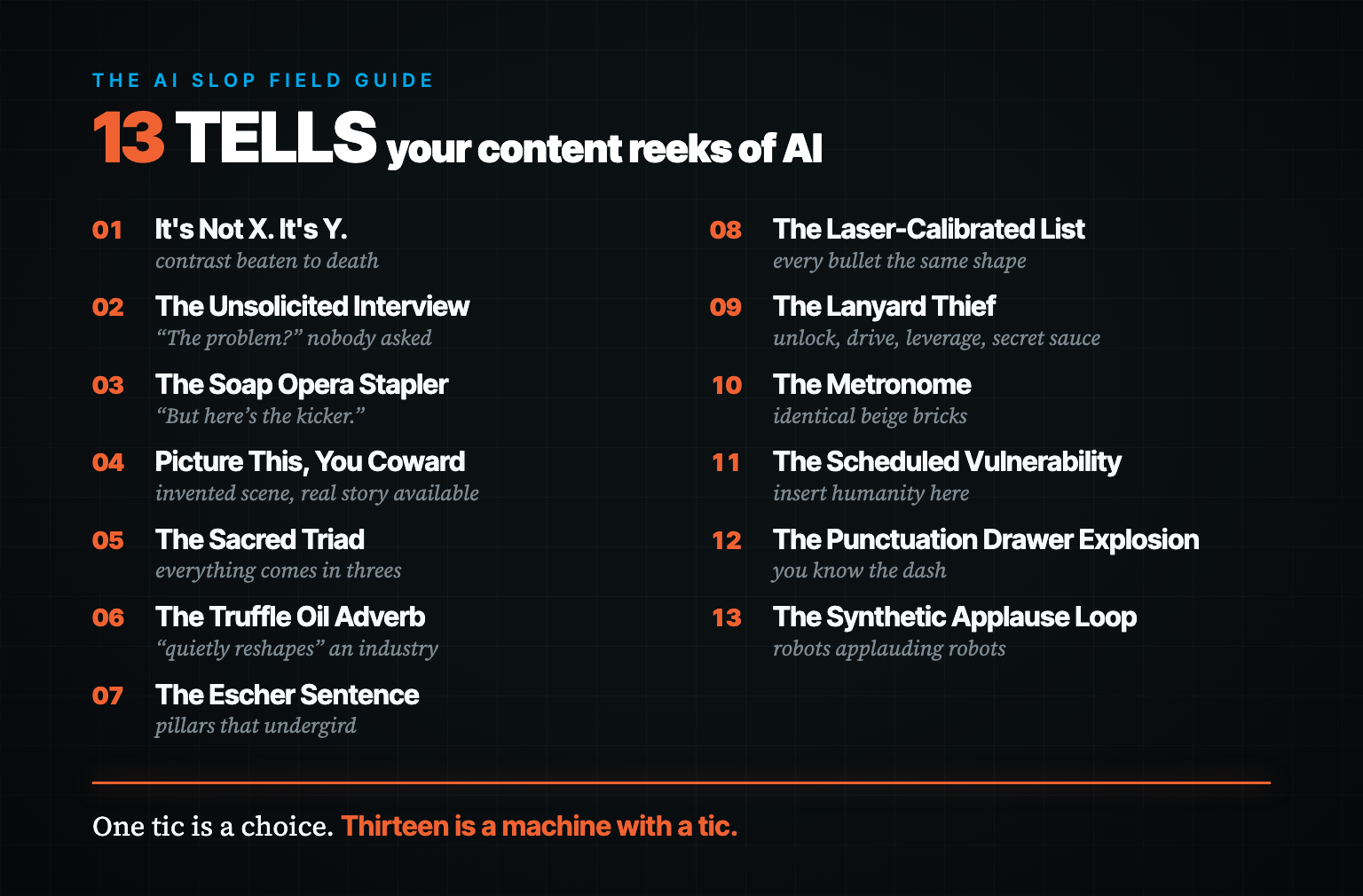
1. It's Not X. It's Y.
The undisputed champion. Go look at the comments in that screenshot again. Nearly every one of them is this.
"It's not about the tools. It's about the mindset."
"This isn't a content problem. It's a positioning problem."
"Not more hustle. Not more grinding. Just more clarity."
"It isn't about working harder. It's about working smarter."
AI learned that direct-response copywriters use contrast for emphasis, then beat the pattern TO DEATH.
It's not delivery. It's... please MAKE. IT. STOP.
I use contrast too. Everybody does. One of these in a piece is emphasis. Four of them is a machine with a tic.
2. The Unsolicited Interview
"The problem?"
"The truth?"
"The result?"
DUDE... nobody asked.
You were already speaking. You can just finish the thought without stopping to interview yourself.
This one drives me nuts.
3. The Soap Opera Stapler
"But here's the kicker."
"That's only half the story."
"And what happened next changed everything."
These staple two ordinary paragraphs together while insisting dramatic music should be playing.
Sometimes the next paragraph is just the next paragraph. It doesn't need to enter the room wearing a cape.
4. Picture This, You Coward
"Picture this: It's 2 a.m., your campaign is failing, and you're staring at the ceiling..."
No, that ain't it.
Tell me about the night your campaign actually failed. Tell me what the clock said, how much money disappeared, what your wife said when you came downstairs, and what you found broken the next morning.
A made-up scene gives you the shape of empathy without the risk of revealing anything real. That's the whole appeal of it.
5. The Sacred Triad
AI loves groups of three the way toddlers love the word "no."
Three lessons. Three problems. Three steps. Three bold fragments in a row.
Humans occasionally have two thoughts. Sometimes we have four. Every once in a while we wander off halfway through the second one because the dog started barking.
The universe doesn't organize every useful idea into a keynote slide.
6. The Truffle Oil Adverb
A tool no longer changes a workflow. It "quietly reshapes" an industry.
A trend "fundamentally shifts" the market.
A feature "silently transforms" the customer experience.
That's unearned gravitas poured over an ordinary idea like truffle oil at a mediocre restaurant.
If something matters, show me what changed. Whispering an adverb over it and hoping I feel chills is not the same thing.
7. The Escher Sentence
This is where a sentence sounds smart until you try to picture it.
"Two overarching pillars undergird the strategy."
So the pillars are above us and underneath us, and the strategy is trapped in an architectural accident? Ummm... I'm confused.
AI is excellent at putting impressive words near each other. It's a lot less reliable at checking whether the resulting metaphor could exist anywhere outside a fever dream.
Read your clever sentences slowly. If the picture collapses, so does the sentence.
8. The Laser-Calibrated List
Strategy: One explanatory sentence.
Execution: One explanatory sentence.
Optimization: One explanatory sentence.
Every bullet gets a bold label, a colon, and the exact same sentence underneath it. The formatting is so consistent you could use it to calibrate a laser.
Real lists change shape. Some items need context. Some need just one word. Some shouldn't be a list in the first place.
9. The Lanyard Thief
"Unlock value."
"Drive impact."
"Leverage the ultimate playbook."
"Discover the secret sauce."
The old AI gave us "tapestry" and "delve." The new AI went to a SaaS conference, stole a lanyard, and came back with different garbage.
Specific language makes a reader see something and understand it.
10. The Metronome
Three sentences per paragraph. Fifteen words per sentence. Same pace, same shape, same safe little landing, over and over, until the whole page looks like a wall built out of perfectly identical beige bricks.
Human speech speeds up. It wanders. It interrupts itself. It drops a single word where a single word belongs.
Messy.
Good writing has rhythm.
11. The Scheduled Vulnerability
Right around the 40% mark, the outline says "insert humanity here."
Suddenly the author confesses to feeling overwhelmed once. No scene. No consequence. No detail that would make the admission cost anything. Then the content returns to its regularly scheduled framework.
Real vulnerability isn't a garnish. If you can swap the confession between five different authors and nobody notices, it belongs to none of them.
12. The Punctuation Drawer Explosion
You know the dash I mean.
AI discovered it around 2024 and apparently gets a small commission every time it uses one. Soon every sentence has three dramatic interruptions, two unnecessary pivots, and punctuation doing work the words should've handled.
I prefer ellipses... possibly too much. But at least that's my annoying habit.
Your writing should contain your annoying habits.
13. The Synthetic Applause Loop
This is the grand finale.
AI writes the post. AI writes the comments. AI answers the comments. Humans glance at the notification count and congratulate themselves for building a community.
Nothing was exchanged. Nobody changed their mind. Nobody risked a real opinion. A conversation-shaped event occurred without a conversation.
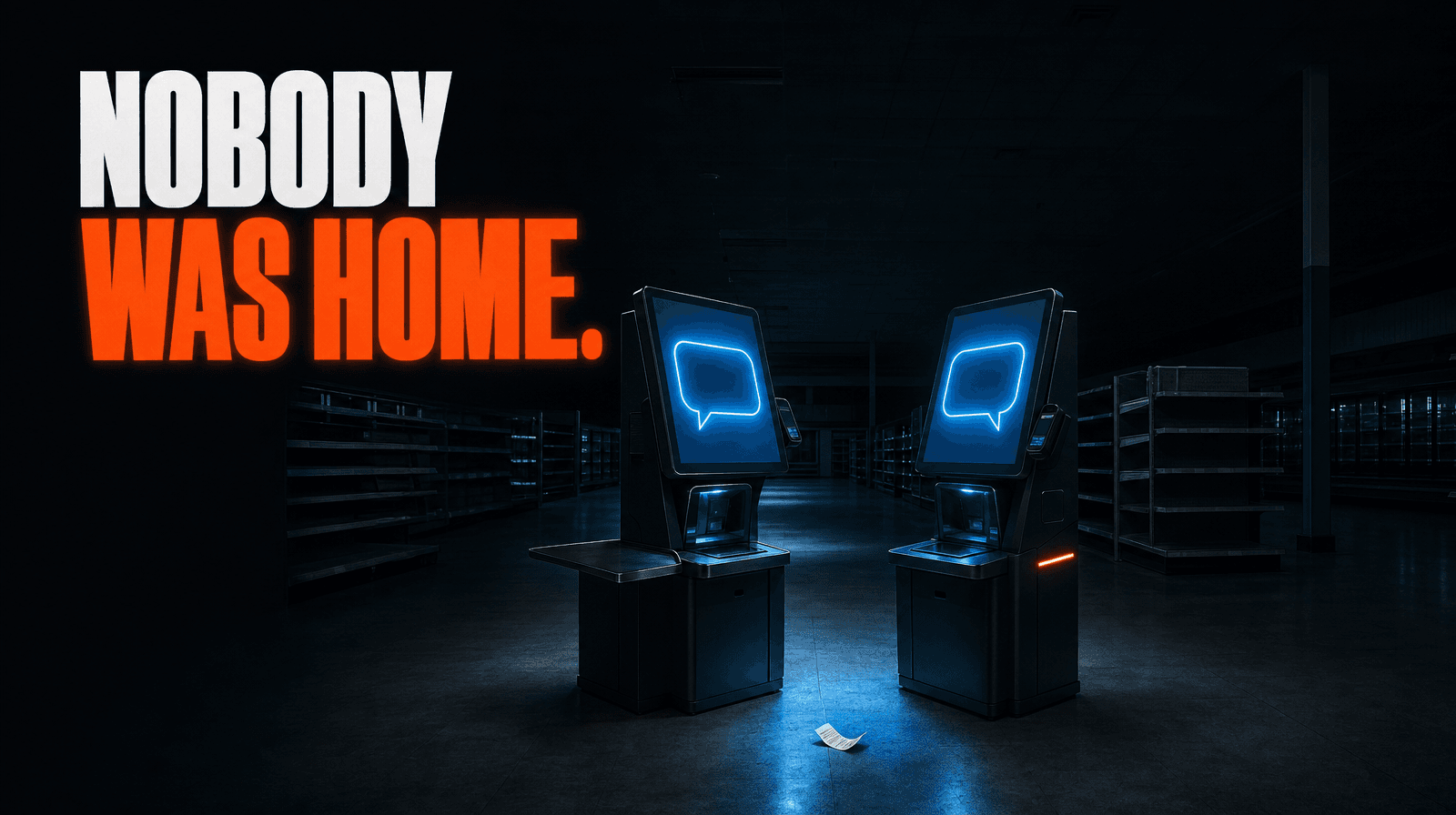
It's two self-checkout machines thanking each other for shopping local.
If that list made you a little quiet, welcome to the club. I've shipped several of these under deadline, and I wrote a whole issue about the time I let my own drafts go out "good enough" and hollow: AI Content Has No Soul Unless You Put It There.
Nobody's clean.
But this gets expensive when your content is supposed to attract serious buyers.
People don't hire an expert because the expert can produce information. Information is basically free now.
They hire judgment.
They're reading to find out how you think, what you notice, what you've survived, what you find funny, where you draw the line, and whether they'd trust you to make a call when the answer isn't sitting inside a template. Generic content strips out the exact evidence a premium buyer came looking for.
AI Gives You the Middle
AI predicts plausible language. That's the trick, minus the mystique.
Give it a prompt and it hands back a statistically likely version of "good content" based on patterns it's already seen. Without strong context or a human pushing back, it drifts toward the center, and the center is the dead middle of what business content usually looks like.
That's f#$@ing boring.
The machine isn't secretly plotting to ruin LinkedIn. It's rewarding people for the average they implicitly asked for.
The sharper accusation belongs to whoever shipped that average and added nothing.
AI gave you the middle. You were supposed to supply the part that couldn't have come from anybody else.
Nobody Can Get Choked Out for You
I've trained in martial arts for most of my life.
25 years into that, I stepped onto a jiu-jitsu mat for the first time figuring I'd do all right. Five minutes later, white belts with six months of training were choking me and bending my arms in directions they didn't particularly want to go.
It was deeply educational.
Today I'm a purple belt, which means I've gotten much more sophisticated about getting smashed by people half my age. I genuinely love it.
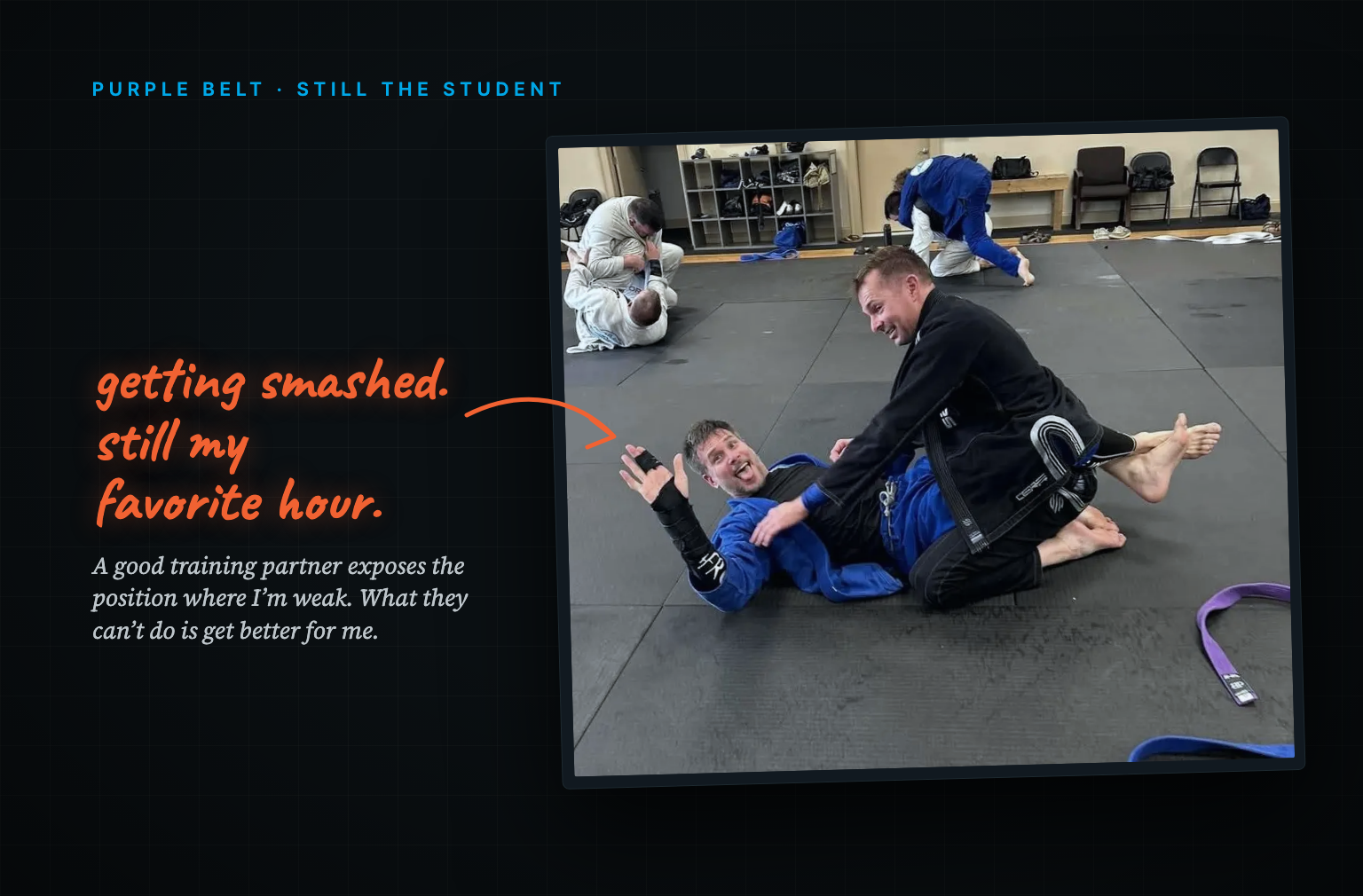
Jiu-jitsu makes it impossible to bullshit yourself about competence. Either the move works against resistance or somebody's sitting on your chest while you reconsider several life choices.
A good training partner exposes the position where I'm weak. They catch the arm I keep leaving out. They force me to adapt in real time. That resistance is most of why I get better.
What they can't do is get better FOR me.
Watching somebody else roll doesn't improve my jiu-jitsu. Having a black belt explain an armbar doesn't put the armbar into my body. I still have to get uncomfortable, get tapped, and do the reps.
AI works the same way. It's a phenomenal sparring partner. It'll reorganize a mess, challenge a weak argument, expose a missing assumption, show me an opening I didn't see, and tell me when a section is boring.
I want all of that.
But if I ask it to climb onto the mat and do every creative rep for me, the skill stays with the machine. Taste doesn't magically transfer into my head when the draft appears.
The Clicky Keyboard Is Load-Bearing
I still sit down and write with my own hands.
No machine finishing my sentences. Just me and my Keychron Q3 Pro with banana switches making that deeply satisfying clickety-clack while I try to figure out what I actually believe.
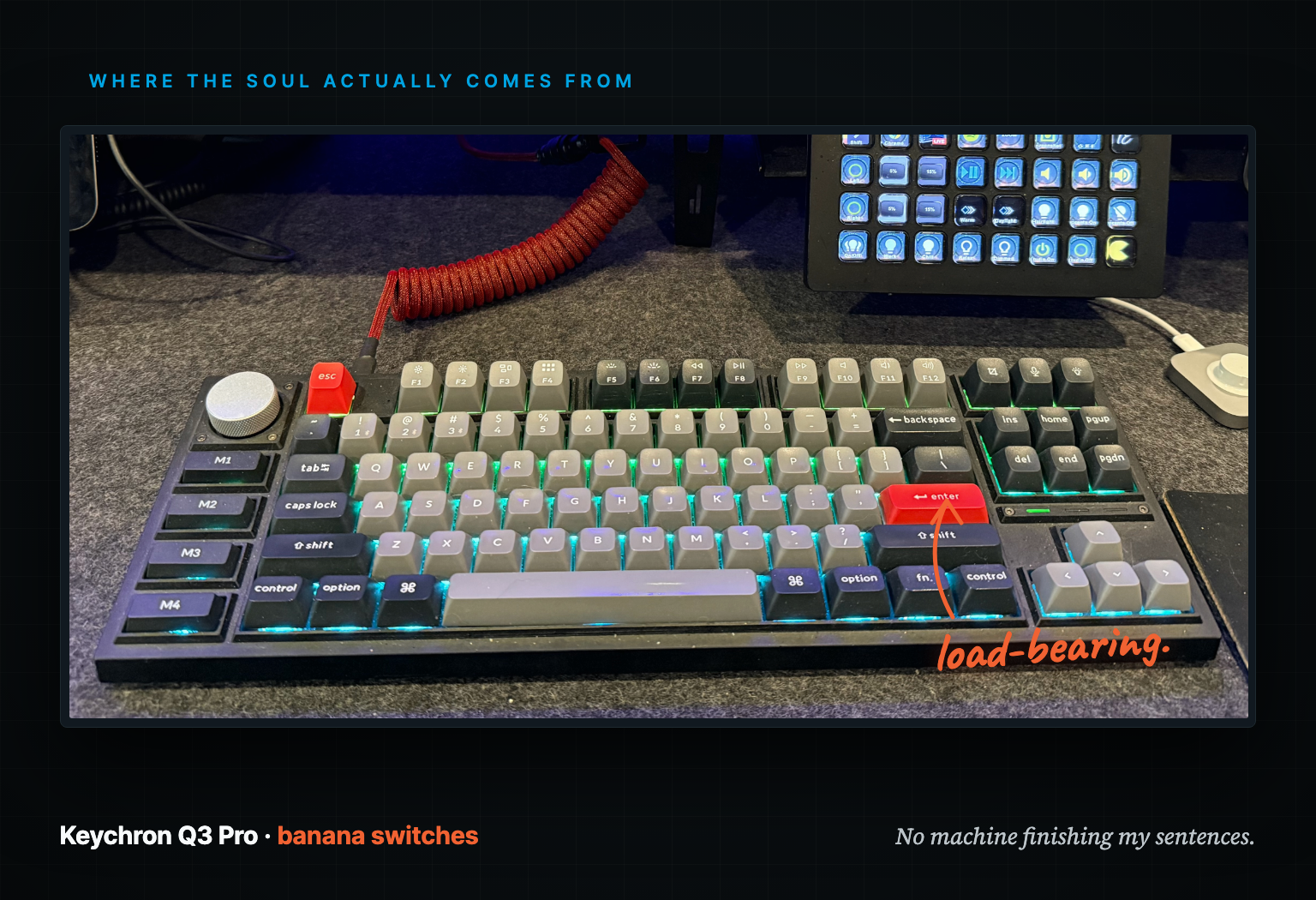
That physical act matters more than it sounds like it should. Writing requires thinking. The friction is what forces me to find where the logic is soft, where the phrasing belongs to somebody else, and where I'm hiding behind a vague sentence because I haven't finished the thought yet.
This issue is a perfect example. Jim briefed Murray, Murray came back with something competent, and it didn't become mine until I put my fingers on the switches and figured out which stories mattered. The LinkedIn rant got meaner. The mat showed up. The asshole AI from the book series showed up. Little glimpses of an actual life got in.
That's where the soul came from.
Quick aside, since it's related. I believe in making the places where I spend my life feel good. I spend a third of it in bed, so I bought a real mattress and pillows that don't feel like somebody stuffed a grocery bag with attic insulation.
I spend another frightening percentage in my office, so I spent even more there. Comfortable chair, dual monitors, clean desk, quiet room, and a keyboard I actually want to touch.
None of that makes me creative. It just makes showing up a hell of a lot more pleasant.
I Read Made-Up Stories On Purpose
I read fiction every day.
Not business books. Not another thread about the morning routine of a 23-year-old billionaire. Actual made-up stories with characters, tension, strange worlds, and language somebody sweated over.
It disconnects my business brain from the constant churn, which I need more than I like to admit.
It also exercises imagination. Character, scene, timing, dialogue, the sound of a sentence, the way a story holds tension before it lets go... all of that finds its way into newsletters, podcasts, videos, and how I tell a story on camera.
I'm not trying to turn reading into another productivity hack, because that's a wonderful way to ruin one of the few things I do purely because I enjoy it. The creative payoff is a bonus.
I just finished all 19 novels in the Expeditionary Force series, which might be my favorite science fiction ever. I'd recommend it even if you don't normally like science fiction. It features an asshole AI that made me spit coffee through my nose on an almost daily basis.
Teach the Machine What Wrong Looks Like
This is where AI earns its keep. I let it react, challenge me, tear apart the structure, find holes, and tell me where I'm boring.
Then I do the part most people skip.
Every time I make the same correction twice, I save it.
"Stop asking rhetorical questions nobody asked."
"Never use a hypothetical scene when I have a real story available."
"One contrast pattern is emphasis. Six is a machine tic."
Those go into my business brain so the next draft starts closer to my taste and farther from the machine's default middle. The compounding asset isn't the draft. It's the record of what I've taught the system about my judgment.
I laid out the larger structure in Your AI Agent Is Only As Smart As The Brain You Give It, and the voice workflow in How To Make AI Write Exactly Like You.
Here's the part to steal from this issue.
Positive adjectives are almost useless. "Be bold. Be authentic. Be conversational."
Cool. Those words mean something different to everybody, and the machine has no idea what they mean coming from you.
Your corrections are worth more, because they show the AI where your boundaries actually are.
So react to a draft first. Mark every place that feels fake, generic, too neat, too polite, or just unlike you. Then run this:
You are helping me build an anti-patterns section for my brand and voice guide.

I will give you four things:

1. Several pieces of my best published writing. These show what sounds like me.
2. A current AI-assisted draft.
3. My line edits and blunt reactions to that draft.
4. Phrases and structures I already know I never want used.

Do this in order:

1. Read my published samples first. Identify the voice traits they genuinely share.
2. Compare the AI-assisted draft with my edits. Find repeated patterns that make it
   sound generic, formulaic, or unlike my published work.
3. Separate one-time fixes from reusable rules. Keep only the reusable rules.
4. Write each reusable rule in this format:
   Avoid: the unwanted pattern
   Prefer: what to do instead
   Reason: why this matters in one sentence
   Example: a short before-and-after using my actual draft
5. Preserve useful flexibility. If a pattern works occasionally, set a practical
   limit rather than banning it.
6. Flag any proposed rule that conflicts with my published samples. Name the sample
   and show the conflict.
7. Do not invent preferences I have not demonstrated.
8. Finish with a clean "Anti-Patterns" section I can paste into my brand guide.
One honest editing session now improves every draft that follows. My own lessons file has turned into one of the most valuable things in my content system, mostly because a correction shouldn't have to happen seventeen times.
The prompt can't create taste for you. It just captures the taste you demonstrated while doing the work.
Get Back on the Mat
AI will hold the pads, push back, show you the opening, and make you faster. Use it.
What it can't do is sit down and figure out what you believe. It can't read a novel and let the characters knock something loose in your head. It can't get choked out on Tuesday and come back Thursday with one less bad habit.
Those reps are yours.
Write one page without a machine finishing the sentences. Read something made purely for pleasure. Then bring the idea back to AI and spar with it.
You still have to get on the mat.
Give Your AI Something Worth Learning
If you already run a serious business, your Brand DNA exists.
It's just scattered across sales calls, old emails, customer stories, hard-earned opinions, half-forgotten failures, the language your best clients use, and about four hundred decisions sitting in your head.
AI can't use what you've never extracted.
The Magnetic Brand System helps you turn that buried knowledge into the voice, positioning, audience, stories, proof, offer context, and anti-pattern rules your AI can actually use. Build it once, improve it every time you create, and take it with you no matter which model wins next month.
Until next time,
—Tim Erway

P.S. Quick Video OS update. It's in beta right now with some of my clients and a small group from a mastermind I belong to. I plan to release it next month once I add a few more capabilities and smooth out the rough edges. No pitch today. Just keeping you hooligans in the loop.
P.P.S. Run that anti-pattern prompt after your next honest editing pass. Your AI keeps making the same mistakes because nobody has ever shown it what "wrong" looks like coming from you.