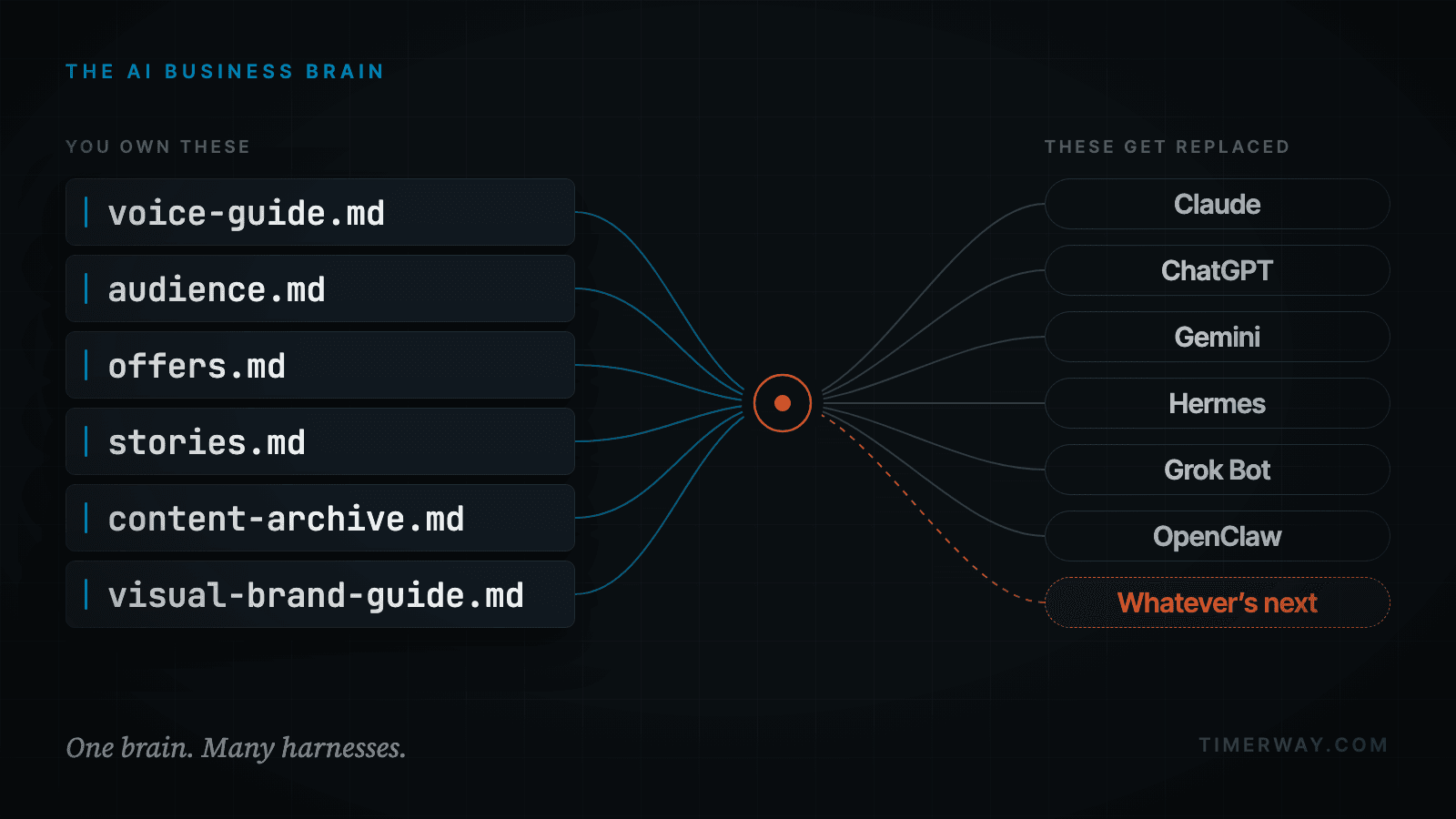
The six files at a glance
- voice-guide.mdWhat sounds like you, and what never would.
- audience.mdWho the agent is talking to.
- offers.mdWhat the business sells, and where the content should point.
- stories.mdThe proof and specificity that generic content can never fake.
- content-archive.mdWhat good looks like for your brand, in your own published work.
- visual-brand-guide.mdWhat people recognise before they read a single word.
1. voice-guide.md
What sounds like you, and what never would.
What goes in it
- How you write, and how you talk when you are not writing
- Sentence rhythm and paragraph length
- Words you use constantly
- Words you would never use
- Three to five samples of your strongest published writing, in full
- Two or three drafts you rejected, with one line on why
- Your editing rules, written as rules
Starter template
# Voice Guide

## How I sound
Three sentences describing what a reader hears.

## Rhythm
Typical sentence length. Paragraph length. Where I break my own rules and why.

## Words I use
List them. Ten is plenty to start.

## Words I never use
List them. Be specific. "Delve", "unlock", "in today's fast-paced world".

## Strongest writing
Paste three published pieces in full. Not excerpts.

## Rejected writing
Paste two drafts I killed. One line each on what was wrong.

## Editing rules
1.
2.
3. 2. audience.md
Who the agent is talking to.
What goes in it
- Who they are, in one paragraph a stranger could act on
- What they want
- What they are afraid of
- What they are tired of hearing
- What they secretly believe
- What they need to hear and will resist
- What separates a buyer from a browser
Starter template
# Audience

## Who they are
One paragraph. Role, stage, situation.

## What they want
The outcome in their words, not mine.

## What they are afraid of
The thing they will not say out loud.

## What they are tired of hearing
Every claim that has stopped working on them.

## What they secretly believe
Including the beliefs that are wrong.

## What they will resist
The true thing they do not want to hear yet.

## Buyer vs browser
What is actually different about the ones who pay.3. offers.md
What the business sells, and where the content should point.
What goes in it
- Current offers, with price
- Who each offer is for
- Who each offer is not for
- The core promise of each
- The mechanism, meaning why it works
- The objections, written honestly
- CTA rules, meaning which content points where
Starter template
# Offers

## Offer 1: [name]
- Price:
- For:
- Not for:
- Core promise:
- Mechanism (why it works):
- Top three objections:
- Where content should point people:

## Offer 2: [name]
Same shape.

## CTA rules
Which topics point at which offer. What never gets a pitch.4. stories.md
The proof and specificity that generic content can never fake.
What goes in it
- Origin stories
- Failures, including the expensive ones
- Wins, with real numbers
- Customer examples, with permission noted
- Weird details that only happened to you
- The lessons you keep repeating
Starter template
# Stories

## Origin
How this actually started. The unflattering version.

## Failures
One heading per failure. What it cost. What it taught.

## Wins
Real numbers. Dates. What made the difference.

## Customer stories
Name (or initials), situation, what changed, permission status.

## Weird details
Small specifics nobody else can claim.

## Lessons I repeat
The five things I say over and over.5. content-archive.md
What good looks like for your brand, in your own published work.
What goes in it
- Past newsletters, final published versions
- Best social posts
- Headlines that worked
- Openings that worked
- Final versions only, never first drafts
Starter template
# Content Archive

## Newsletters
Paste or link the published version. Newest first.

## Best social posts
The ones that actually landed. Note why.

## Headlines that worked
A running list.

## Openings that worked
First two paragraphs only. This is the highest-value section.

Rule: published versions only. A first draft in here teaches the wrong thing.6. visual-brand-guide.md
What people recognise before they read a single word.
What goes in it
- Brand colors, with hex values
- Fonts, with weights
- Logo rules
- Graphic style
- Screenshot standards
- Image prompt rules
- Examples of good visuals and bad ones
- Your never-make-it-look-like list
Starter template
# Visual Brand Guide

## Colors
Name, hex, and what each one is for.

## Fonts
Family, weights, what each is used for.

## Logo rules
Clear space, minimum size, what is never done to it.

## Graphic style
Flat or dimensional. Photographic or illustrated. Dense or sparse.

## Screenshot standards
Window chrome, background, crop, annotation style.

## Image prompt rules
The exact phrases every image prompt must include, and must exclude.

## Never make it look like
The list that stops every tool defaulting to purple-and-teal gradient slop.
Where the files live
Plain text. Folders. Outside whatever tool you are using this month. Obsidian, Notion, Google Docs, or a folder on your desktop called brain with six text files in it. What matters is that the brain is not loyal to the tool. The tool works for the brain.
Six files is the start. Here is where it grows to.
/business-brain
  /brand
    voice-guide.md
    visual-brand-guide.md
    forbidden-language.md
    positioning.md

  /audience
    ideal-customer.md
    beliefs-and-objections.md
    pain-points.md
    language-bank.md

  /offers
    offer-map.md
    current-offers.md
    proof-and-results.md
    funnels.md

  /stories
    origin-stories.md
    failure-stories.md
    customer-stories.md
    personal-proof.md

  /content
    newsletter-archive.md
    best-posts.md
    content-principles.md
    repurposing-rules.md

  /workflows
    newsletter-workflow.md
    social-workflow.md
    video-workflow.md
    research-workflow.md
Start ugly
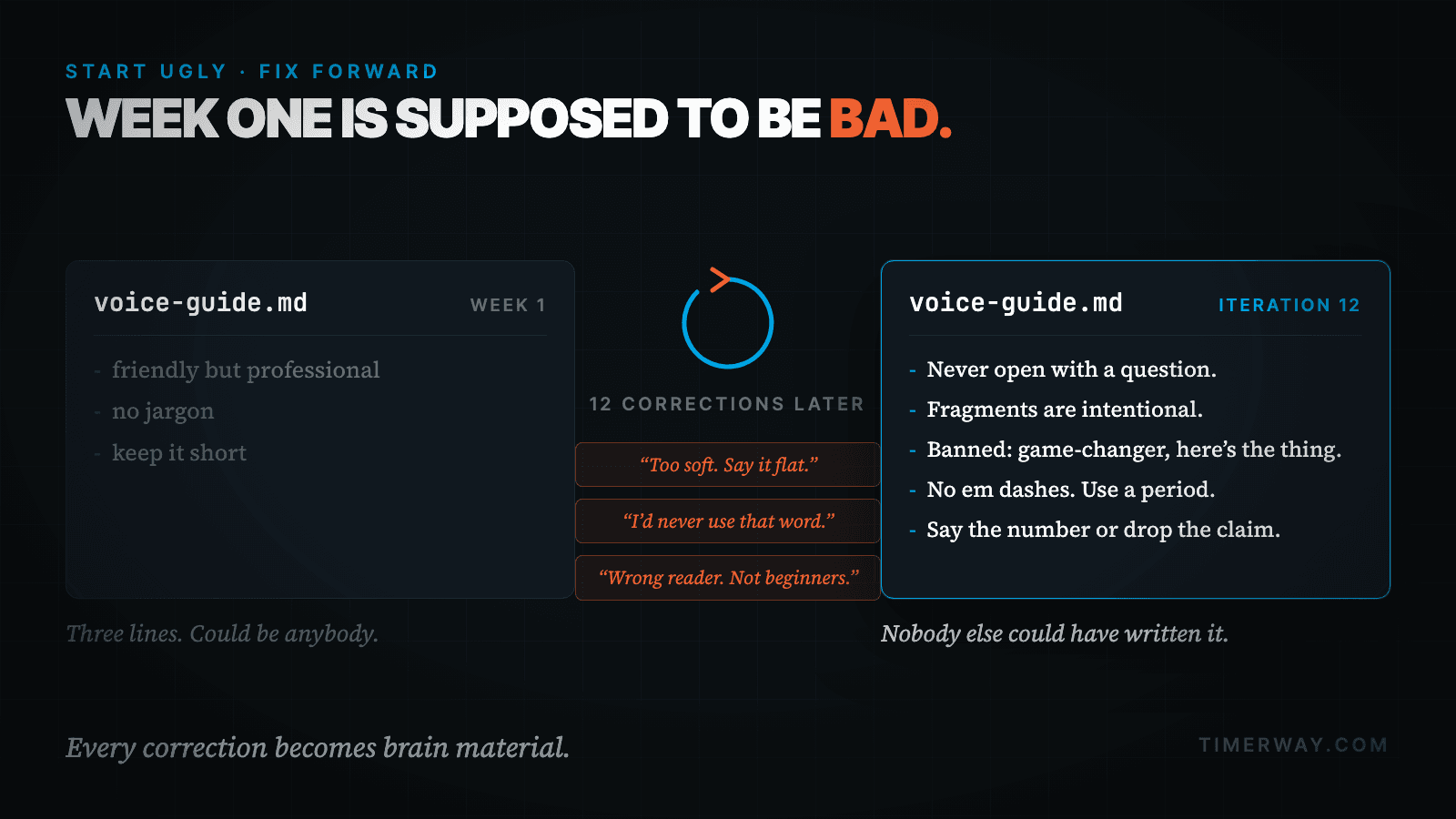
Do not spend three weeks building the perfect vault. Your voice guide will be two paragraphs in week one. Your audience file will have gaps. That is fine. Every time the AI produces something that sounds off, that correction is brain material.
The brain does not need to be perfect on day one. It needs to exist on day one.
Common questions
- What files should I give an AI agent about my business?
- Six business context files: voice-guide.md, audience.md, offers.md, stories.md, content-archive.md and visual-brand-guide.md. A mature business brain grows to about twenty-four files across six folders, but six is the point at which an agent stops guessing.
- What is a context file for an AI agent?
- A plain-text document that tells an AI agent what it cannot work out on its own: how you write, who you serve, what you sell, and the stories only you have. The agent reads it at the start of a task, so you stop re-explaining your business in every chat.
- Where should the files live?
- In plain text, in folders, outside whatever tool you are using this month. Obsidian, Notion, Google Docs, or a folder on your desktop called brain with six text files in it. What matters is that the brain is not loyal to the tool. The tool works for the brain.
- What is the first job I should give an AI agent?
- The job you already do every week and dislike. It is repeatable, you can judge the output instantly because you have done it a hundred times, and every correction you make becomes brain material. Do not start with the job you have never done. You will not be able to tell whether the output is any good.
- Do I need this if I run a small business with no team?
- Small businesses and solo operators are the case it was built for. A team carries context in people's heads, so a shared brain is a nice-to-have. Alone, the context lives in one head and dies at the end of every chat session. The six files are how a one-person business stops starting from zero every morning.
- What if my files are bad at first?
- They will be, and it does not matter. Your voice guide will be two paragraphs in week one. Every time the AI produces something that sounds off, that correction is brain material. Start ugly and fix forward. Someone with six messy files and a feedback loop is on their tenth iteration while the perfectionist is still planning.
- Do I have to rebuild these when I switch AI tools?
- No, and that is the entire point. The files are plain markdown. Any capable model can read them. When the tool you use today is replaced, and it will be, you point the new one at the same six files and keep going.
Read next
- Your AI Agent Is Only As Smart As The Brain You Give ItThe original letter this guide came from, including why the tool is rented land.
- How To Make AI Write Exactly Like YouThe step-by-step process for building voice-guide.md, the most important of the six.
- Stop Asking AI Questions. Start Giving It A Job.What changes once the brain exists and the agent has real context to work from.
- 9 Jobs To Hand Your New AI AgentNine specific first jobs, with the exact words to start each one.
- Here's Exactly How To Start Building Your AI TeamThe move after the six files, going from one agent to a team that shares the brain.
- 13 Weeks With My AI Team. Here's What I'd Do Differently.What broke over three months of running this for real, and what was worth the time.
- How To Create Graphics With AI That Actually Grow Your AudienceThe visual half of the brand, and what visual-brand-guide.md is protecting you from.