
A Small Newsletter List Can Support a Six-Figure Business
Start with the offer, attract the right readers, and use one weekly letter to find the people who want your help.

A couple weeks ago, there was an unexpected death in the family. I dropped everything and headed to California. Next week, I’m going back for the memorial service.
I’m used to business setbacks. This is different. I’m still trying to get my head around it.
Last weekend, my two daughters, son-in-law, and grandbaby came to visit. I’m new to this whole grandpa thing, but damn... it’s a blessing.
Then, on the last day of their visit, I came down with what my wife calls a “man cold.”
Completely debilitating, obviously.
Though I did manage to power through five novels. Being sick has its privileges.
Between the trip, the visit, and lying around feeling sorry for myself, I’ve been thinking a lot about what I want my business to make possible.
Being able to leave when my family needs me. Being present when they come to visit. Having room in my life for something besides the next thing on my to-do list.
That’s the shit that matters.
Several people have asked me how to build a newsletter and content system like mine. I want to answer that, but before we get into AI agents or publishing tools, there’s a business decision that matters more.
What are you going to sell, who needs it, and how many customers do you actually need?
Get clear on that, and a newsletter with fewer than a thousand subscribers can make a lot more sense than spending your life trying to grow a giant audience.
I’ll show you the economics, the simple content system I use, and how to find the people on your list who want help with a particular problem. Including how I’m doing it in this letter.
I’m behind on my goals. The business is still moving.
I started this build-in-public experiment with a goal of reaching a million in revenue between two businesses, without rebuilding the kind of operation I’d worked so hard to get out of.
In my TimErway.com business, it’s me and my agents.
And I’ve fallen short of my goals.
Back in March, my account got hacked, and I lost access to my Facebook Page and Instagram account. I eventually got the Page back, but the restrictions on the business side are still keeping me from running ads.
Last week, I mailed another actual letter to Meta’s legal department. Printed. Signed. Exhibits and everything.
At one point, after documenting the mistake in their own case notes, support closed the ticket and invited me to take a free digital marketing course.
Dude. I don’t need a course. I need access to my fucking account.
Anyway... I’m not making you sit through the entire Meta saga again.
The point is that the growth plan I intended to run hasn’t been available to me. New leads have slowed to a trickle.
We’ve still managed to grow revenue across the businesses I’m actively working on. But I’ve had to pay more attention to the people we’re already reaching, the problems they need solved, and what we offer them.
I’d prefer to have the traffic and the better offers. Obviously.
But this has reinforced something I’ve learned repeatedly over the years:
Your offer determines how much audience you need.
Work backward from the sales you need
My TimErway.com list is still under a thousand subscribers.
That’s what I mean by a micro-list in this letter. A small group of relevant people, not a magic subscriber count where money suddenly starts appearing.
It can also be a segment of a much bigger list. You might have thousands of subscribers and only a small group interested in the specific problem your next offer solves.
That group is worth knowing.
For a simple example, suppose you sell a service for $5,000 and want it to generate $100,000 over a year.
You need 20 sales.
That’s an example, not a forecast. And it’s gross revenue, before delivery costs, software, refunds, taxes, and paying yourself.
But it gives you a useful starting point.
You can work out who would get enough value to justify that purchase, how you’ll earn their trust, and whether you can deliver the work profitably without filling every hour of your calendar.
Compare that with selling only a $27 product. You’d need 3,704 sales to get past $100,000 in gross revenue.
That’s a helluva lot more customers to find and support.
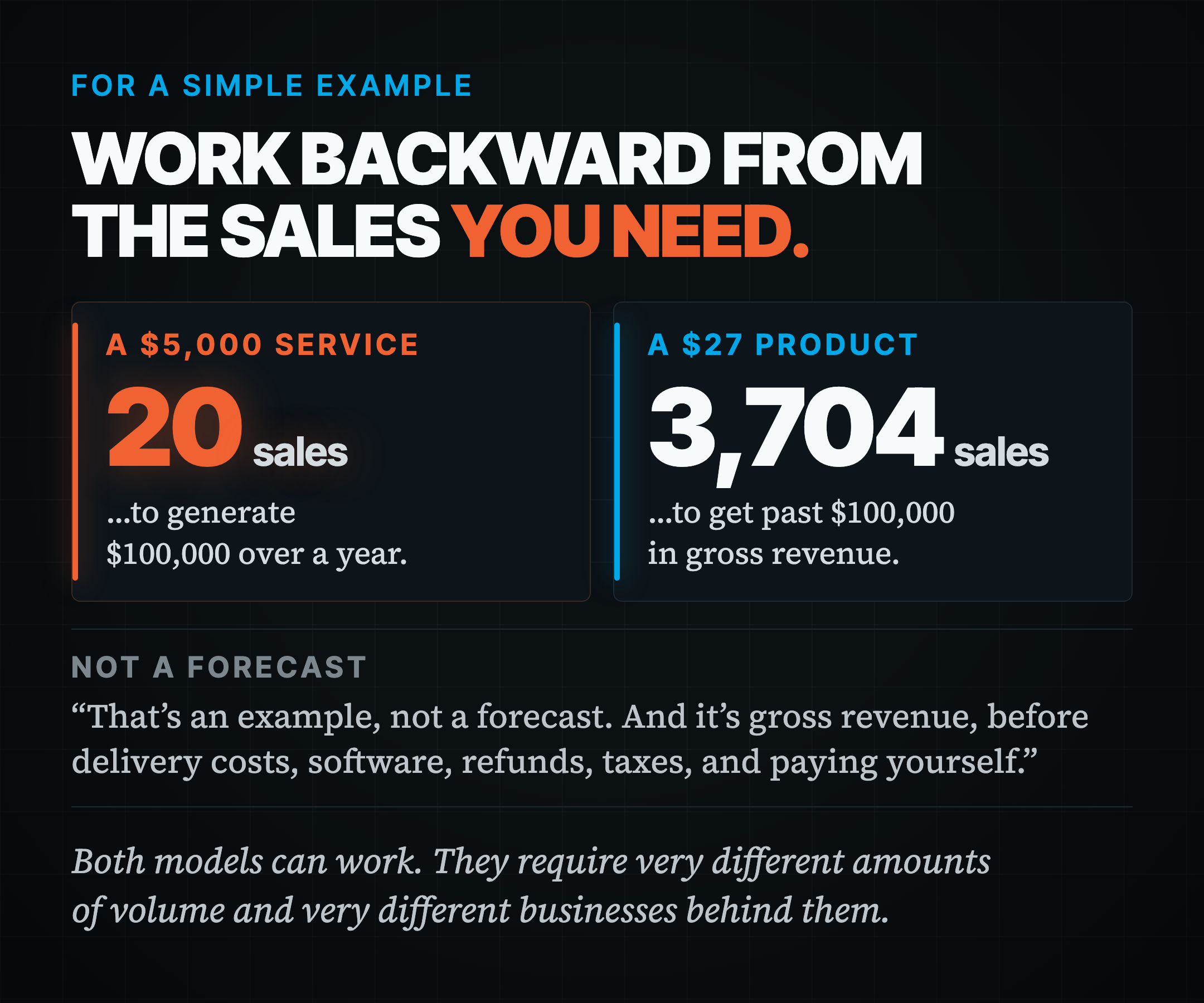
Both models can work. They require very different amounts of volume and very different businesses behind them.
And no, you can’t just slap a $5,000 price tag on something nobody wants and announce that you’ve fixed your business model.
The problem has to matter. The buyer has to be able and willing to pay. And you’ve gotta be able to deliver.
A small list of the wrong people won’t fix any of that. Neither will a big one.
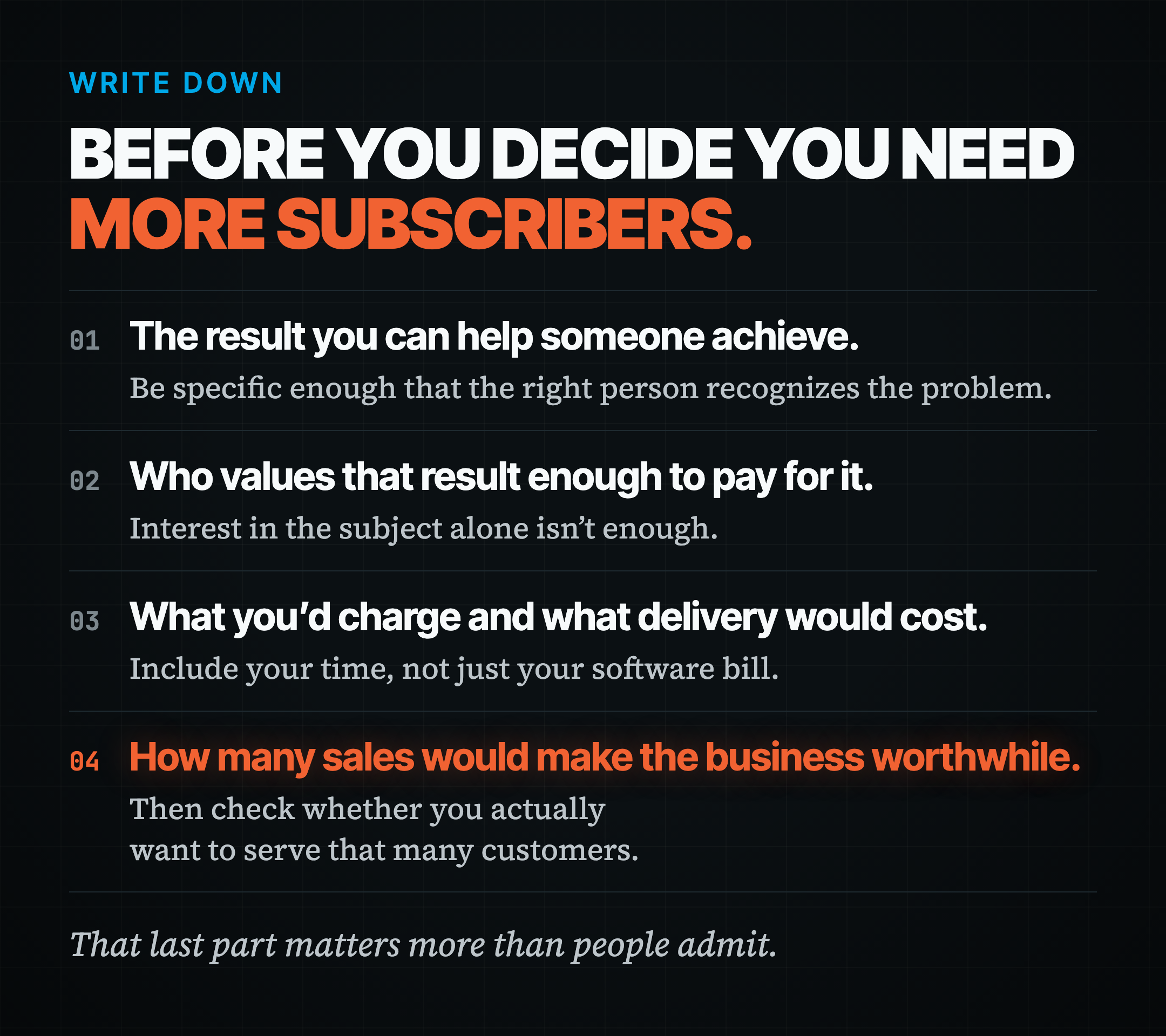
Before you decide you need more subscribers, write down:
The result you can help someone achieve. Be specific enough that the right person recognizes the problem.
Who values that result enough to pay for it. Interest in the subject alone isn’t enough.
What you’d charge and what delivery would cost. Include your time, not just your software bill.
How many sales would make the business worthwhile. Then check whether you actually want to serve that many customers.
That last part matters more than people admit.
I’ve generated over $100 million in sales across my career. I’ve also built businesses I didn’t enjoy running.
I’m not interested in designing another one of those.
A cheap product is one way in. It isn’t a requirement.
I know the low-ticket funnel model well.
Sell an inexpensive product, acquire customers at volume, and offer some of those customers higher-value help afterward.
A company I stepped away from operating uses that model successfully at multiple seven figures a year. It also has a big team, substantial ad spend, and a lot of overhead.
There’s nothing inherently wrong with it. It’s just not the business I want to build again for myself.
I still sell low-ticket products in my personal brand. They help people solve a specific problem, experience the value of my work, and decide whether they want more help.
But somebody who buys a cheap writing product isn’t automatically a prospect for a custom agent implementation. Those can be different people with different needs.
Some busy operators don’t want to learn every step. They want a useful plan and someone who can help them get it built.
Making that person buy a little course first doesn’t necessarily help either of you. They want the thing done.
That’s why my Agentic Build Plan is available directly. It’s $500 for a completed plan that’s prepared before our review call. You keep it whether or not you want help with implementation afterward.
The paid step delivers something useful on its own. It also means the conversation starts with an actual business problem and a plan, rather than me spending the call trying to convince somebody to hire me.
You can design your own version of that around what you do well. It doesn’t have to involve AI.
The decision is whether your customer wants to learn, wants guidance, or wants the work done. Build the path around that.
Give the right people a reason to keep reading
Once you know what you want to help people do, the newsletter has a job.
It lets them see how you think, learn something useful, and decide whether they trust you with a bigger problem.
I covered the production side in How To Build a Newsletter That Pre-Sells Your Offers. In that issue, I shared the early result: 418 subscribers and $28,697 in revenue over six weeks.
That was a particular result from that period, not what every small list produces. But it’s why I’m more interested in the people joining than in making the subscriber counter look impressive.
For this letter, I want to make the next part practical.
Suppose your paid work helps business owners build a newsletter and content system. You could write about:
Choosing what to write about when you sell more than one thing.
Getting an AI draft to sound like you without spending all afternoon editing it.
Turning one useful letter into social posts people actually want to read.
Figuring out which subscribers are interested in your next offer.
Each subject helps with something your prospective customer already cares about. And each naturally connects to the larger system you can help them build.
That’s more useful than posting whatever AI news happens to be getting attention that morning and hoping the right buyers turn up.
Pick one real question and answer it well.
You don’t have to teach your entire business in every issue. You also don’t have to hide all the useful information so people will pay you.
Some readers will use what you teach and do it themselves. Others will understand the work better and decide they want your help.
Both are fine.
One letter gives the rest of the content somewhere to lead
My weekly process starts with a conversation.
I dump the idea, the story, the examples, and whatever I’m annoyed about into a conversation with my agent. We work out the structure, create a draft, and edit it until I’m happy putting my name on it.
You’re reading the result of that process right now.
The letter then gives us material for social posts. Different angles, written for the platform, rather than the same paragraph pasted everywhere.
Those posts help new people find the letter. Some subscribe. The next issue gives them another useful reason to pay attention.
Then, when there’s a relevant next step, I offer it.
The loop is straightforward:
A useful letter → relevant social posts → new readers and subscribers → more useful letters → a relevant offer.
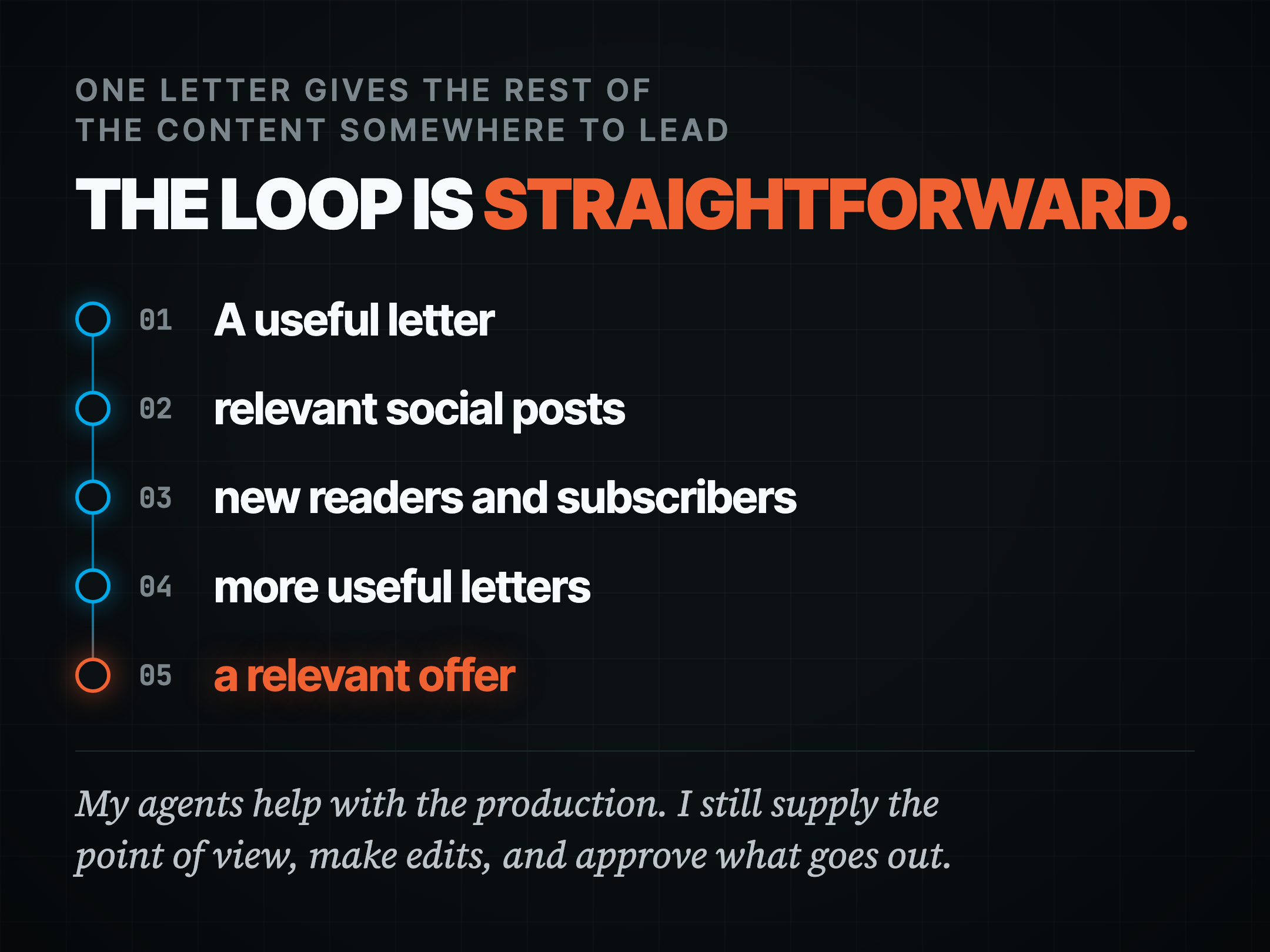
My agents help with the production. I still supply the point of view, make edits, and approve what goes out.
You don’t need to be everywhere. Start with a place where the people you want to help already spend time, and where you can show up consistently.
And you still need new people discovering you. A small-list strategy isn’t an excuse to stop growing or keep pitching the same exhausted group forever.
It means you can focus on attracting people who fit the offer instead of chasing volume your business may not need.
Let readers tell you what they’re interested in
This is the part you can use even if you already have a large list.
Don’t assume everybody wants everything you sell.
Write about a specific problem. Teach something useful. Then give the people who want more help an easy way to tell you.
If you’re considering a workshop, you can say so before you’ve built it. Be clear that you’re asking about interest, not selling a finished event.
When somebody intentionally signs up for those details, tag that interest in your email system or CRM. You don’t need another newsletter or an entirely separate business. You need to know who asked to hear about this particular thing.
Then, when you have an actual offer, you can tell that group what it includes, what it costs, and who it’s for.
A raised hand isn’t a sale. Plenty of interested people won’t buy. But it’s a better starting point than assuming every subscriber wants the same pitch.
That’s exactly what I’m doing here.
People have asked how to create a newsletter and content system like mine. This letter explains the business strategy behind it. The next step is finding out who wants help putting it together.
The letter itself is part of the process I’m teaching.
No mystery funnel hiding behind the curtain. I’m telling you what I’m doing.
Want help building your version?
I’m considering a practical workshop where I help you build your newsletter and content system around what you sell.
The idea is to connect the pieces: who you’re writing for, what the letter leads to, how to create it in your voice, how to turn it into social content, and how to identify the readers who want your help.
I haven’t finalized the format, date, or price yet. I’m gauging interest before I do.
If that sounds useful, you can ask me to send you the details when they’re ready.
Send me details about the newsletter and content workshop. No commitment to buy.
That’s it. You’re not reserving a seat or agreeing to some mystery price. You’re letting me know this is something you’d like to hear about.
And if you don’t need the workshop, you can still use the process: pick a valuable problem, write something useful about it, and find out who wants help solving it.
I’m still working toward my own goals. I’d like to get there without missing the things that made me want more freedom in the first place.
Here’s to a business that leaves room for the rest of your life,

—Tim Erway

P.S. If you already know you want my help directly, the Agentic Build Plan is available now for $500. Your complete plan is prepared before our review call, and you keep it either way. If you want us to help build it afterward, we can discuss the scope and options; the $500 is credited toward the build. No need to wait for a workshop announcement.