AI Scares Me Too. Here’s How I’d Prepare Your Business Anyway.
A mountain-town debate, the work I’d look at first, and a practical way to start adapting without betting your business on a chatbot.
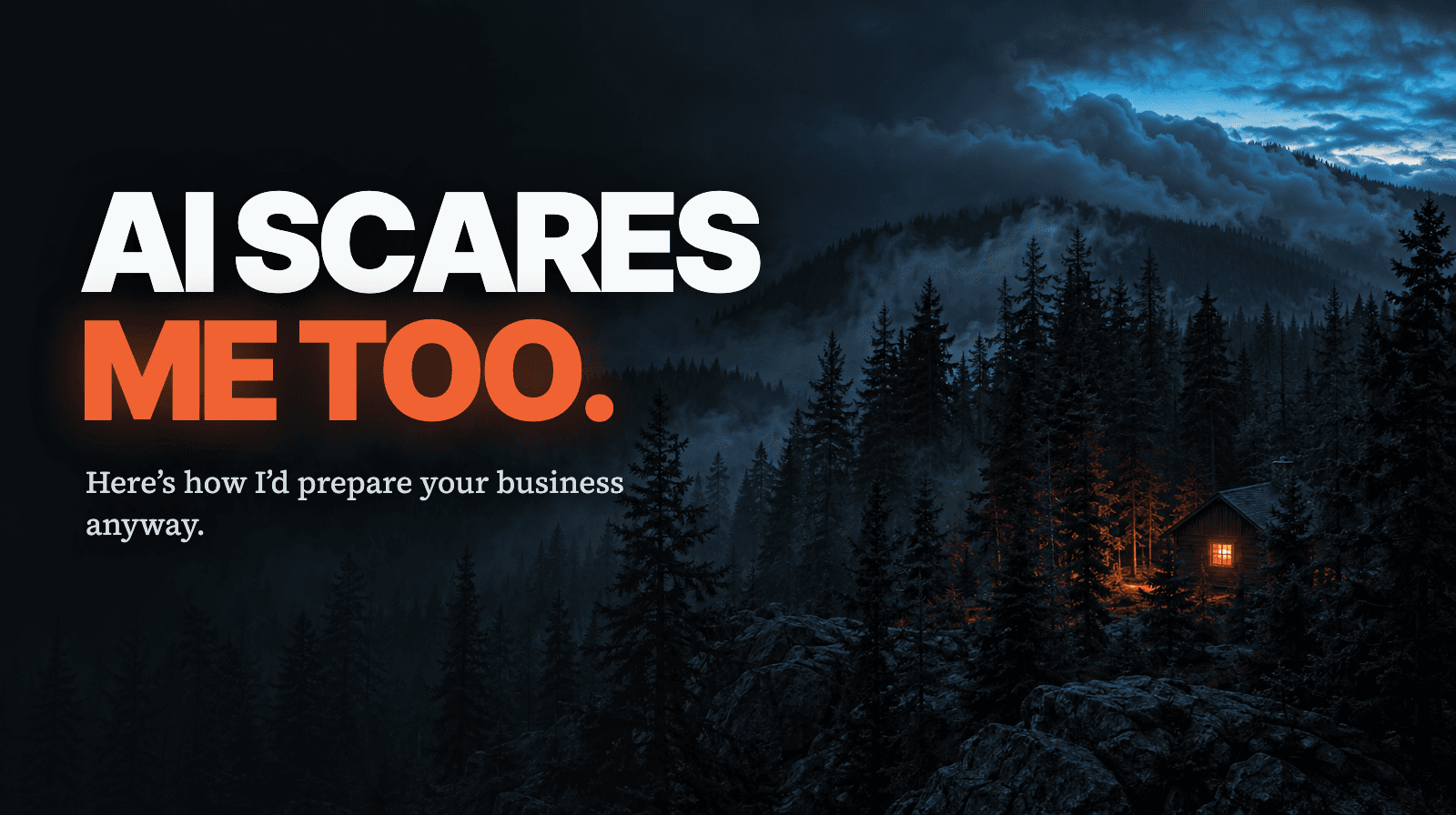
I’m in Twain Harte, California, a beautiful little mountain town where I lived just before joining the Coast Guard.
This is my first real visit back since then. The smell of the evergreens brings back memories, and the place feels sort of frozen in time. That’s one of the things I love about small mountain towns. So much of the world is changing, and then you come back to a place like this and get to enjoy the parts that haven’t.
We’re staying at a B&B, which means you get to meet people.
That’s also one of the problems with staying at a B&B.
I ended up sitting next to a guy with some pretty unique ideas about the world. We disagreed on just about everything we discussed. I enjoy a good debate, so I was having fun.
My wife was considerably less amused after the first hour.
Eventually, we got onto AI. He thinks it’s taking us toward a police state, where everything we do is monitored and controlled. He also brought up the headlines about AI killing us all.
And this is where our otherwise impressive streak of disagreeing started to break down.
Because I share some of those concerns.
I spend a lot of time showing you how to use AI to grow your business and get your time back. That doesn’t mean I’m comfortable with everything happening around it.
But I also don’t think ignoring it puts us in a better position.
So today, I want to bring this down to something you can actually do something about: the work in your business that’s likely to change, the opportunities that opens up for smaller teams, and a simple way to start preparing this week.
You don’t have to be thrilled about where all of this is going to make an intelligent decision about what you do next.
Yes, the headline is real
On September 9, the BBC reported that Evan Hubinger, an AI safety researcher at Anthropic, believes there’s a greater than 10% chance AI could kill all humans within the next decade.
Anthropic is the company behind Claude. This is someone working on the technology, not your uncle posting from the emergency bunker he built behind the garage.
His exact wording was, “I personally think it is >10% within the next decade.”
That’s a personal estimate. It is not an established probability, and it doesn’t mean scientists ran the numbers and agreed we have a one-in-ten chance of getting deleted.
He also described the risk from current models as low. His concern is where more powerful systems could go.
Those distinctions tend to get a little less attention than KILL ALL HUMANS.
The media knows what gets us to click. But I’m also not going to dismiss a warning just because the headline is sensational. If people building this stuff are worried about controlling it, that deserves scrutiny, testing, and more than a reassuring statement from the company selling it.
Same with surveillance. Giving governments or companies more ability to monitor people is a legitimate concern. Using AI to help write a proposal doesn’t mean I’ve signed up for a world where an algorithm decides whether I’m allowed to leave the house.
We can want limits on dangerous uses and still find useful ways to work with the technology.
I wrote about the bigger shift in It’s the End of the World as We Know It. I still don’t have a tidy prediction for how this plays out.
What I do have is a business to run, people I care about, and a strong preference for understanding something that could change both.
Your job doesn’t have to disappear for your work to change
A lot of the labor-market conversation gets reduced to a list of jobs AI will supposedly eliminate.
Writers. Programmers. Designers. Analysts. Apparently everybody except the guy making the list.
I’d look at the actual work before getting too attached to predictions about entire professions.
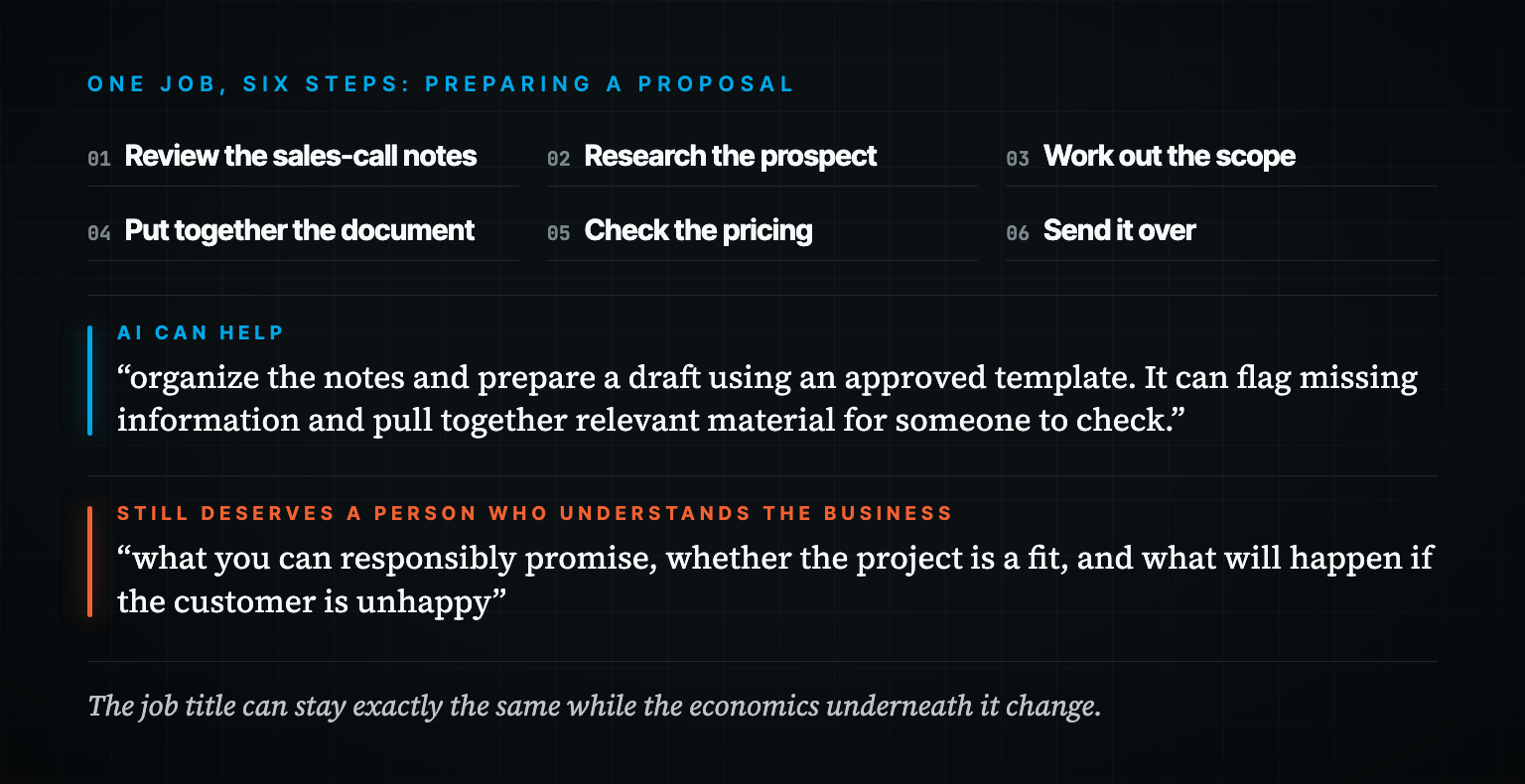
Take somebody who prepares proposals for a service business. They review the sales-call notes, research the prospect, work out the scope, put together the document, check the pricing, and send it over.
Those steps don’t all require the same judgment.
AI can help organize the notes and prepare a draft using an approved template. It can flag missing information and pull together relevant material for someone to check.
Deciding what you can responsibly promise, whether the project is a fit, and what will happen if the customer is unhappy still deserves a person who understands the business.
Now imagine that the routine preparation takes substantially less time. You might get proposals out sooner, handle more opportunities with the same team, or need fewer additional hires as you grow.
The job title can stay exactly the same while the economics underneath it change.
That’s why knowledge workers need to pay attention. If much of your week involves turning information into another document, report, design, or piece of software, it’s worth finding out which parts AI can already help with.
You want firsthand knowledge of where it works, where it falls apart, and what your expertise contributes. Some tasks will still need you doing most of the work.
And I’m not going to give you that smug line about how only people who refuse to adapt will get hurt. Good people can do everything they’re told and still lose a job. Transitions like this can be brutal, and “learn to prompt” is a pretty shitty response to someone who just lost their income.
But if you have room to start learning before a change is forced on you, I’d use it.
If I were doing that proposal job, I’d want to become the person who knows how to get a better proposal out faster, catch the mistakes, and improve the process. I’d rather build that experience now than wait for someone else to decide what my role should become.
A small team can attempt things it used to have to postpone
The same change that puts pressure on certain kinds of labor can make a new business possible.
Think about a founder with an idea for a small software product. Previously, getting something useful in front of a customer might have required enough money to hire developers before the founder even knew whether the idea was worth pursuing.
Now, depending on the product, AI-assisted development can help that founder put together a working prototype and test the core idea with a much smaller initial commitment.
That doesn’t mean every app is a weekend project. A demo and a dependable product are different things. If customers are trusting it with their money or private information, somebody competent needs to check security, reliability, and what happens when it breaks.
But you may be able to find out whether anyone wants the thing before assembling a team to build the whole thing.
That’s a meaningful change.
Or consider a small consulting business with useful expertise but no marketing department. The owner can talk through a customer problem, use AI to help develop the explanation, and turn it into a newsletter, a useful guide, and follow-up material.
The owner supplies the experience and checks the work. AI helps with the production that otherwise keeps getting pushed to next week.
That’s close to how this letter gets made. I bring the experience, the opinions, and the initial brain dump. I work through the copy with my agent, edit it, and decide what gets published. I’m not asking a machine to have a childhood in Twain Harte on my behalf.
A smaller company can also use these tools to prepare customer information, organize follow-up, and help people get answers without making every request wait on the owner.
None of that guarantees it will beat a larger competitor. Large companies have access to AI too, along with budgets, distribution, and customers you may not have.
But a small team can sometimes make a decision and try it while the bigger organization is still scheduling the meeting about who should attend the meeting.
You can shorten the time between an idea and finding out whether it’s useful. For an entrepreneur, that’s a hell of an advantage.
AI literacy needs to include the person doing the work
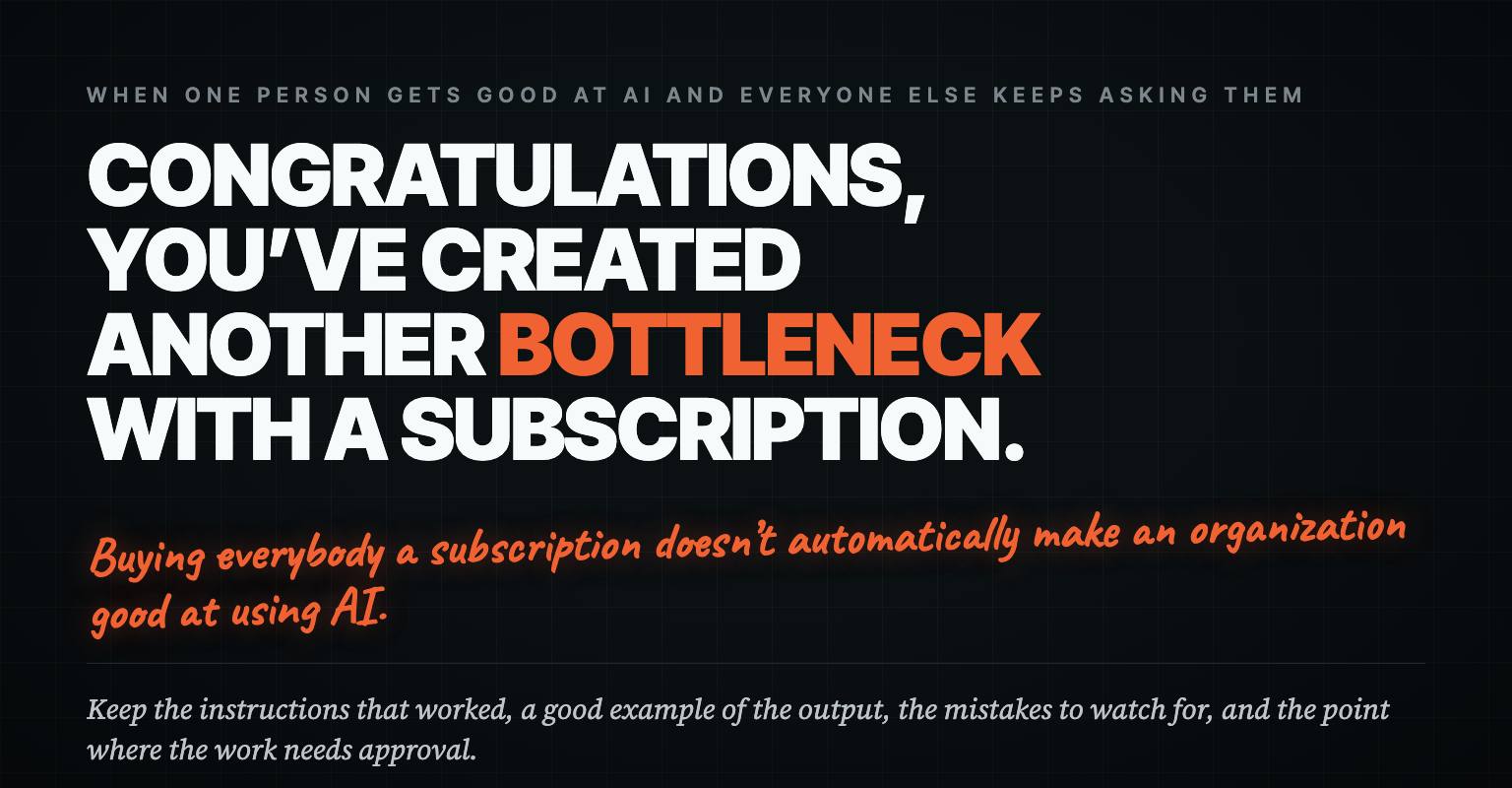
Buying everybody a subscription doesn’t automatically make an organization good at using AI.
People need to know what information they can share, what a good result looks like, how to check it, and which decisions still belong to a human.
That’s the kind of AI literacy I’d build inside a small business.
Start with someone who understands the work. If you’re improving customer support, involve the person who knows which questions are easy and which ones turn into a mess. If you’re improving proposals, involve the person who knows where the scope usually goes wrong.
Let them help design the experiment. Just dropping a tool into their lap and announcing that everyone is now supposed to be more productive is a great way to get an enthusiastic nod and absolutely no change.
Then make the learning available to the rest of the team. Keep the instructions that worked, a good example of the output, the mistakes to watch for, and the point where the work needs approval.
Otherwise, one person gets good at using AI and everyone else keeps asking that person to do it for them. Congratulations, you’ve created another bottleneck with a subscription.
Last week, I wrote about stacking leverage to grow sales and get your time back. The useful part was connecting knowledge, labor, and systems so a gain in one part of the business improves another.
This is how you begin doing that with the people and work you already have.
Try it on one piece of last week
You don’t need a company-wide transformation plan to learn something useful this week.
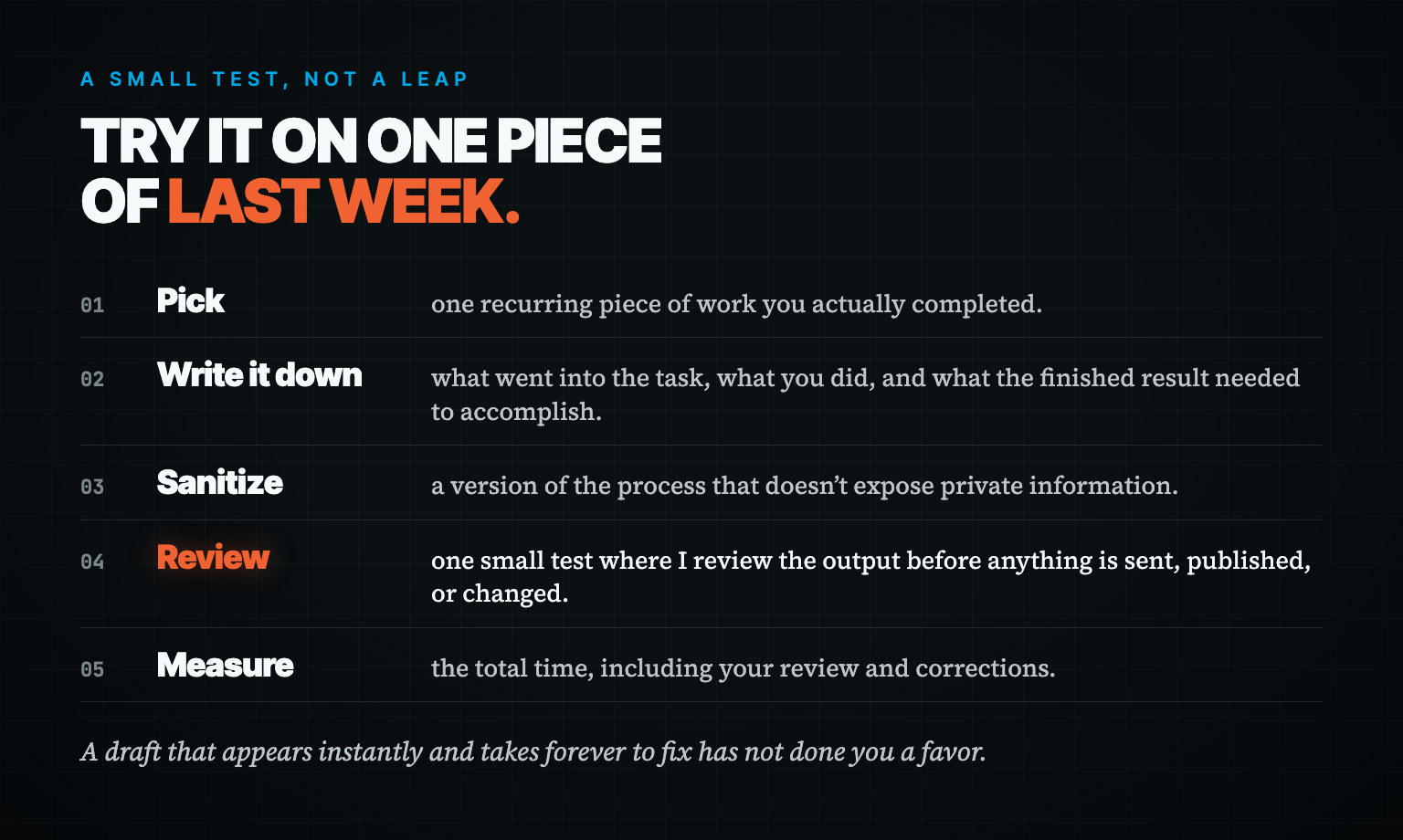
Open your calendar or task list and pick one recurring piece of work you actually completed. Something frequent enough to matter, where a mistake can be caught before it hurts a customer.
A proposal draft is a good candidate. So is turning meeting notes into a follow-up draft, or preparing an internal report from approved information.
I wouldn’t start by giving a new agent permission to move money, make promises, or send whatever it feels like to your customer list.
Write down what went into the task, what you did, and what the finished result needed to accomplish. Include the annoying parts. Especially the parts where you copied information from one place to another and briefly reconsidered your career choices.
Then give your AI a version of the process that doesn’t expose private information. Use a tool your business has approved for that data, or work with a redacted or fictional sample.
You can start with this:
Help me improve one recurring workflow in my business.

The result I need is: [describe the finished result].

These are the steps I currently take: [list the actual steps].

Good work has to meet these standards: [explain what you check].

Identify which steps you could help prepare, which require my judgment, and what information you’re missing. Ask before making assumptions. Suggest one small test where I review the output before anything is sent, published, or changed. Tell me how we should compare the result with the way I do it now.
Use the answer to plan your test. The AI still has to demonstrate that it can do the work.
For the proposal example, feed it a sanitized set of notes from an old opportunity and your approved proposal structure. Ask it to prepare a draft and list anything missing. Don’t let it invent prices or helpfully promise services you don’t provide.
Then compare it with what you actually needed to send.
Did it understand the customer's problem? Did it miss an important constraint? How much rewriting did you have to do? Would you trust it to prepare another one under the same rules?
Measure the total time, including your review and corrections. A draft that appears instantly and takes forever to fix has not done you a favor.
Try a few different examples before deciding it works. A clean, simple case can hide problems that show up the moment a customer says something unexpected.
If it helps, save the process and use it again. If it doesn’t, narrow the assignment. Maybe it’s useful for extracting requirements, but not yet for drafting the scope.
You still learned something that will help you make the next decision.
And decide what you want back from this. Faster response times, room for another customer, more time to test an offer, or an afternoon that doesn’t belong to your inbox.
You’re allowed to choose the afternoon.
If you want help choosing where to start
That’s what my Agentic Build Plan is for.
You tell me about your business through the intake. I identify the biggest leverage problem, map the workflows and tools that address it, and lay out the order I’d build them in.
It’s $500, and the plan is finished before our review call. You keep it whether you build it yourself or have me help implement it. If we do the build together, the $500 is credited toward it.
You don’t need to automate your entire business to make a worthwhile improvement. Getting one expensive, recurring headache handled can give you room to work on the next thing.
I’m glad I came back to Twain Harte. There’s something comforting about a place that still feels familiar after so much time away.
I don’t expect the rest of the world to stay that way. And I don’t have to love every part of what’s coming to learn how to work with it.
I can take the risks seriously, push back on uses I disagree with, and still help a small business owner do something that would have been out of reach a few years ago.
For now, that seems like a more useful response than either pretending everything is fine or deciding there’s nothing we can do.
Also, the next time I get into a debate at a B&B, I should probably check on my wife before the second hour.
Here’s to keeping our heads and getting some of our time back,
—Tim Erway

P.S. If you’re unsure where to start, pick the task you’re already dreading doing again next week. Use the prompt above and try it on an old example before you trust it with a live one. And if you want my help choosing and mapping that first improvement, the Build Plan is here. You can be concerned about the future and still make next week a little easier.