
How To Build a Newsletter That Pre-Sells Your Offers
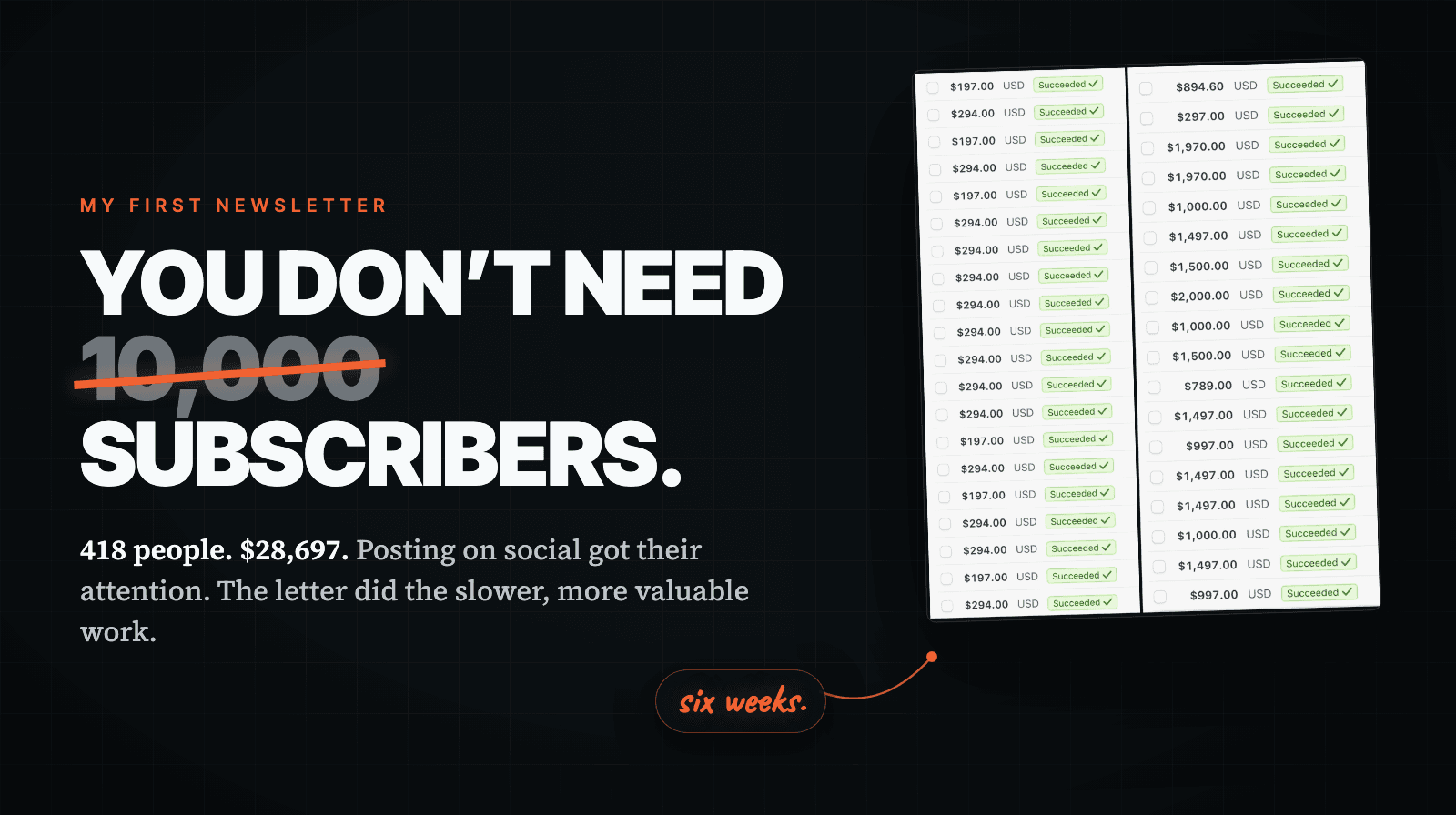
Rick asked how I publish a newsletter like this. The answer starts with 418 subscribers and $28,697 in six weeks.
Last month I hosted a couple of live events.
One was the Agentic Business webinar. The other was a Super Saturday. I don't remember which one this happened at, so apparently my sophisticated event-attribution system is me squinting at the calendar and guessing.
Anyway...
Rick asked me something close to this:
"How do I publish a newsletter like yours?"
Rick's an attorney and a professor. He helps lawyers achieve sustainable peak performance without burning out, using neuroscience.
That's a pretty damn good niche for a newsletter.
He knows who he helps. He knows the result they want. And I'm willing to bet the lawyers he talks to ask him the same twenty questions over and over again.
He does not need to become a writer.
He definitely does not need to spend the weekend opening fourteen software tabs and accidentally appointing himself Director of Newsletter Technology.
He needs a simple way to turn what he already knows into a letter that earns trust, leads naturally toward what he sells, and gives the right people a reason to keep listening.
That's what I'm going to walk you through.
Not newsletter theory. The actual system I'd help Rick set up... who the letter is for, what it should lead to, where the ideas come from, how I talk mine into existence, and how to get the thing published without becoming an IT guy.
You do not need 10,000 subscribers
When I published my first newsletter, I did not have a giant audience waiting for me.
Six weeks later, I had 418 subscribers.
And I'd generated $28,697.
Four hundred and eighteen people.
That happened by posting on social media, getting the right people onto my list, and publishing a newsletter that let them spend more time with my ideas.
The social content got their attention. The newsletter did the slower, more valuable work. It let them watch me think, solve problems, explain what I believed, and decide whether I was somebody they wanted to buy from.
So when I finally put an offer in front of them, they were already primed.
That's the beauty of an audience you own. You don't need 10,000 random subscribers who barely remember giving you their email address. You can do very well with hyper-responsive micro-list filled with the exact people your offer was built for.
I know because I did.
Now, the honest clarification...
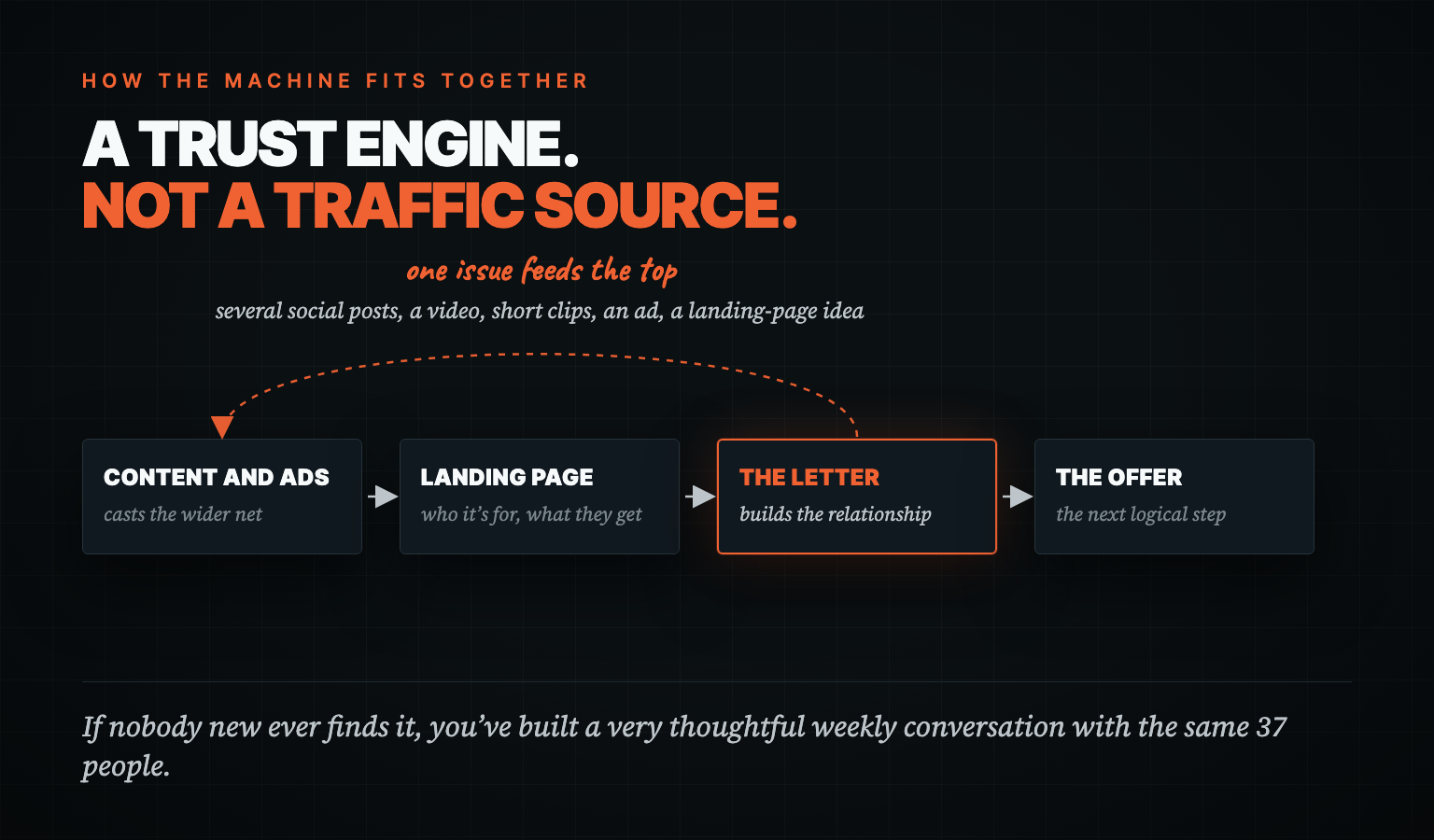
A newsletter is a trust engine. It is not a traffic source.
If nobody new ever finds it, you've built a very thoughtful weekly conversation with the same 37 people. Those 37 people may adore you, but eventually somebody has to invite more people to the bar.
That's where social content, YouTube, referrals, and paid traffic come in.
A newsletter gives you more material to put at the top of that machine. One issue can become several social posts, a video, short clips, an ad, or a landing-page idea. Those pieces cast the wider net and bring people onto the list. The letter builds the relationship after they arrive.
If you have a front-end offer people actually want, you can even use it to offset the cost of paid traffic. Get the numbers right and the first purchase can cover some or all of what you spent acquiring the lead. Sometimes it can do better than break even.
You're not buying a list and hoping to make the money back someday. The offer helps pay for the audience while the newsletter keeps building trust with the people who don't buy immediately.
That's a hell of a machine when it works.
But it starts with having something worth saying to a specific person.
I'd build Rick's letter around one lawyer
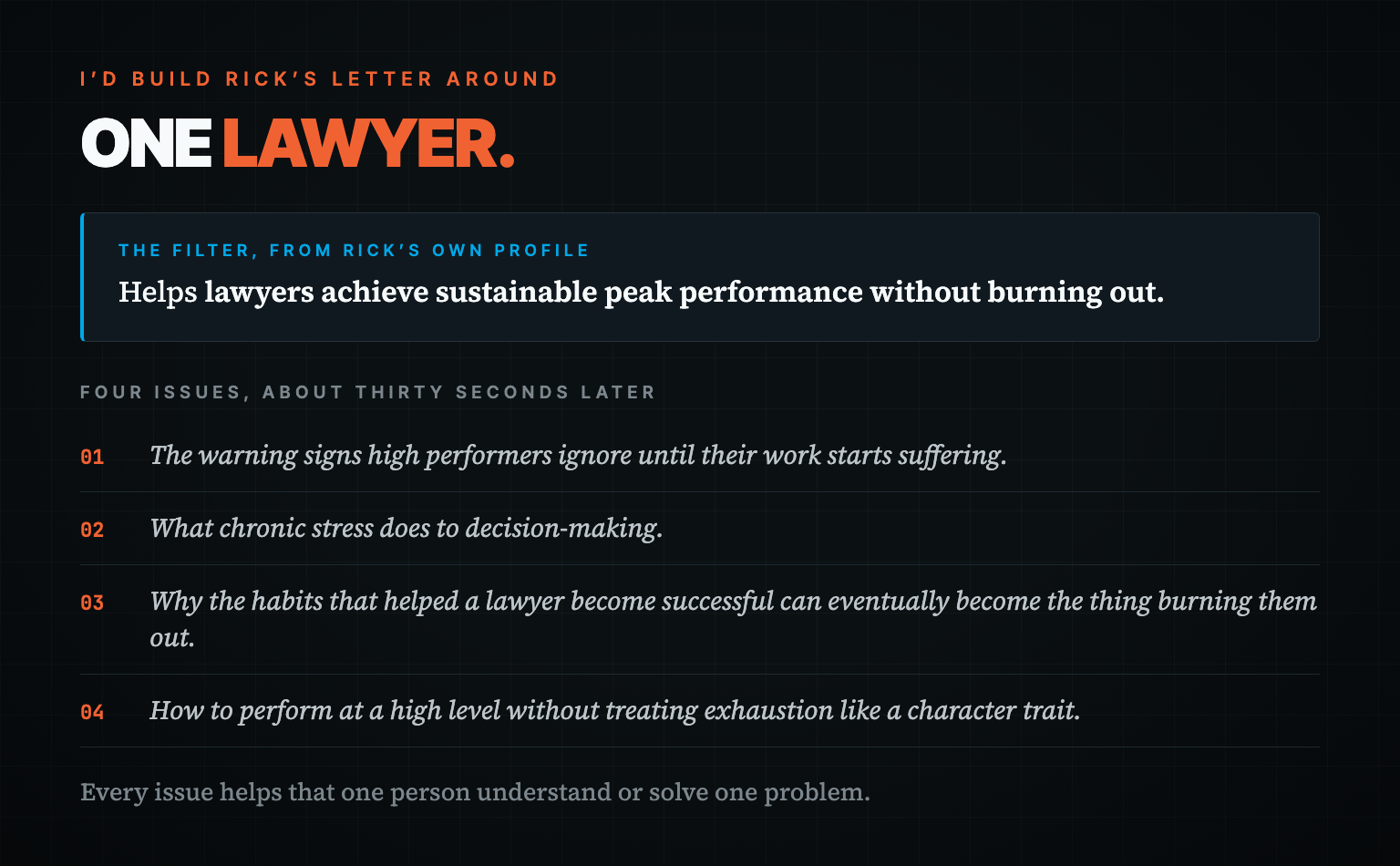
Rick's profile already says he helps lawyers achieve sustainable peak performance without burning out.
Good. That sentence gives him the filter.
He is not writing for "people interested in performance." He's writing for a lawyer who is good at the job, carrying too much, and starting to realize that grinding harder may not be the brilliant long-term strategy it once appeared to be.
The brief they re-read three times at 11pm. The short fuse with the associate. The Sunday-night dread that now starts on Saturday.
Every issue should help that person understand or solve one problem that lives inside Rick's world.
The warning signs high performers ignore until their work starts suffering.
What chronic stress does to decision-making.
Why the habits that helped a lawyer become successful can eventually become the thing burning them out.
How to perform at a high level without treating exhaustion like a character trait.
I'm not telling Rick those are his four content pillars. I know approximately enough neuroscience to spell it correctly.
I'm showing you how quickly the ideas appear once the audience gets specific.
Then the letter needs somewhere to lead.
I don't know the exact offer Rick wants to sell, and I wouldn't invent it for him. But the newsletter and the offer need to live in the same world.
If his paid work helps attorneys perform better without destroying themselves, every issue should move the reader a little closer to understanding that problem, trusting Rick's approach, and seeing why solving it matters.
That doesn't mean every issue turns into a pitch.
It means the pitch never feels like a home invasion.
The reader has been following the same conversation all along. When Rick finally says, "I can help you do this," it makes sense.
Your clients are already handing you the ideas
You do not need a content calendar that looks like a NASA launch window.
Start with the questions people already ask you.
Rick asked me how I publish a newsletter like mine, so I'm answering him with this issue. His clients and students are doing the same thing every week. The question he has answered six times and is slightly tired of answering is probably the next newsletter.
You can also test ideas in public.
Post a short opinion, lesson, or story. If people respond, argue, or ask you to explain it, go deeper in the letter. I used that loop on Facebook for years... right up until Meta locked me out of the business side of my own account and continued billing me for the privilege.
Very innovative company.
The point is, the method still works anywhere people can react to your ideas.
You can ask the list too. Tell them to reply with the problem they want you to unpack. Readers will plan half your editorial calendar if you shut up long enough to listen.
And I use research.
Rex, my research guy, looks at what the people my audience already follows are talking about, what is suddenly getting attention, and which ideas are breaking away from the usual noise. I don't need another 47-minute YouTube video with three sponsor reads and a guy who takes twelve minutes to begin the point. I want to know what hooked people, what was genuinely useful, and what I have something different to say about.
Questions. Reactions. Research.
You'll run out of Fridays before you run out of things to write.
I talk the first draft into existence
This issue went through the same process I'm describing.
I started by talking. No formal outline in my head. No attempt to sound like a writer. I dumped the idea, the Rick story, the newsletter argument, the tools, and several opinions about Facebook into a conversation with Grok Jim.
He turned it into an outline and wrote the first draft.
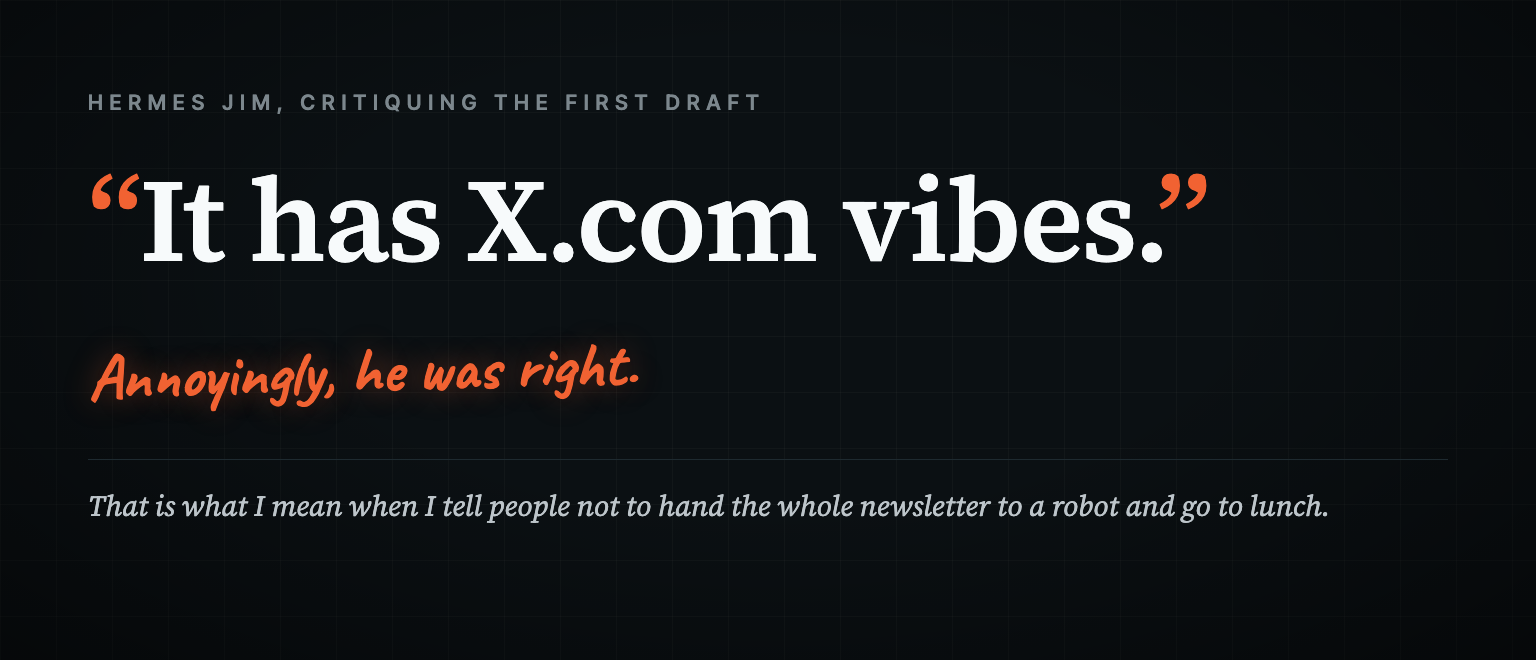
Then I handed that draft to Hermes Jim and asked him to critique it. He told me:
"It has X.com vibes."
Annoyingly, he was right.
It had good information, a clear structure, and enough clever little hammer lines to sound like somebody had chopped a LinkedIn carousel into paragraphs. So I gave him more context, told him what I agreed with, added the 418-subscriber story, clarified what happened with Rick, and sent him back in.
You're reading that version now.
That is what I mean when I tell people not to hand the whole newsletter to a robot and go to lunch.
The machine can organize the ideas, find the structure, write a draft, and catch problems I am too close to see. But I still have to care. I still have to tell it when a line sounds like a template, when the argument is missing proof, or when it technically sounds like me but is trying way too hard.
Before you make the first issue, give the agent some context it can keep using.
Who you help. What you sell. How you talk.
The stories you tell. Examples of work you actually like. The opinions you hold that somebody in your industry may want to argue with.
I keep that context in plain files so I don't have to explain my business again every Friday. The free templates for the first six are in The AI Business Brain.
Once that foundation exists, the weekly process is straightforward.
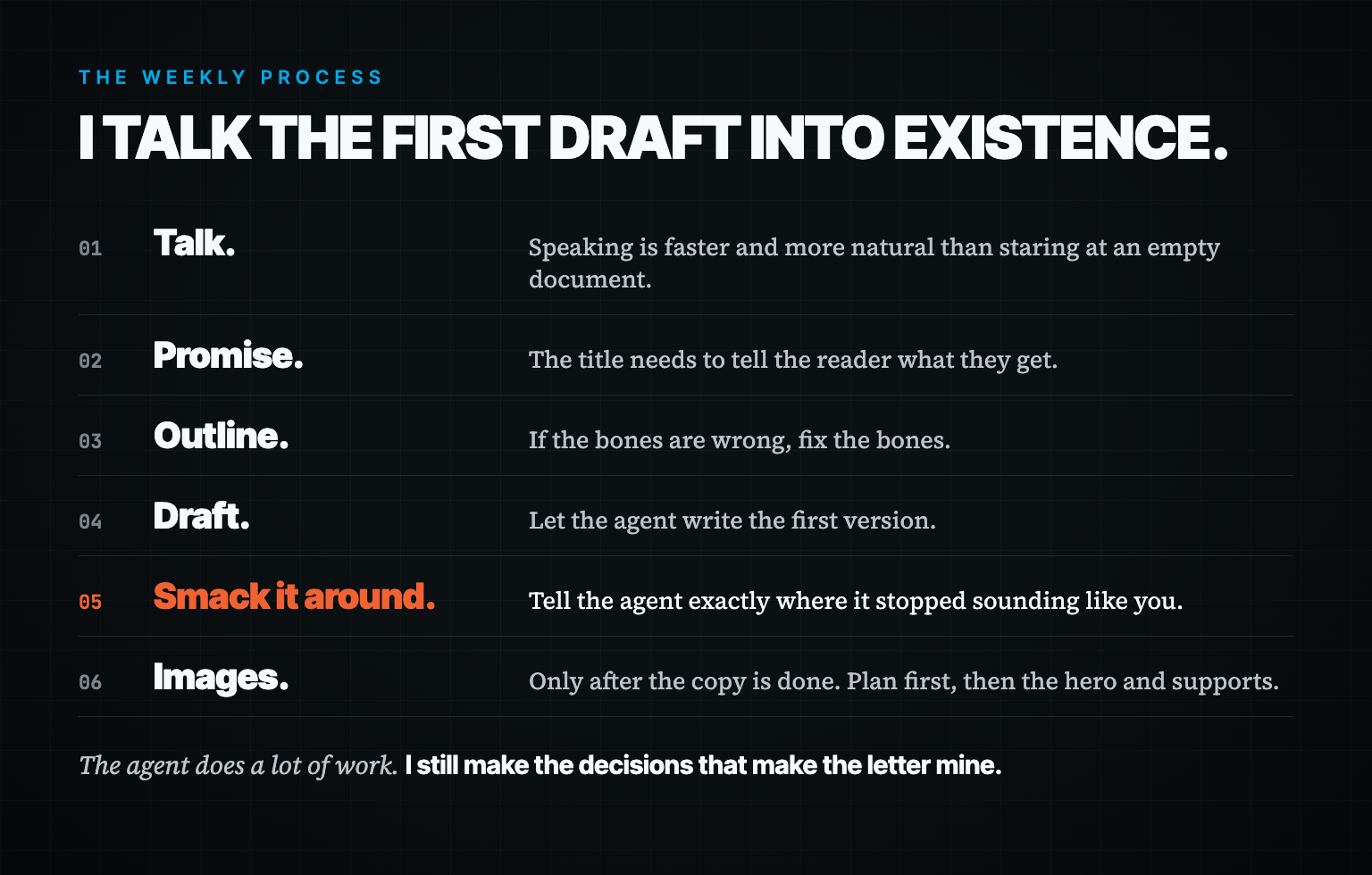
First, talk through the idea. I use Wispr Flow because speaking is faster and more natural for me than staring at an empty document pretending I am about to become Hemingway.
Then settle the promise. The title needs to tell the reader what they get. A controversial opinion with no payoff is just a tweet wearing a newsletter costume.
Next, approve the outline before the draft. If the bones are wrong, fix the bones. Do not spend an hour rearranging furniture in a house with no plumbing.
Then let the agent write the first version.
After that, smack it around. Talk more. Rewrite a line. Tell the agent exactly where it stopped sounding like you. Save the corrections that keep repeating so the next issue starts closer.
Only after I'm happy with the copy does Gavin touch the images. He makes a plan, I approve it, and then he creates the hero and supporting graphics. There's no reason for him to illustrate a section I may delete twenty minutes later.
Talk. Promise. Outline. Draft. Smack it around. Images.
The agent does a lot of work.
I still make the decisions that make the letter mine.
Let’s talk about the tech
If you already have an email platform and a list, use the thing you already pay for.
Do not blow up a functioning setup because somebody posted a screenshot of a shinier dashboard. See whether your current platform can create and save drafts through an agent connection. Many can. If it can't, copy and paste is mildly annoying... not a reason to postpone the newsletter until 2029.
If you're starting from zero and want a tool built specifically for newsletters, I use Beehiiv.
If you want the newsletter, email campaigns, automations, CRM, and landing pages under one roof, look at GoHighLevel or my white-label version, AwesomeCRM.com.
I use Beehiiv with AwesomeCRM.com because it fits the rest of my business. My agent stages the newsletter draft for me. I review it. I make the final call. Then I click send.
That connection does require a one-time setup. The robot does not establish trust with your email account through telepathy.
But once the connection exists, the weekly instruction can be as simple as:
"Stage this as a draft. Don't send it."
That's the part worth automating. Not your judgment. The repetitive clicking between your finished document and the send platform.
You also need a landing page where new readers can subscribe. It can live on your website, inside your email platform, or on Beehiiv's built-in site. Make it clear who the letter is for and what they'll get from reading it.
Then use the newsletter to feed the traffic loop.
Publish the letter. Pull out the strongest ideas. Turn them into posts, videos, and ads. Send the right people back to the landing page. Let the next letter deepen the relationship.
Do that every week and you are not just sending emails.
You're building an audience that knows how you think before you ever ask them to buy.
Rick could start this week
He doesn't need 10,000 subscribers.
He doesn't need fifty-two topics planned in advance.
He doesn't need to become a writer, hire an editor, or develop a strong opinion about newsletter software.
He needs one specific lawyer in mind. One useful question. One clear connection to the work he sells. Then he needs to talk through the answer, let the machine help shape it, argue with the draft until it sounds like him, and send it.
The next issue can come from whatever readers ask after that one.
That's how the system gets easier. The letter creates the conversation that creates the next letter.
And while that's happening, the right readers are watching him think.
They're learning how he sees their problem. They're getting small wins. They're deciding whether they trust him.
Eventually he makes an offer.
And it doesn't feel like a stranger appearing at the bottom of an email asking for money.
It feels like the next logical step in a conversation they've already been having.
That's what the newsletter is for.
If you want the voice, audience, stories, positioning, and visual foundation your agent needs to create content that actually belongs to your business, that's The Magnetic Brand System. Add the Long-Form Content Engine at checkout and you'll have the writing frameworks I use for letters like this one.
Until next time,

—Tim Erway

P.S. Paste this whole issue into whatever agent you already use and tell it: "Walk me through building this system for my business. Ask me one question at a time, and don't let me hide behind the technology." Then answer the questions.
P.P.S. If you've got a Rick question... reply and ask it. Apparently that's how these newsletters get written now.