How I Turned My Agents Into People Who Actually Do Things
For a while, the smartest thing in my business was waiting on me to copy and paste.
Last year my whole content operation lived inside Manus.
I had one project where I wrote my newsletters. All my reference material was in there... old issues, voice notes, the stuff that made the writing actually sound like me. And honestly? It worked. The drafts were good. I'm not going to sit here and pretend I was suffering.
But here's how publishing actually went.
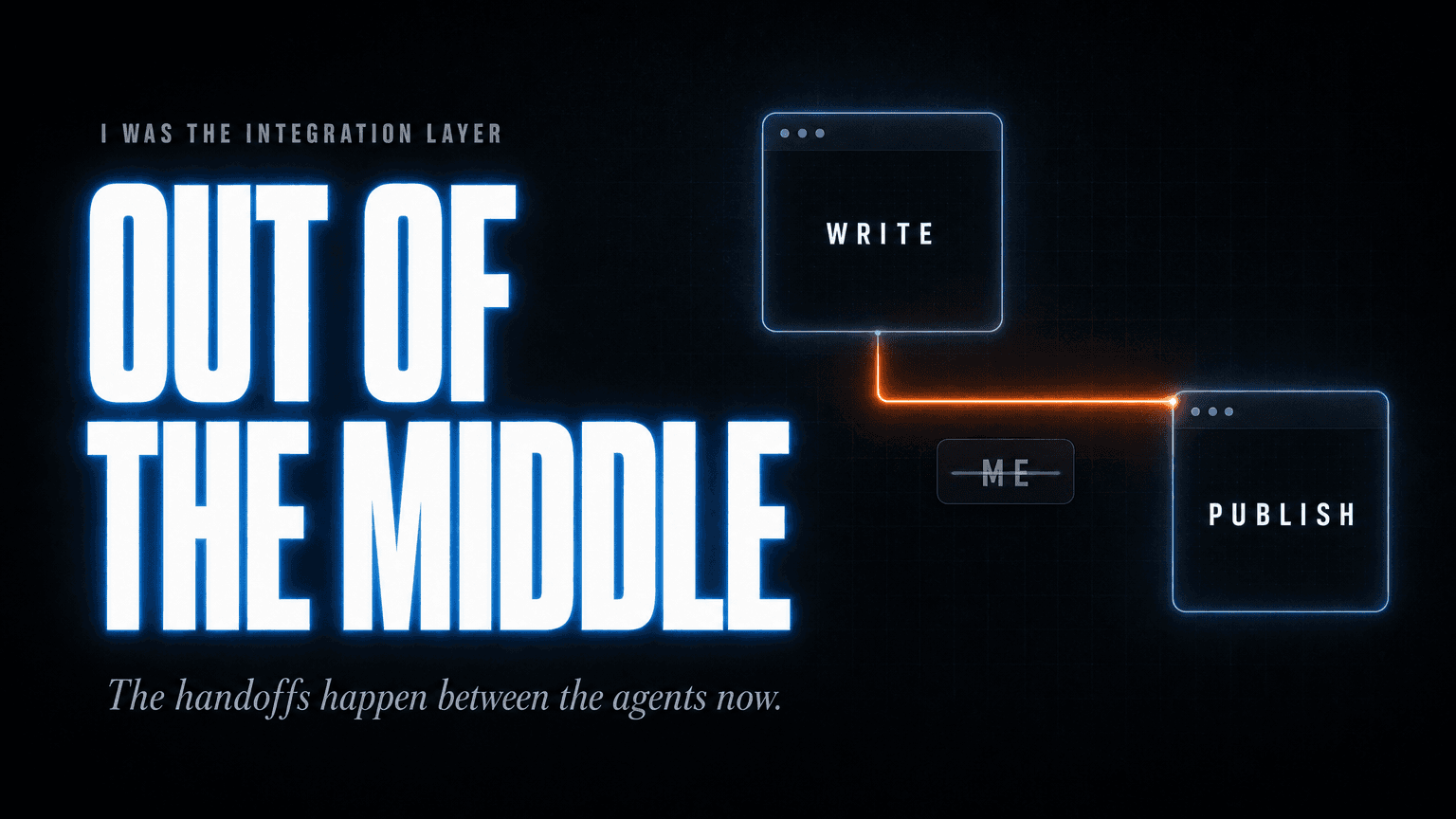
To get a finished newsletter onto my site, I'd open a completely different Manus project. Then I'd copy the newsletter out of the first one and paste it into the second one, because that was the project wired up to push things live to my website (which was also running on Manus back then).
So every week looked the same. Write in one place. Copy. Switch projects. Paste. Publish.
It worked fine. It just had a person standing in the middle of the whole thing.
That person was me.
I'd built myself a sharp little writing setup and then quietly appointed myself its assistant. The AI did the thinking. I did the moving-things-from-one-box-to-the-other. And if you've ever hired someone brilliant and then spent your afternoon doing their filing, you already know that's a strange way to run a business.
The last couple of issues were about the two halves of making an agent worth a damn. First the brain, the files that teach it who you are, which I walked through in Your AI Agent Is Only As Smart As The Brain You Give It. Then the soul, the editing pass that keeps it from sounding like everyone else, in AI Content Has No Soul Unless You Put It There.
Both of those matter. But you can nail both and still land exactly where I was on Manus. An agent that writes beautifully, and a human doing every handoff in between.
So that's what I want to get into today. Not making the agent smarter. Getting it to actually do the work, in the actual tools, without you playing telephone in the middle.
How it runs now
These days I don't copy and paste anything.
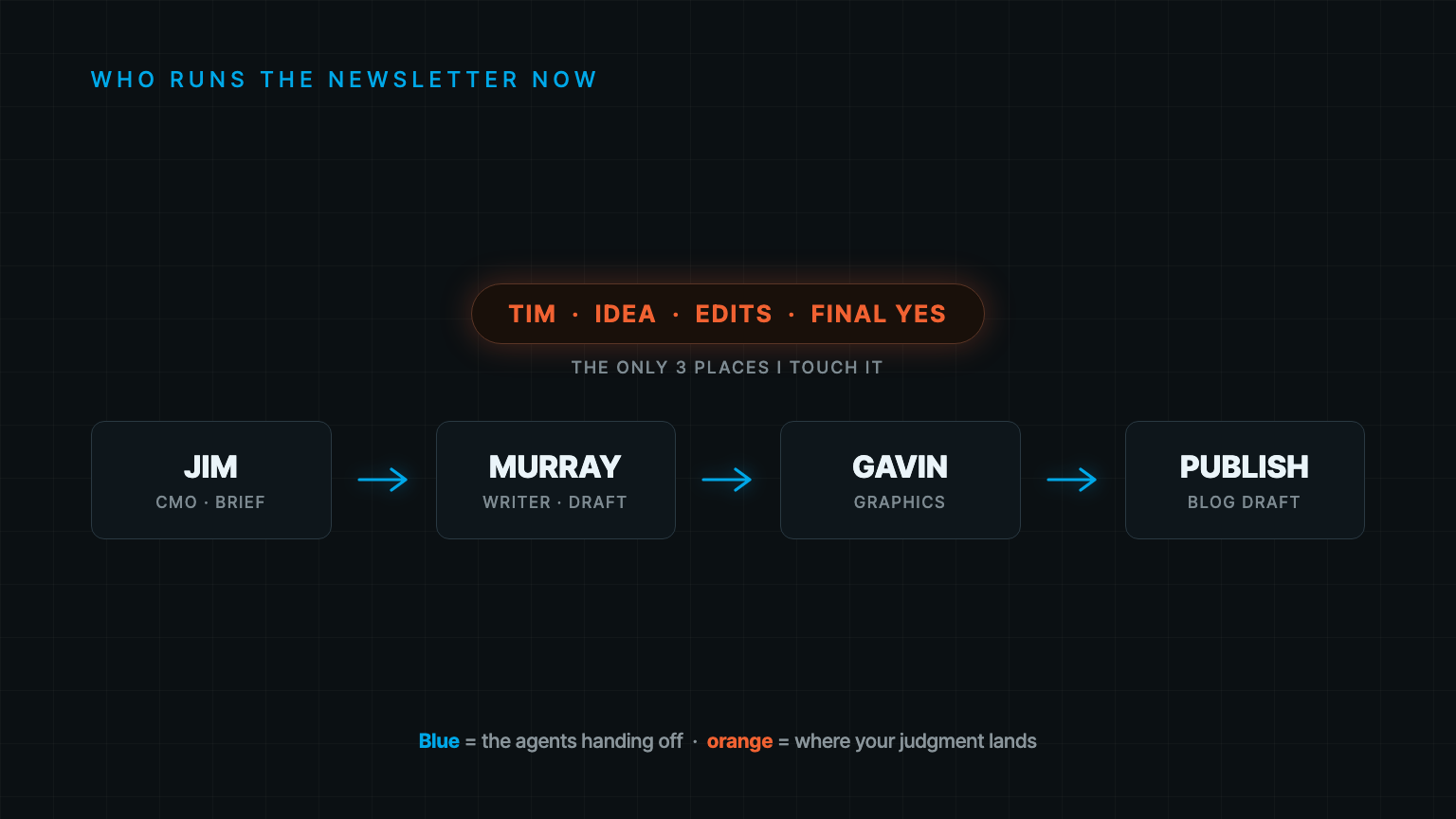
It starts as a conversation. I'll be in Discord, talking to Jim, who's my CMO. We kick an idea around until the brief actually says something real instead of "write about AI agents again." Once I'm happy with it, Jim hands it off to Murray.
Murray writes the first draft. Then Jim and I get back in there, talk through what's landing and what isn't, and Murray writes the real version off the back of that.
From there, an image plan goes to Gavin, who makes the graphics. And once it's all together, I tell it to publish to my blog as a draft, sitting there waiting for one last read before it goes out.
Look at what's not in that list.
Me, copy-pasting between two projects. Me, being the wire that connects one tool to the next. The handoffs happen between the agents now. I show up where my judgment actually matters, the idea, the edits, the final yes, and I stay out of the plumbing.
That's the whole shift. On Manus, I was the integration layer. Now the integration is just part of the system, and I get to go back to being the editor instead of the intern.
That's the moment this stuff stops feeling like a chatbot and starts feeling like an operating system.
And it's bigger than the newsletter
The newsletter's just the example I know cold, because I run it every week. But the same thing is true across the rest of the business now, and that's really the point.
Take AwesomeCRM.com. I can ask one of my agents to go find every lead who opened the last few emails and never booked a call, and it actually goes and pulls that list out of the CRM. Then it'll draft the follow-up in my voice, send the offer to the people who are genuinely warm, and book the calls. I'm not exporting a spreadsheet and feeding it back in. It's working inside the tool the way a good salesperson would, except it never forgets to follow up. (Which, if you've ever managed salespeople, is about two-thirds of the job.)
Or take my meetings. I run Fathom on my Zoom calls, and the second a call ends I'm pretty much done thinking about it, because by the time I've refilled my coffee the thing has already written its own summary, pulled the action items, turned them into actual tasks for the right agent, and lifted the two or three good lines I said into my running list of content ideas. The call used to be where my work started. Now it does the first chunk of that work before I've even stood up.
And underneath all of it, the agents can see what I see. The Discord threads, the Google docs, the inbox. They live where I already work instead of off in some side window I have to remember to go visit. None of that is flashy. It's just the difference between an assistant who's in the room and one you have to go brief from scratch every single time.
(It's not all smooth, by the way. Meta still has me locked out of my own Business Manager, and we're somewhere around week twelve of that circus. Some platforms you don't get to integrate with. You just get to file tickets and wait. But where you can actually connect, the payoff is real.)
How the connections happen
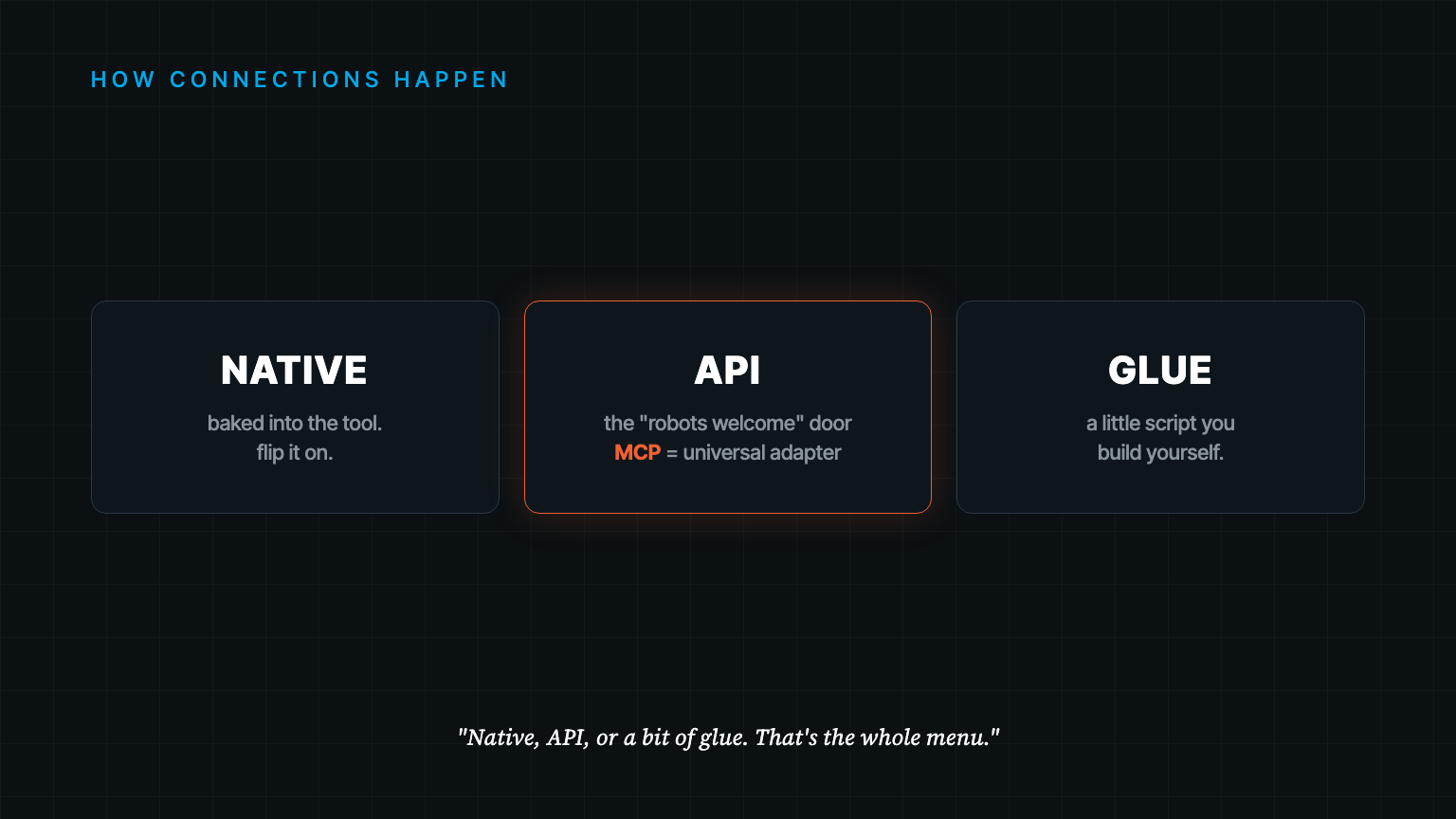
You don't need to understand the wiring to flip the switch, but here's the short version, because somebody always asks.
There are basically three ways an agent reaches into a tool.
Sometimes the tool just builds it in. AwesomeCRM.com has agent abilities baked right into the product, so there's nothing to bolt on. You turn it on, and the assistant can already work inside it.
Most of the time there's an API, which is really just the official "robots welcome" door into a piece of software. There's a newer flavor of this getting a lot of attention lately called MCP, and the easiest way to picture it is a universal adapter that lets any halfway-capable agent plug into any tool that supports it.
And when a tool has no door at all, you build a little one yourself. A small custom script the agent can run. That's the duct tape for the stuff that was never designed to talk to anything else.
Native, API, or a bit of glue. That's the whole menu. And you don't do it all in a weekend. You connect one tool, then the next, and every one you wire in is one more thing you stop doing by hand.
The part that makes it compound
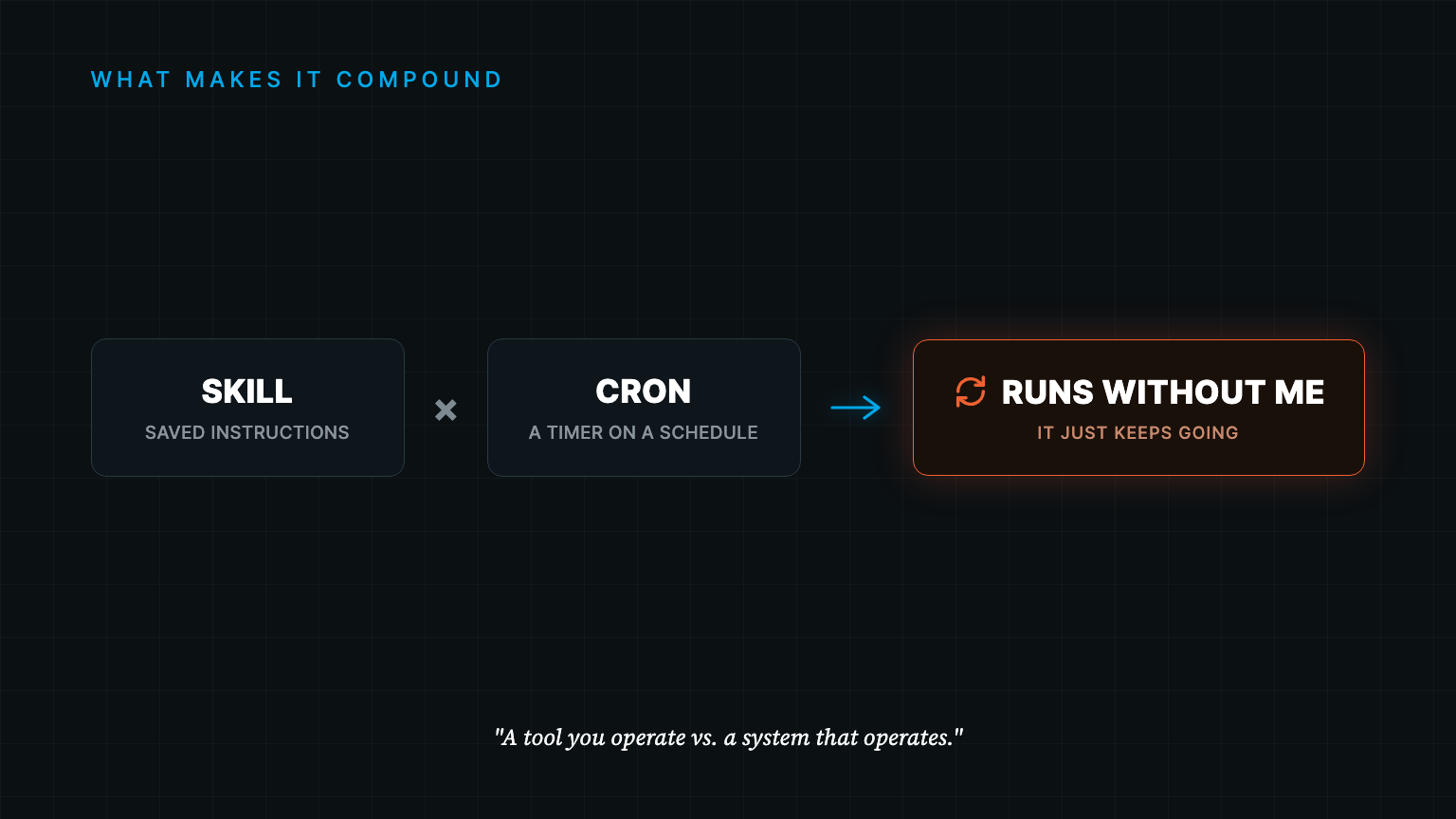
Two things turn "connected" into "runs without me." Skills and cron tasks.
A skill is just a saved set of instructions for something you do over and over. My whole newsletter process, pull the brief, draft it, run the voice pass, plan the images, stage the post, lives in one skill. I don't re-explain it every week. I just run it.
A cron task is a timer that runs a skill on a schedule whether I ask or not. So the weekly content pull happens on its own. The follow-ups go out on their own. The Monday recap is written before I'm awake.
You set the job up once, and it keeps doing it. That's the line between a tool you operate and a system that operates.
You're not married to any of this
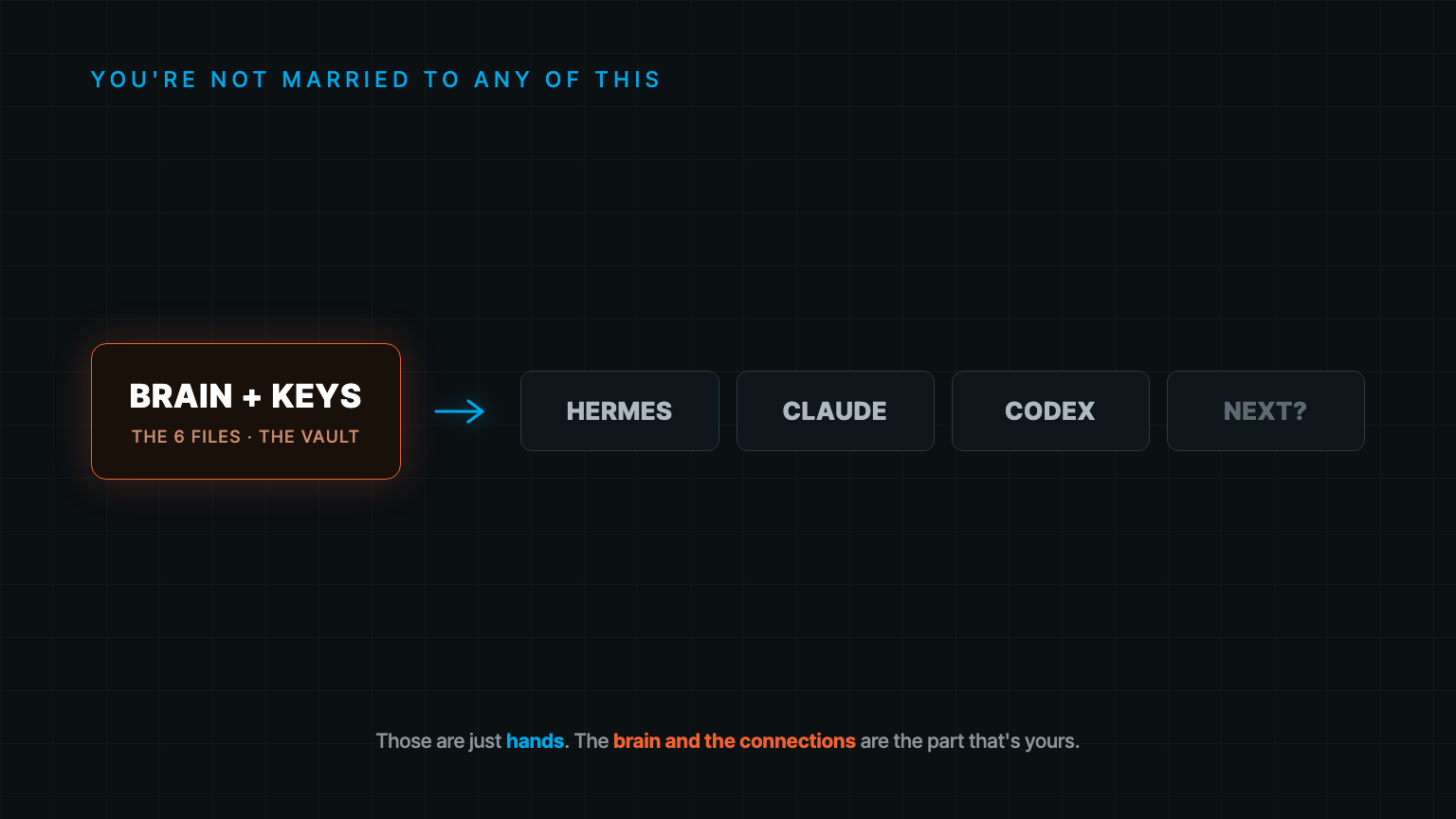
Here's the part I really don't want you to miss, and it's the reason I can sleep fine at night while wiring my business up to a pile of robots.
None of this is loyal to one AI.
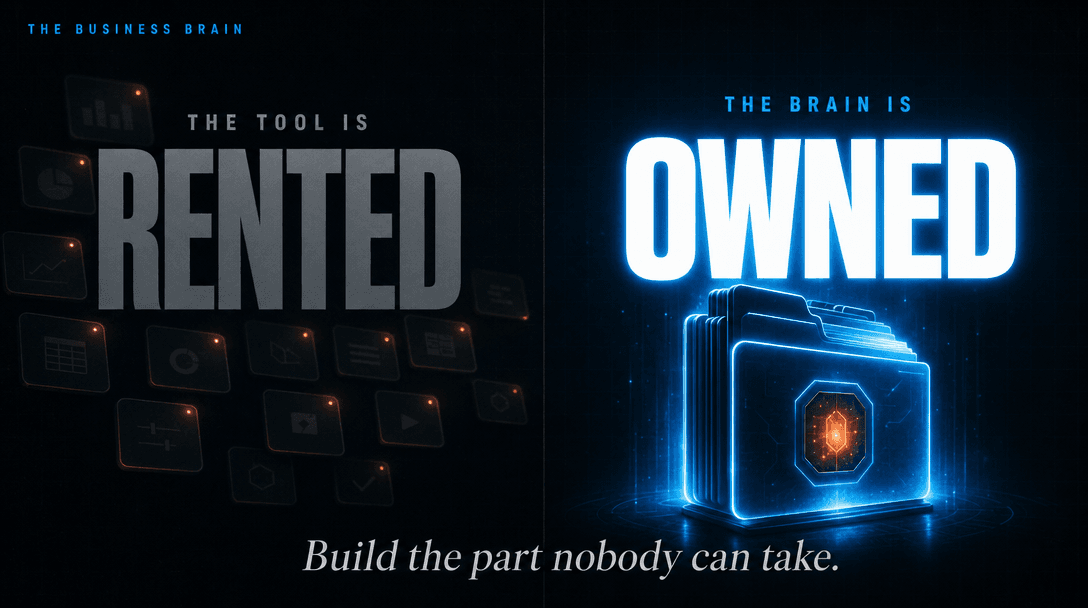
The brain lives in plain files. Mine sit in an Obsidian vault. The keys to all the connected tools live in one password vault built for the agents. Hand a new agent those two things, the files and the keys, and it picks the job right back up where the last one left off.
And I can prove that, because it's the reason you're reading this.
My normal setup broke today. Some cleanup we did earlier this week knocked out a key, and the whole thing fell over right when it was time to get this issue out. A year ago, that's a missed week and a shrug at the robots. Today I just handed the same brain and the same keys to Claude instead and picked the workflow up mid-stride. Same files. Same voice. Same access. Different hands.
You'd never know it came out a different door. And that's the entire argument against betting your business on one tool. Hermes, Claude, Codex, OpenClaw, whatever gets announced next Thursday and owns everyone's timeline for the weekend... those are just hands. You want hands you can swap. The brain and the connections are the part that's actually yours. I made that whole case back in I Don't Care Which AI Agent Wins Anymore, and this week it went and proved itself on me in real time.
Do the brain first
One thing before you go wire everything up.
An agent with deep access and no real understanding of your business is the genuinely scary version. Fast, connected, and clueless about who you are and how you sound. That's how you end up automating the wrong message to the wrong people in a voice that isn't yours, at scale, before lunch.
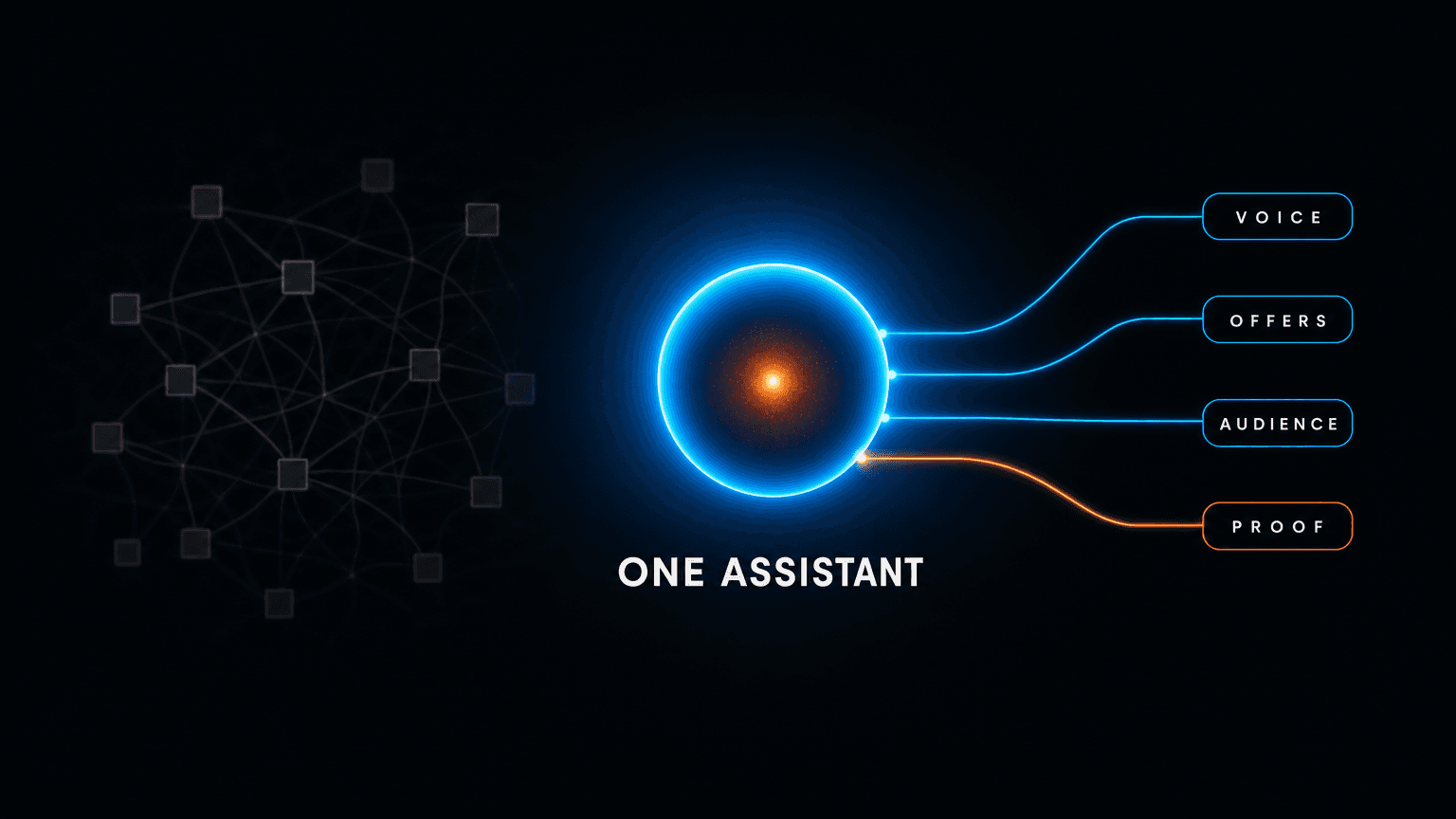
So before you hand an agent your CRM, your calendar, and your inbox, it needs the basics down. Who you are. Who you serve. What you sell. How you actually talk.
That's the foundation, and building it is the whole reason I put together the Magnetic Brand System. It walks you through the part most people skip, your audience, your positioning, your offers, your voice, your stories, and hands you the actual files your agents need before you ever give them the keys.
Build that once. Then go connect it to everything you've got.
Build Your Business Brain With Magnetic Brand System
Back to the copy-paste machine
I still think about that old two-project setup on Manus.
It wasn't bad. The writing was good. But I was the thing holding it together, copying and pasting my way through every week, and I couldn't have walked away from it for more than a few days without the whole thing going quiet.
That's what's different now. The work doesn't sit and wait for me to move it from one window to the next. The agents pass it down the line, and I step in where it actually counts.
I stopped being my AI's assistant.
It started being mine.
Until next time,

—Tim Erway

P.S. Full honesty, because it's too good not to tell you. The setup that normally writes this letter was dead in the water when I sat down to ship it, thanks to a key we broke during some cleanup this week. So this issue came out through a completely different agent. Took me a few minutes to reroute, and the work didn't change at all, because the work doesn't live in the agent. It lives in the brain and the connections. That's pretty much this whole letter, demonstrated by accident.
P.P.S. If you're just landing here, this is the third in a little run. Start with the brain, then the one about giving it some soul, then come back to this one about actually putting it to work. They build on each other.