
How to Make People Want What You Sell Without Turning Every Post Into a Pitch
Create excitement, keep readers interested, and give them a useful reason to take the next step.
I love a good piece of marketing that doesn't feel like marketing.
I'll happily read a long explanation of something I'm interested in. Show me a problem I recognize, help me understand why it happens, and demonstrate a better way to deal with it... you've got my attention.
By the time you tell me what you sell, I may already want it.
That's the kind of work that got me into direct response copywriting. And it's still the stuff that gets me excited.
Lately, I've talked a lot about agents, workflows, and how I'm building my business. Useful stuff. But I want to spend this week on the marketing decisions those systems are supposed to help us make.
Because an AI specialist can produce a helluva lot of words. That doesn't mean anyone will care enough to read them.
I want to show you how to give people a reason to care, create some excitement about a better outcome, and keep them interested long enough to understand your approach. Then, when you make an offer, it actually belongs in the conversation.
You can use this in a newsletter, a webinar, a sales letter, or an educational post. The length changes. The decisions are pretty similar.
Give people a reason to care before you give them information.
A while back, I wrote about the framework behind my marketing. The basic idea is helping someone move from where they are to where they want to be, and showing them a useful way to get there.
I called those places Suckville and AwesomeTown.
Very sophisticated terminology. Feel free to put it on a slide.
But the important part is understanding the trip from the reader's perspective. They don't wake up wanting to learn your framework. They want something to get better.
A consultant might want clients who stop treating their expertise like a commodity. A business owner might want a steady source of qualified inquiries. Someone writing a newsletter might want to stop spending Sunday night fixing a draft they're embarrassed to send.
Those are reasons to pay attention.
“Today we're going to discuss content frameworks” doesn't give me much to work with. It tells me the subject, but it leaves me to figure out why I should care.
Compare that with:
You can publish useful content every week and still leave people with no reason to consider buying from you. I'm going to show you how to connect the lesson to the problem you help solve.
Now I understand what I'm getting and why it might matter.
The promise doesn't have to be huge. It has to be relevant, clear, and something you can actually deliver in the piece.
Before I ask my writing specialist for a draft, I want us to be able to finish this sentence:
“After reading this, the right person will understand ______ well enough to ______.”
That gives us something to build around. It also makes editing easier. A section can be interesting and still have no business being in this particular letter.
Make a better outcome feel possible.
Excitement comes pretty naturally when someone sees a believable way to get something they want.
You don't need to announce that your idea is revolutionary. You need to help them understand what could change.
Take last week's letter about building a business with a small newsletter list.
I could have spent several paragraphs telling you that a small audience can be powerful. Plenty of people say that. It's encouraging, but it doesn't explain much.
The simple offer comparison does more work.
A $5,000 service takes 20 sales to generate $100,000. A $27 product takes 3,704 sales to get past the same gross revenue. That's an illustration, before costs, not a forecast. You still need buyers and an offer you can deliver.
For context, another company I'm involved in does well over 20 sales a month, at a higher price point, and generates multiple six figures in monthly revenue. The $100,000 comparison is just easy math to make the point. It isn't the ceiling.
You can immediately see why the two offers need different marketing and delivery plans. That distinction matters whether you're building your first business or already doing millions.
Before deciding you need more reach, look at the offer you're putting in front of people. The price, delivery cost, and fit with the audience change what that reach is worth.
That comparison gets you thinking about which result your buyers value, what they'd pay for it, and what it would take to serve them. Now you have something concrete to evaluate.
That's where the excitement comes from. The explanation helps you see an option you hadn't fully considered.
Give readers something they can picture, evaluate, or try.
A worked example, a useful comparison, a real demonstration, or an honest result usually does more for that than a pile of enthusiastic adjectives.
Look at the claim you want to make in your next piece. Find one example that lets the reader judge it for themselves. If you say your approach saves time, walk through the work it removes. If you say it improves a sales conversation, show what changes in the conversation. Give them more than your enthusiasm to go on.
And don't skip the difficult parts. If the approach needs setup, skill, money, or a tradeoff, explain it. The right person can get excited about something that requires work. They just need to understand the work they're signing up for.
Give them a reason to read the next section.
Once someone cares about the outcome, you still have to help them follow the explanation.
This is where anticipation matters.
There's a big difference between giving someone a reason to keep reading and dragging out the answer because you want another thirty seconds of their attention.
We've all seen the latter. The headline promises something useful. Then you get eight paragraphs about how important it is, three declarations that everything is about to change, and a reminder that you won't believe what comes next.
Dude. Just tell me.
You can create anticipation by showing readers where the explanation is going and then delivering on it.
For a simple example, suppose you help consultants improve their sales calls. A newsletter could open like this:
You finish a sales call thinking it went pretty well. The prospect seemed interested. They asked about the price. You sent the proposal.
Then... nothing.
Before you write another follow-up email, look at what happened before you quoted the price. I'll walk through three things to check: the result they wanted, what was keeping them from it, and how they planned to choose a solution.
That's a sample opening, not a story about one of my clients. Notice how it works.
It starts with a situation the intended reader can recognize. Then it offers a specific explanation worth investigating, instead of telling them to “follow up harder.” The three checks tell them what they're about to get.
The rest of that hypothetical letter would need to deliver those checks, with examples of what to listen for and how to respond. That's what makes the opening a promise rather than a tease.
You can also see this in my original five-step workflow letter. It opens with me creating the newsletter talking to my agent like a team member, then tells you that the piece you're reading came from the process I'm about to teach. You get to inspect the result while learning how it was made.
That gives you a reason to care about the walkthrough. It doesn't require me to hide the answer.
You don't need a dramatic cliffhanger at the end of every section. Often, the best reason to keep reading is that the previous section was useful.
And when you promise an example, a process, or an answer, give it to them. Don't make them buy something to get the payoff you promised in the opening.
Explain why your approach works.
My older framework letter talks about a unique mechanism: the explanation for how your approach produces the result someone wants.
This is worth going a little deeper on, because it's easy to get carried away with names.
You can give an ordinary process a very impressive title. AI will happily generate twenty of them. Some will sound like they belong on a bottle of pre-workout.
A name can help someone remember your approach. But they still need to understand what you actually do and why it helps.
Suppose a consultant helps businesses improve their sales calls.
“Use my proprietary conversion framework” doesn't explain much.
A more useful piece of content might show how reviewing lost calls reveals a recurring problem: the seller is recommending a solution before understanding what the prospect needs to decide.
Then it demonstrates a different sequence. Ask about the desired result. Clarify what's preventing it. Understand how the buyer will evaluate a solution. Only then explain the offer in terms that address those concerns.
That's a hypothetical example, not a client case study. But it gives you something to understand and test. You can see what changes in the conversation and why that might help.
For your own content, try explaining three things:
What changes when someone uses your approach.
Why that change addresses the problem.
What example or evidence supports the explanation.
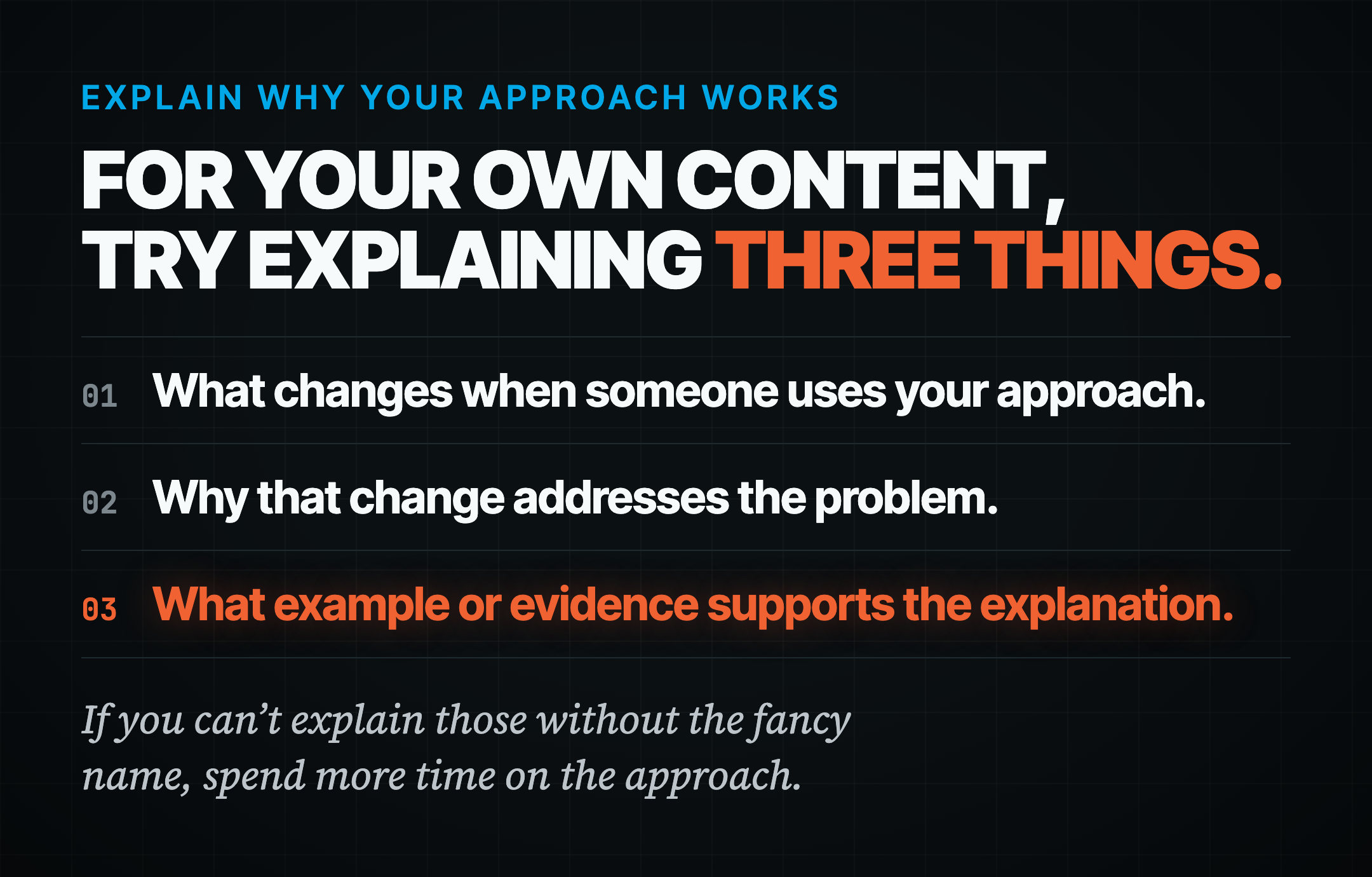
If you can't explain those without the fancy name, spend more time on the approach.
This is also where useful education builds trust. You're giving people a way to evaluate what you say. They can compare it with their experience, try a part of it, and decide whether your thinking makes sense.
They may disagree. That's fine. The goal is to help the right person make an informed decision, not make every reader nod along.
Let the offer follow the lesson.
A common problem with content marketing is that the content and the offer barely know each other.
You read a useful article about improving your sales calls, and the last paragraph suddenly pitches a course on personal branding. Maybe there's a connection somewhere, but the writer hasn't made it.
It feels like someone remembered they were supposed to sell something before hitting publish.
When the lesson is related to the problem you help solve, the invitation is easier to make.
The reader understands the problem more clearly. They've seen your approach. They have a better idea of what trying it would involve.
Some will use what you've taught and do it themselves. Good. They got value from your content.
Others may want your templates, your feedback, or help applying the approach to their situation. That's a legitimate reason to make an offer.
You don't have to spend the next five paragraphs convincing them that doing it themselves will be an unbearable nightmare. Explain what the help includes, who it suits, and what the next step is.
Teach something useful enough that the reader benefits either way. Then make it easy for the person who wants help to ask for it.
The next step also needs to fit where the reader is. Sometimes that means buying. Sometimes it means asking for details, trying a resource, or replying with a question. Make the invitation specific enough that people know what happens next.
No need to pretend we're closing registration at midnight.
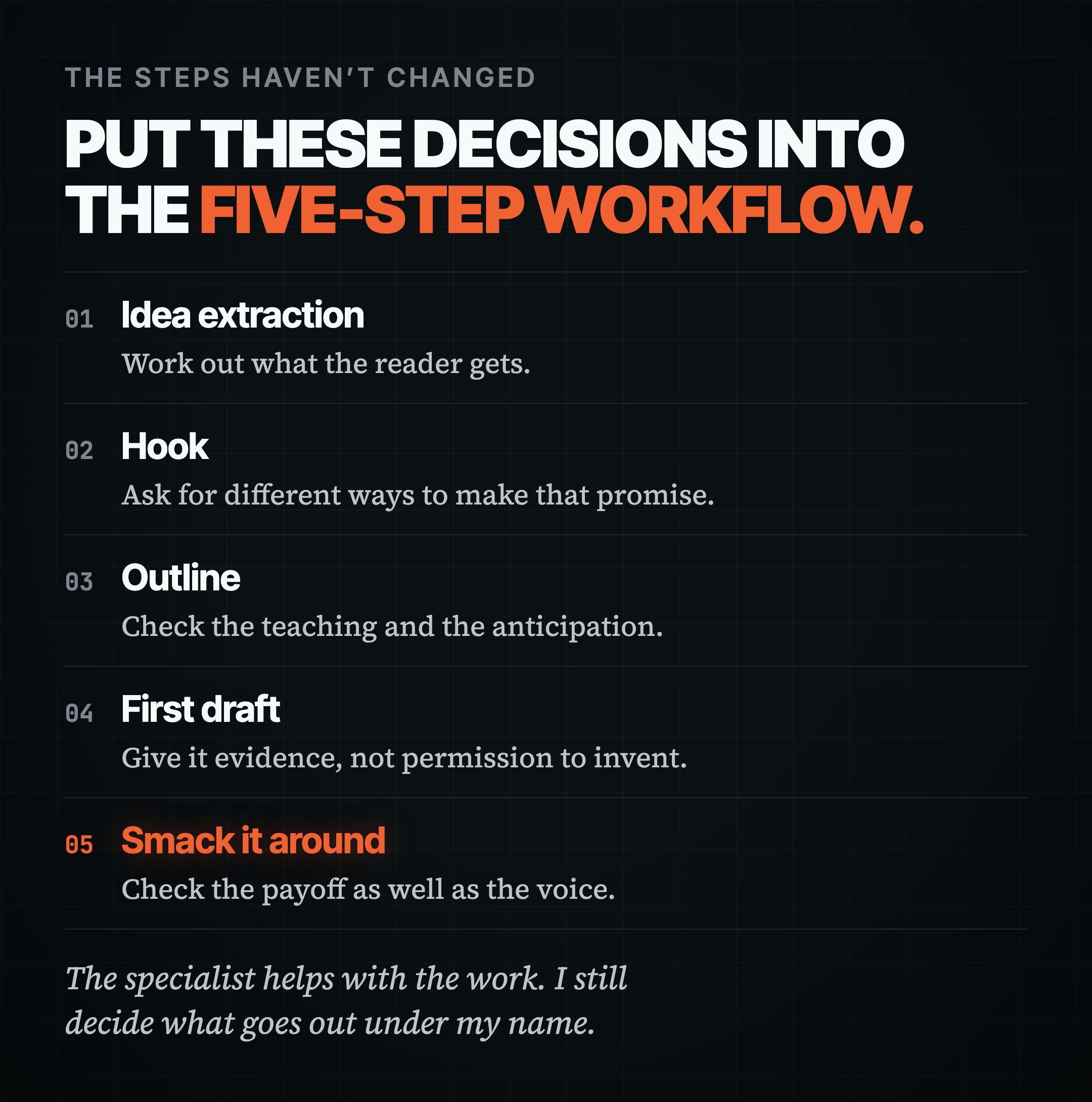
Put these decisions into the five-step workflow.
I still use the five-step talk-to-content workflow I published earlier this year.
The steps haven't changed. But these are the decisions I want the specialist helping me make inside them.
1. Idea extraction: work out what the reader gets.
Talk through your experience, observations, and examples. Then finish: “After reading this, the right person will understand ___ well enough to ___.” Get clear on that before asking for a draft.
2. Hook: ask for different ways to make that promise.
Have the specialist suggest three to five openings. Pick the one that makes the right person care, and check that the letter can deliver it. A dramatic hook that attracts the wrong reader doesn't help much.
3. Outline: check the teaching and the anticipation.
Ask which framework suits the idea and why. Review the order: establish the problem, explain the approach, demonstrate it, and give the reader a way to apply it. Each section should fulfill part of the opening promise. Don't force every idea through last week's structure.
4. First draft: give it evidence, not permission to invent.
Supply your voice examples and real source material. Ask for concrete demonstrations, label hypothetical examples, and make it flag claims that need support. A polished sentence doesn't make something true.
5. Smack it around: check the payoff as well as the voice.
Read it as the person you wrote it for. Did the example make sense? Did you explain why the approach works? Did you deliver what the opening promised? Then deal with the awkward wording, forced jokes, and anything that makes you say, “Dude. I don't talk like that.”
If you want to try this with your own specialist, start the conversation with something like this:
I want to create a newsletter for [reader] about [idea].
The problem they recognize is [problem].
My perspective is [what I believe and why].
Here are the real examples and source material we can use: [material].
My related offer is [offer], and the appropriate next step is [action].

Help me clarify what the reader will understand or be able to do.
Ask for anything important that's missing. Then suggest three openings
and recommend a structure, explaining why it fits this idea.
Use my voice guide. Don't invent stories, evidence, or offer details.
Wait for me to choose an opening and approve the outline before drafting.
The prompt starts the conversation. Your examples, framework choices, and feedback are what make the result useful.
Twenty minutes was the experience I described in that earlier issue, not a guarantee for every letter. The finished draft still needs graphics where they help, formatting, checks of the site and email versions, and final approval before publishing and sending.
The specialist helps with the work. I still decide what goes out under my name.
Pick one useful idea and give it somewhere to go.
You don't need to add a big sales pitch to every piece of content.
You do need to know why you're creating it, what the right reader gets from it, and how it connects to the help you offer.
That's the kind of marketing I enjoy making: something useful and interesting enough that people choose to spend time with it, and connected enough to my work that the right person can see when they'd want my help.
If you'd like help building your own newsletter and content system around what you sell, I'm considering a practical workshop on exactly that: audience, offer alignment, voice, the letter itself, and turning it into social content.
I'll be sharing all of my content frameworks with workshop participants, along with how to choose and use them for your own business. You'll have something to keep working with after the workshop, rather than a bunch of notes about why you should create more content.
The format, date, and price aren't final. Asking for details doesn't commit you to buy or reserve a seat.
Until next time,

—Tim Erway

P.S. Take one piece of content you're working on and finish this sentence: “After reading this, the right person will understand ___ well enough to ___.” If you can't finish it plainly, work on that before asking your specialist for a longer draft.